












SCADA is supervisory software used across industrial sectors. As software, it helps control hardware and records data collected from all remote locations.
What Is SCADA
In industrial facilities that process water, wastewater, and oil and gas, the technology used for monitoring is highly complex and critical. Without appropriate technology, these industries would be unable to deliver the essential services that people rely on for everyday life.

Among the most important technologies in the modern industrial context are SCADA and PLC. While some may assume these two are competing with each other, the reality is that these distinct technologies work in parallel to deliver critical services.
SCADA is a system of software and hardware elements that enables industrial organizations to:
-
- Control industrial processes locally or at remote locations
- Monitor, collect, and process real-time data
- Interact directly with devices such as sensors, valves, pumps, motors, etc. through human-machine interface (HMI) software
- Record events into a log file
What Does SCADA Stand For?
SCADA stands for Supervisory Control and Data Acquisition. It is a system for supervisory control and data collection.
SCADA System
SCADA systems are critical to industrial organizations because they help maintain efficiency, process data to enable smarter decisions, and communicate system issues to help minimize downtime.
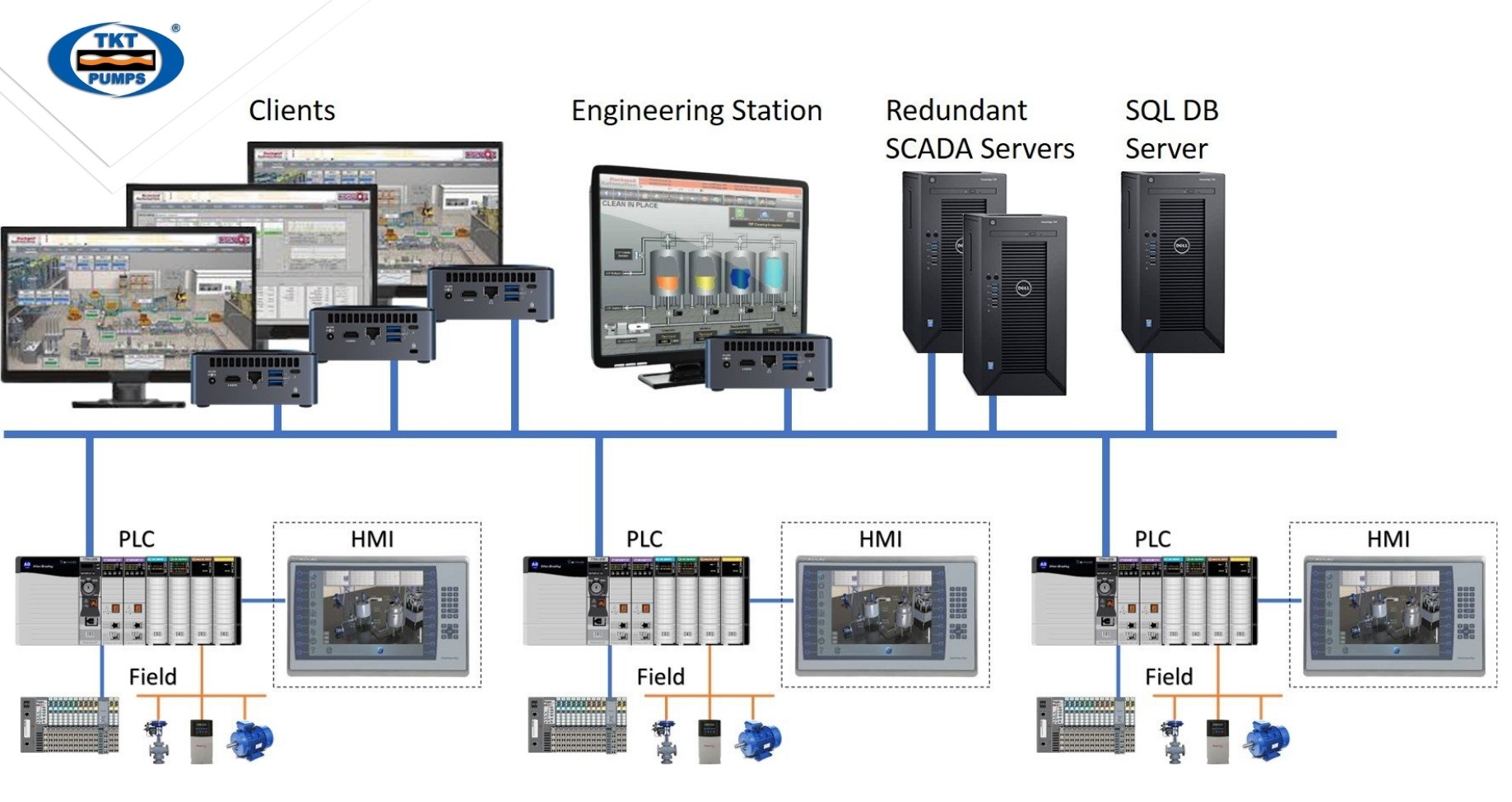
SCADA software processes, distributes, and displays data, helping operators and other personnel analyze data and make important decisions.
SCADA software connects with computers, graphical user interfaces, sensors, and networked data communications to provide a comprehensive view of the process. In this context, management teams in these industries rely on SCADA to monitor progress and make operational adjustments across the entire plant.
Because SCADA is a central system, it is typically installed on computers in a supervisory control center at the plant. To provide the necessary data, SCADA operates alongside multiple other systems. It serves as an interface, consolidating various plant data for evaluation purposes. From this information, operators can enter changes as needed through the SCADA interface to control the flow and operation of working components within the plant.
Example:
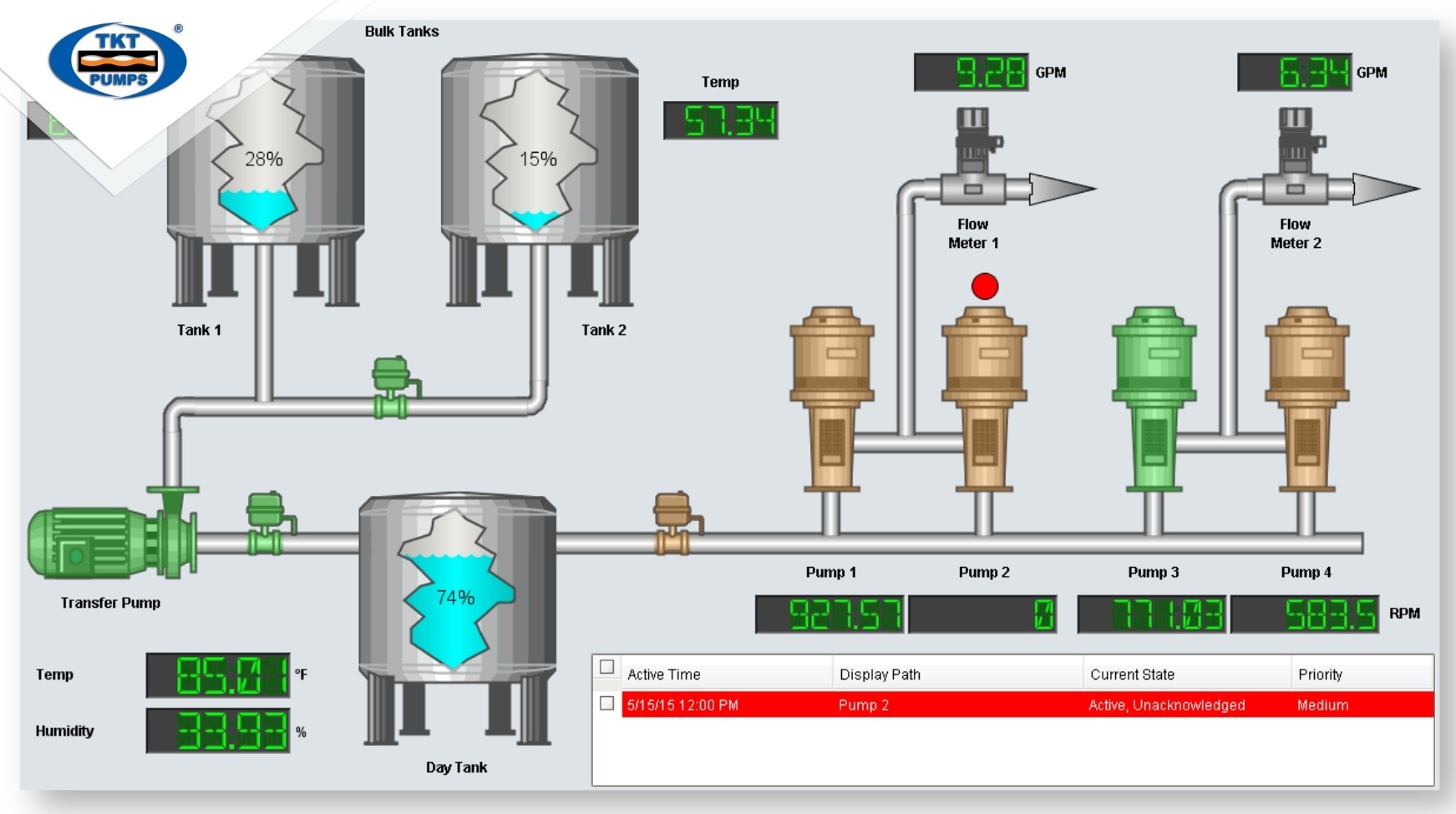
The SCADA system quickly notifies the operator through the HMI dashboard that a production batch has a high defect rate. The operator pauses operation and reviews SCADA system data to identify the cause of the issue.
The operator reviews the data and discovers that the production line system has malfunctioned. The SCADA system’s ability to notify the operator of a problem helps them resolve the issue and prevent further incidents, minimizing defective product output.
SCADA for wastewater treatment controls screw pump systems, centrifugal pumps, metering pumps, and industrial valves operating within the wastewater treatment process…
Functions of SCADA
SCADA systems perform several functions that enable proper management of remote facilities. The following are the core functions of a SCADA system.
Data Acquisition
SCADA data acquisition typically involves some type of analog-to-digital conversion. Temperature is converted to a 4-20mA signal. Transmission signal strength is converted to dBm. Measured pressure is converted to a 4-20mA signal…
Networked Data Transmission
Collected data is transmitted either spontaneously or upon data request to some form of upstream aggregation or consolidation. Communication channels may be analog (T202, POTS) or digital (RS485, TCP/IP). SCADA network topology typically also includes some form of transport authentication independent of any content authentication.
Data Presentation
Collected data is processed, organized, and presented so that system operators can make appropriate reactive and control decisions. Presentation may range from tabular display of recorded events to graphical representation based on mapping or image backgrounds.
Control
If control decisions are warranted and the system supports output, appropriate commands can be sent to effect specific operational or configuration changes. Most control actions are carried out by RTUs and PLCs.

What Is the Difference Between PLC and SCADA?
When comparing SCADA with PLC, it is important to start with the basics. At its core, the difference between a programmable logic controller and SCADA comes down to the type of technology. A PLC is physical hardware.
SCADA, on the other hand, is software. To illustrate this point, a PLC is physical — you can hold a PLC and inspect it. As software, SCADA runs on a computer system and can be compared to an operating system such as Windows.
With this comparison in mind, SCADA has a much broader scope. The software is designed to control the entire system, collecting data from all inputs and monitoring all devices. A PLC, by contrast, focuses on a single element of the system.
What Is the Relationship Between PLC and SCADA?
Given these differences, it might seem reasonable to assume there is no connection between PLC and SCADA. However, the relationship between PLC and SCADA is significant. Both PLC and SCADA software are used in the same industrial context in processing plants. This means these technologies are fundamentally partners in operating a plant safely and efficiently.
SCADA can be regarded as the broad software framework that supports the system. The PLC is one part of the system that SCADA monitors. PLCs need SCADA to direct their functions, while SCADA relies on data from PLCs to complete its overall picture.
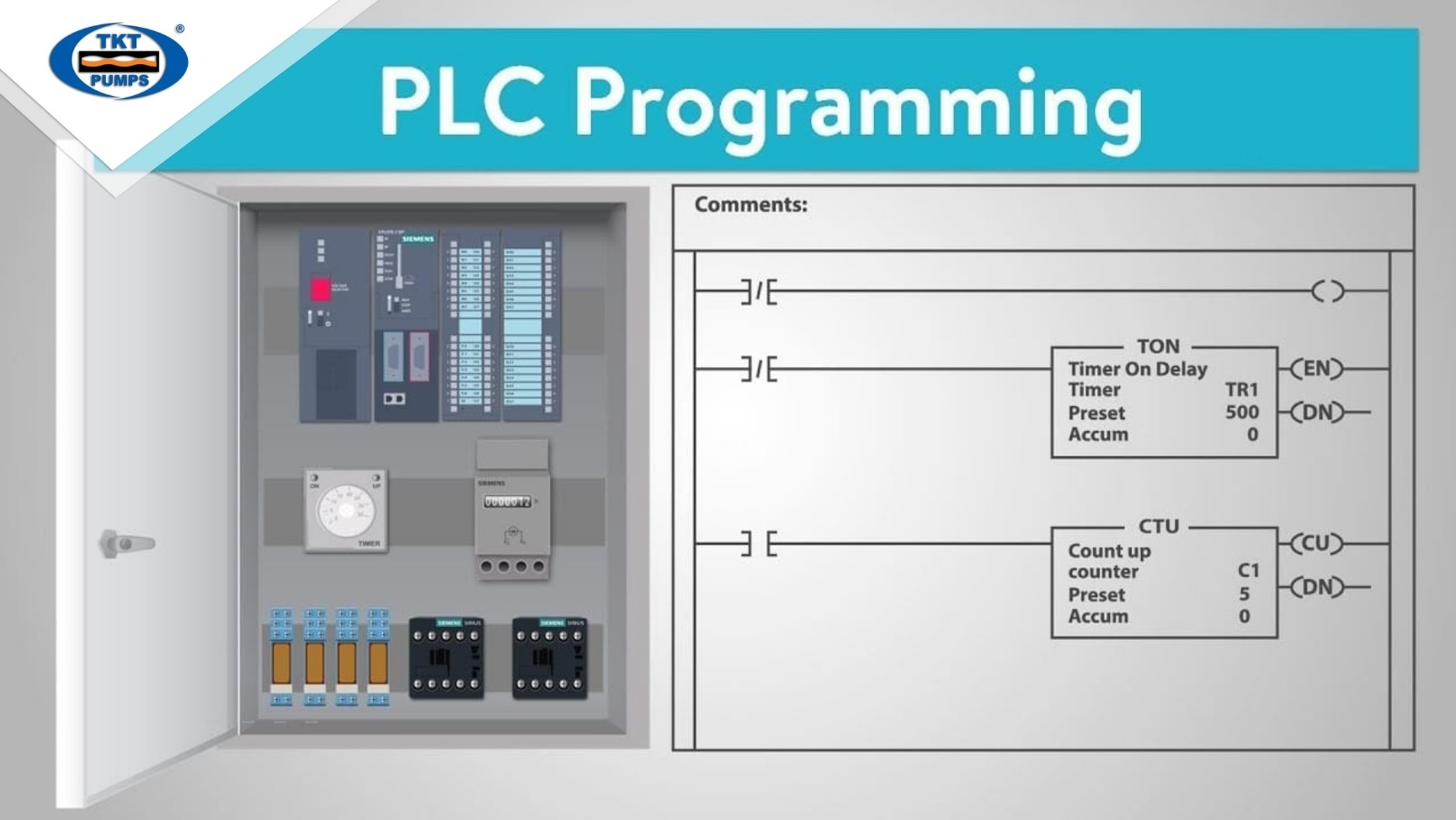
This PLC & SCADA relationship is consistently robust in creating an automated system to accurately assign maintenance tasks. For example, if used to monitor a turbine, the PLC may collect data showing excessive vibration in the system. The PLC will transmit that data back to the SCADA software. SCADA will analyze the readings and determine whether adjustments to the system are required. If changes must be made, SCADA will transmit the changes back through the PLCs to facilitate the repair.
Clearly, the question is not SCADA versus PLC. Instead, it is a well-developed technology partnership. By understanding the function of both systems, it is easy to see how they work together to achieve effective performance in an industrial context.
Thái Khương has shared information on what SCADA is, the SCADA system, and the functions of SCADA in industry. At Thái Khương, you can not only access and use well-known pump equipment from Europe, but also receive consultations on integrated SCADA system solutions for process-based operations.