













Centrifugal pumps are classified into many types, including: single-stage centrifugal pumps, two-stage centrifugal pumps, multi-stage centrifugal pumps, etc. — all designed to serve specialized industrial pumping applications.
Among industrial pump types, the centrifugal pump is a widely used and versatile piece of equipment. It is used to convey low-viscosity fluids across a wide range of modern processes, including: agriculture, construction, chemical processing, oil & gas, pharmaceuticals, food & beverage, and more.
Two-Stage Centrifugal Pump
As part of the multi-stage centrifugal pump family, two-stage pumps can handle large volumes of fluid and deliver very high flow rates for process applications. In addition, the pump’s flow rate can be adjusted freely to meet the user’s requirements.
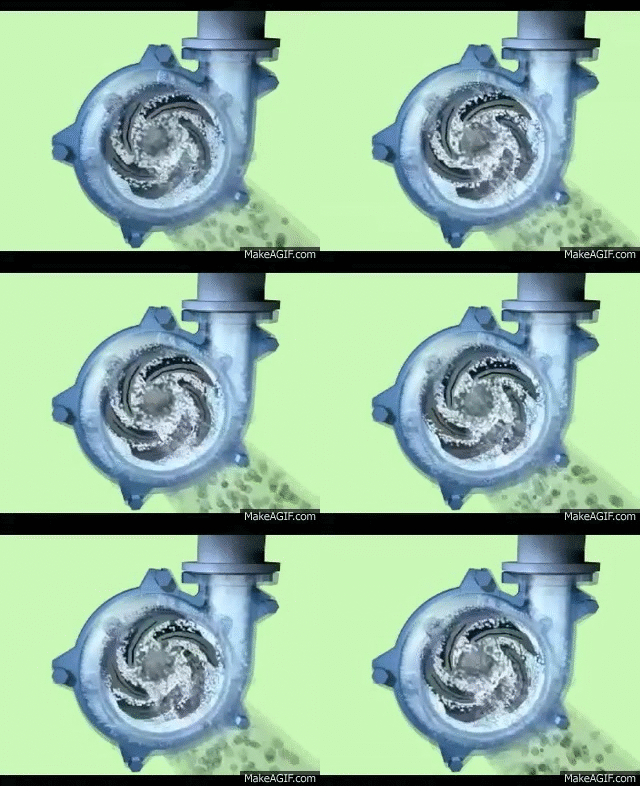
The distinguishing feature of a two-stage centrifugal pump is its use of rotating impellers to move water or fluid through centrifugal force.
The construction of a two-stage centrifugal pump is relatively straightforward, largely similar to that of a single-stage centrifugal pump. The key difference lies in the impeller assembly — also referred to as the rotating impeller.
We will compare the differences between these two pump types in greater detail in the section below. Let’s take a closer look to understand their key distinctions!
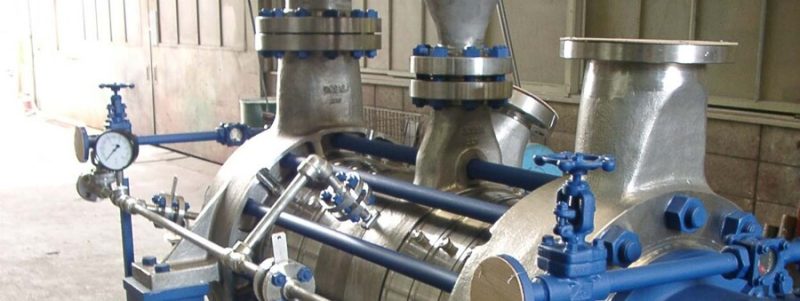
Centrifugal pumps by Salvatore Robuschi and CaprariComparing Two-Stage and Single-Stage Centrifugal Pumps
First, let’s examine their construction — a key aspect for distinguishing between these two pump types. However, despite their structural differences, both types share similar characteristics and working principles, as they are both centrifugal pumps.
Construction of a Two-Stage Centrifugal Pump
Two-stage centrifugal pump vs. single-stage centrifugal pumpSingle-Stage Centrifugal Pump
A single-stage centrifugal pump is designed with only one single rotating impeller. The pump can be equipped with either a single-suction port or a double-suction port.
The main construction components include:
-
- Pump body
- Pump casing
- Shaft connected to an external motor
- Impeller
- Bearings
- Mechanical seal
- Shaft packing / gland seal
Single-stage pumps have a simple structure that is easy to maintain and service. Their fluid-conveying capability is well-suited for applications requiring high flow rates but low pressure.
However, when operating beyond the design flow rate, the pump may experience thrust and radial force imbalance. In general, single-stage centrifugal pumps are more widely used than two-stage or multi-stage centrifugal pumps.
Two-Stage Centrifugal Pump
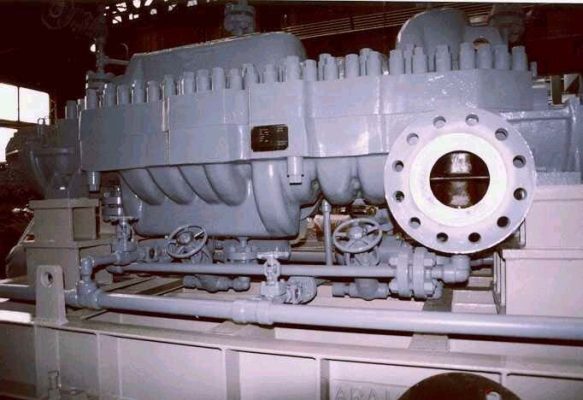
The two-stage centrifugal pump belongs to the multi-stage centrifugal pump family, comprising two or more impellers of the same function arranged in series.
The impellers are mounted in a uniform row on the same shaft inside the pump body. The maximum lift or head of a multi-stage pump is always greater than 125 meters. These pumps are typically used for applications requiring medium to high head.
During pumping, the fluid passes through each impeller inside and progressively increases in pressure as it moves from one impeller to the next — until the discharge pressure meets the application’s requirements.
Although it is a centrifugal pump, the multi-stage pump relies heavily on the rotational force of multiple impellers to generate the necessary centrifugal force to convey the fluid.
Multi-stage centrifugal pumps have no limit on the number of impellers that can be installed. The pressure level can be adjusted by adding or removing impeller stages as needed. The pump can be equipped with a single-suction or double-suction port at the first impeller stage.
Performance of a Two-Stage Centrifugal Pump
Clearly, the most prominent and easily recognizable difference between two-stage and single-stage centrifugal pumps is the number of impellers. But beyond this feature, there are many other important factors to consider — such as operating efficiency, pressure output, installation footprint, and cost — that users need to evaluate to gain a clearer picture of the advantages and disadvantages of each type.
Let’s first consider the efficiency of each pump type!
Operating Efficiency
Two-stage or multi-stage centrifugal pumps rely on the rotation of two or more impellers to generate centrifugal force and move the fluid. As a result, the impeller design in two-stage pumps features a smaller diameter than those in single-stage pumps, which reduces the clearance between the impeller and the pump volute casing.
Smaller clearances mean that each rotating impeller achieves better hydraulic efficiency and operates as precisely as possible. As a result, two-stage or multi-stage pumps deliver higher operating efficiency than single-stage pumps, while requiring only a smaller motor and consuming less energy.
Pressure Output
Multiple impellers in a two-stage centrifugal pump are mounted in line on a horizontal or vertical shaft. Essentially, each impeller functions as an individual pumping unit. As the fluid passes through each impeller, pressure is progressively increased. Therefore, multi-stage pumps can generate significantly greater pressure than single-stage pumps.
For this reason, multi-stage pumps should be selected for applications requiring pressure levels beyond the capability of single-stage pumps.
Installation Footprint
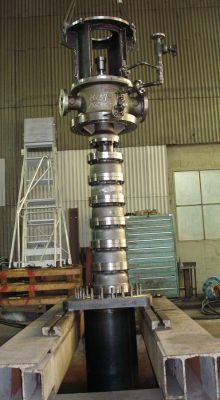
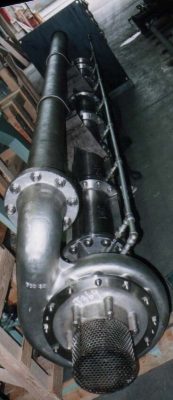
To save space when using multi-stage pumps with multiple impellers, users can opt for a vertical shaft design and installation. Single-stage centrifugal pumps can also be installed vertically in the same way. However, both pump types will occupy a large floor area when multiple units are arranged in a pump system, regardless of whether they are installed horizontally or vertically.
Vertical installation of a two-stage centrifugal pump to save spaceMaintenance of Two-Stage Centrifugal Pumps
This depends on the pump’s size and internal structure. In general, single-stage pumps are easier to repair and maintain than multi-stage pumps, due to their more compact, straightforward design with fewer internal components.
Operating Cost
For applications handling clean fluids free of solid particles, or simple pumping duties, users should consider single-stage centrifugal pumps as they offer lower operating costs.
However, for industrial production requirements, two-stage or multi-stage centrifugal pumps are a reliable choice, as they address the required flow rate and pressure demands.
In most cases, the cost of selecting the right pump will always depend on the pump type and the nature of the fluid being handled. Therefore, always consider related costs such as materials, power, piping, energy consumption, and maintenance expenses to make a well-informed selection.
Ability to Handle Solids-Laden Fluids
Due to the design that minimizes clearance between the impeller and pump casing, multi-stage pumps cannot handle fluids containing solid particles or corrosive fluids. If the fluid to be pumped contains significant debris or a notable concentration of solid particles, two-stage or multi-stage centrifugal pumps are not a suitable choice. In such cases, users should opt for a single-stage centrifugal pump.
Applications of Two-Stage Centrifugal Pumps
Due to the small clearance between the impeller and pump casing in two-stage pumps, they cannot handle fluids containing solid particles or corrosive fluids, as mentioned above. This is why these pumps are typically used to convey and process water or low-viscosity fluids. The following are some of the main applications for multi-stage centrifugal pumps:
-
- Industrial boiler applications
- Reverse osmosis processes
- Domestic water supply
- Agricultural irrigation applications
- Fire protection and fire-fighting applications
- Heating and cooling systems
- Water circulation processes
Conclusion
Two-stage centrifugal pumps use small-diameter impellers with minimal clearances, resulting in good operating efficiency. The pump requires only a small-capacity motor with low energy consumption to generate high pressure.
The installation cost of a multi-stage pump may be higher than a single-stage pump, but the operating and running costs are lower. However, the pump will require a variable frequency drive (VFD) for adjustment if there are any pressure changes in the application. The only drawback is that it cannot handle fluids containing solid particles or abrasive materials.
Single-stage centrifugal pumps can be equipped with isolation valves and bypass valves, allowing users to control pressure manually in a flexible manner.
The piping system can support flow direction changes in the pump to maintain the required pressure level. The drawback is that the head is limited to 125 meters. The pump also depends significantly on the impeller design and requires a larger motor compared to a two-stage pump.
In general, the choice between a two-stage (or multi-stage) centrifugal pump and a single-stage centrifugal pump depends greatly on the nature of the industrial application being served.
If the application involves fluids containing solid particles and requires high flow rates, the single-stage pump is the preferred choice. For applications requiring high head, a two-stage centrifugal pump should be prioritized.
To make the most informed decision, users should thoroughly research suitable pump types, evaluate the operating conditions and environment, and consider the relevant factors discussed above to select the pump that best fits their needs.
Thái Khương Pumps currently supplies two-stage (and above) as well as single-stage centrifugal pumps from the brands Salvatore Robuschi and Caprari, both of Italian origin, manufactured to EU and G7 quality standards (you can browse available products here).
If you have not yet found a suitable centrifugal pump, or have any questions requiring technical consultation or need pricing information, please contact us immediately.
Thái Khương Pumps is always ready to listen and assist you.