













The submersible pump was first invented by Armais Arutunoff in 1928. He was an engineer in the oil distribution system of Armenia, with the device initially called a submersible oil pump, installed in an oil well.
In 1929, the Pleuger pump was introduced as a refined design of the submersible pump of that era. This is a pumping device combined with a completely airtight motor. The entire pump body can be submerged in liquid and is applied to prevent cavitation. The working principle of the submersible pump is to push the fluid toward the surface, rather than a jet pump that sucks the fluid. Therefore, submersible pumps are evaluated as considerably more efficient. In this article, Thái Khương Pumps presents a general overview of submersible pumps.
What is a submersible pump?
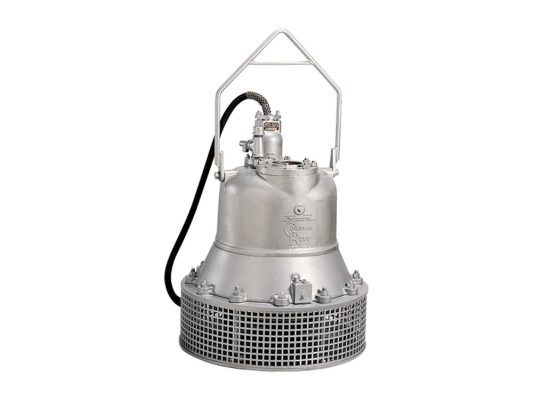
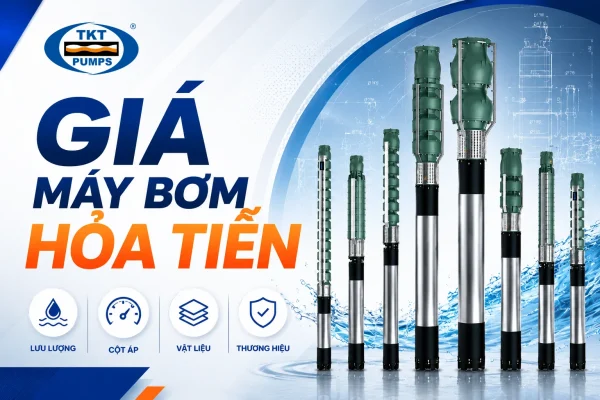
A submersible pump is a pump that is fully submerged in liquid, designed for the purpose of moving fluids at deep levels and capable of resisting the penetration of liquid into the internal components of the pump.
Because of the operating characteristic of being almost 100% submerged in water, the electric motors are designed to be sealed and tightly connected to the internal components of the pump. Based on the intended use, the submersible pump will have the following characteristics:
- The material and design are prioritized for resistance to the physical and chemical effects of the liquid environment.
- The motor has the ability to self-lubricate throughout extended periods in the operating environment.
Submersible pumps are widely used in the fields of wastewater treatment industry, water supply and drainage, and irrigation.
What components make up the construction of a submersible pump?
Currently, submersible pumps are gradually evolving in line with user trends, so pump manufacturers are constantly improving and modifying some structural characteristics to meet market demands.
What is the working principle of a submersible pump?However, what is the construction of a submersible pump? They still consist of the following main components:
-
- Pump casing
- Pump shaft
- Impeller
- Pump seal
- Outlet component
- Inlet component
- Pump motor
- Waterproof oil chamber
The construction materials of submersible pumps are materials with high corrosion resistance, high rust resistance, and water resistance such as Inox, PP, PP DE…
Popular submersible pump models available todayWhat is the working principle of a submersible pump?
Submersible pumps operate based on the working principle of a vertical-shaft centrifugal pump. The fluid is transported by the acceleration of the impellers to the diffuser, where the kinetic energy is converted into pressure energy. Specifically:
Centrifugal-type submersible wastewater pump: operates on the centrifugal principle. When the pump motor operates, the pump self-primes, then the pumped fluid is pushed out through the pump blades by centrifugal force and is pushed from bottom to top through the pump pipeline to the outside.
Volumetric-type submersible wastewater pump: operates on the principle of creating a vacuum environment. When the motor operates, the pump creates a vacuum environment inside the pump casing, then pushes the fluid from bottom to top based on pressure and pressure differential.
The hydraulic motor of the pump then operates in a closed cycle and an open cycle.
- Closed cycle: keeps the energy fluid separate from the produced fluid.
- Open cycle: mixes the energy fluid with the produced fluid through surface separation.
The pump shaft is connected to a gas separator or a protector by a mechanical coupling at the bottom of the pump. Fluid enters the pump through a suction screen and is pushed upward.
In addition, there are also screw-type submersible pumps that allow efficient operation in liquid environments with high impurity content.
What are the advantages and disadvantages of submersible pumps?
|
Advantages |
Disadvantages |
| Variety: Submersible pumps come in many different types depending on the intended use. | Corrosion: Long-term contact with any liquid leads to corrosion. In particular, submersible pumps are commonly used to handle corrosive and abrasive fluids.
– Seals are particularly susceptible to corrosion, leading to leakage and motor damage. – Submersible pumps are usually made from corrosion- and abrasion-resistant materials, so their cost is typically higher than other pump types of the same power. |
| Easy to use: Mostly electrically operated without requiring as many operations as other pumping tools. | |
| Self-priming capability: Can self-prime because they are fully submerged in liquid, acting as a good agent for pump priming. | |
|
Energy saving: Submersible pumps are also more efficient than other pumps because water pressure supports the movement of fluid into the pump, requiring less energy. |
Accessibility: Cannot be directly observed, making it difficult to inspect and perform regular maintenance when failures occur. Especially in deep-well applications. |
| Noise: Completely minimized or absent due to being deep underwater. |
Applications and popular types of submersible pumps
Submersible pumps have the advantage of high efficiency and can operate well in harsh conditions. For example: Wastewater treatment, Septic tank pumping, Dredging, Oil and gas, Mining, Maritime… Let us join Thái Khương Pumps in reviewing some main applications of submersible pumps before going into the detailed classification of submersible pumps in each specific application.
In some cases, certain industries would not be able to operate without submersible pumps. Below are some types of submersible pumps in each specific application.
- Central chamber pump: The pumping system is placed at deep water levels; hydrostatic pressure allows the fluid to move into the central chamber through the inlet filter and fill to the static level. These pumps work with air compressors, nitrogen tanks, or compressed air. The main advantage of central chamber pumps is simple operation, small diameter, flexibility, and the ability to pump large volumes of water relative to their size.
- Deep-water submersible pump: These pumps are a type of submersible pump used in municipal water supply systems. This pump is placed underwater by connecting to a motor to run. When the pump starts operating, it must be fully submerged in water. These pumps are used to push fresh water as well as mildly acidic water.
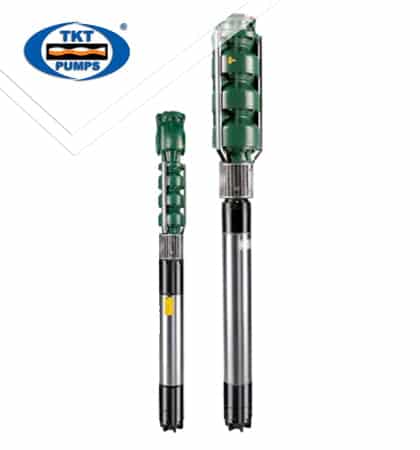
A notable candidate for deep-water submersible pumps is the Submersible Pump Series 10 – 18 – Caprari, one of the high-power industrial pump types applied in medium flow rate and medium head lifting systems.
- Steel submersible pump: These pumps are designed entirely from stainless steel and have resistance to high-acid environments and hot water. The fluid source is processed in a closed loop for easy movement to the surface. The entire pump can be submerged in water when operating.
The standout pump product for this application is the E4XP Submersible Pump – Caprari, one of the high-efficiency multi-stage industrial submersible pump types.
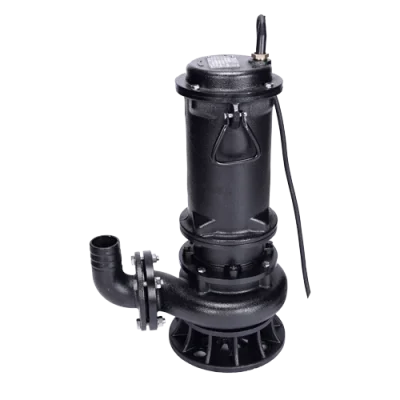
- Submersible wastewater pump: applied in fields related to the environment and urban settings with the purpose of handling complex fluids containing impurities.
This is considered the main application of submersible pumps. Because of their compact design, easy installation, high oxidation resistance, and in particular the pump impeller can handle fluids with high solid particle concentrations effectively, minimizing blockages throughout pump operation.
Vertical Shaft Submersible Wastewater Pump SP – DP PUMPSA notable pumping device is the Vertical Shaft Submersible Wastewater Pump SP – DP PUMPS, one of the high-power industrial pump types that can be operated by a float switch, with easy maintenance or repair operations.
- Submersible sludge pump: commonly used in sand and mineral mining industries to handle fluids containing solid materials effectively.
Given the characteristics of sludge, the ability to handle high solid particle fluids is required. Therefore, submersible pumps are specially designed to adapt to sludge — from design materials to pump impellers — for sludge processing.
Submersible Sludge Pump AP50 – BLAGDONThe representative pump product to highlight is the Submersible Sludge Pump AP50 – BLAGDON, one of the submersible pump types designed for use in liquid environments with high solid sludge content, with the advantage of powerful operation, easy use and maintenance.
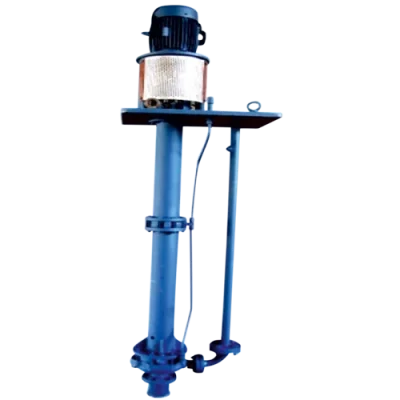
- Submersible dewatering pump: used for drainage and water discharge purposes, commonly seen in water treatment systems of high-rise buildings or maritime applications for dewatering, preventing flooding when necessary, and depending on the need to handle high or low fluid flow rates.
A standout candidate for this application is the Vertical Shaft Submersible Pump – Salvatore Robuschi, one of the industrial submersible pump types designed flexibly according to the characteristics of fluid environments, with the ability to customize the shape and size of certain pump components accordingly.
What factors should be considered when selecting a submersible pump?
Currently, submersible pump products are very diverse and widely available on the market, so finding a suitable pump product across a range of PRICES and BRANDS from various countries is not overly difficult.
Therefore, Thái Khương Pumps notes the following 2 key issues: Technical specifications and The reliability level of the supplier.
Technical specifications
The selection process for an industrial submersible pump product is similar to selecting other industrial pump products. However, Thái Khương will highlight the most important considerations as follows:
- Confirm the fluid: Due to the characteristic of the submersible pump operating deep in the material environment, identifying the fluid is necessary to increase operating efficiency as well as pump lifespan during operation. The common fluids that submersible pumps handle are clean liquids, lubricants, sludge… When the fluid is identified (liquidity, viscosity, solidity), we can easily plan the technical specifications as well as the design characteristics related to OPERATING EFFICIENCY.
- Flow rate: After identifying the fluid to be pumped, we proceed to select a reasonable pump flow rate according to the required capacity (based on the parameters provided by the supplier).
- Pump head: Head is the pump’s capacity for horizontal and vertical fluid delivery when handling liquid, usually related to information about: the location of water processing, the dimensions of the pipeline, the number of connector joints…
- Power selection: Power is usually directly proportional to flow rate and pump head. For domestic pump products, we should pay attention to the POWER SOURCE at the installation site, while for industrial submersible pump products, the POWER SOURCE is always ensured at a high voltage level throughout the operating period.
After determining the above 4 criteria, we proceed to the step of selecting the industrial pump brand.
Reputable brand
Due to the characteristic of submersible pumps operating for extended periods in liquid environments, depending on the intended use, we will have specific designs to handle different types of fluids effectively. Therefore, we need to thoroughly research the characteristics of fluids in the environment that may affect the performance and operating capability of the submersible pump in order to make an appropriate selection.
Submersible pumps are more demanding than other pump products because they operate entirely in a material environment, so encountering failures is fairly common. Therefore, choosing a reputable unit/company to supply products will help customers reduce pressure when unexpected incidents occur, and at the same time enable warranty or repair of pump equipment quickly when troubleshooting issues arise.
What to note when installing a submersible wastewater pump?
The pump must be installed according to the manufacturer’s instructions or the guidelines and diagrams in the accompanying catalogue.
After installation is complete, the rotation direction must be tested. (Many installation technicians overlook this issue because submersible wastewater pumps are usually submerged in foundation pits or pools, so the pump can deliver water regardless of whether the rotation direction is correct or reversed.)
Control panel: To protect the pump motor for long-lasting and safe operation, a control panel should be used to avoid risks from electrical incidents that may lead to motor damage or motor burnout. The protection control panel must have phase-loss protection, phase-reversal protection, and rotor-locking protection.
This is a comprehensive knowledge overview to understand what a submersible pump is and how to select an appropriate industrial submersible pump. If you have any questions requiring clarification, please reach out through the contact channels of Thái Khương Pumps or call the Hotline 0941.400.488 for detailed consultation on submersible pump products.