












📖 TECHNICAL GUIDE: PROCEDURE FOR HANDLING & RECOVERING INDUSTRIAL PUMPS AFTER FLOODING
Our deepest sympathy goes to the flood-affected areas still reeling from the disaster! Amid this difficult time, Thái Khương Pumps (Thái Khương Services) would like to share some critically important technical notes for proactively handling and recovering industrial pumps that have been submerged in floodwater.

Flooding events pose a dual threat: destroying electrical systems and corroding mechanical components. Floodwater is not clean water; it is a mixture containing mud, sand, and chemicals that acts as an extremely powerful abrasive and corrosive agent.
Before starting the recovery process, there is one “Golden Rule”:
⛔ PROHIBITED ACTION: CLEARLY DISTINGUISH BETWEEN “TESTING” AND “INSPECTION”
The most serious and costly mistake is attempting to start the pump immediately.
- “Testing” (RISKY): Plugging in power and pressing the button. What seems like “testing” is in reality a “GAMBLE” with a 100% risk of motor burnout. Water and mud inside will immediately cause a short circuit, destroying the motor windings, and can even cause a deadly arc flash.
- “Inspection” (PROFESSIONAL): Using a Megger meter (Megohmmeter) to measure insulation resistance. This reading is the ONLY evidence that the pump is sufficiently dry and safe to operate.
🛠️ 3 CRITICAL FIRST SAFETY STEPS (URGENT)
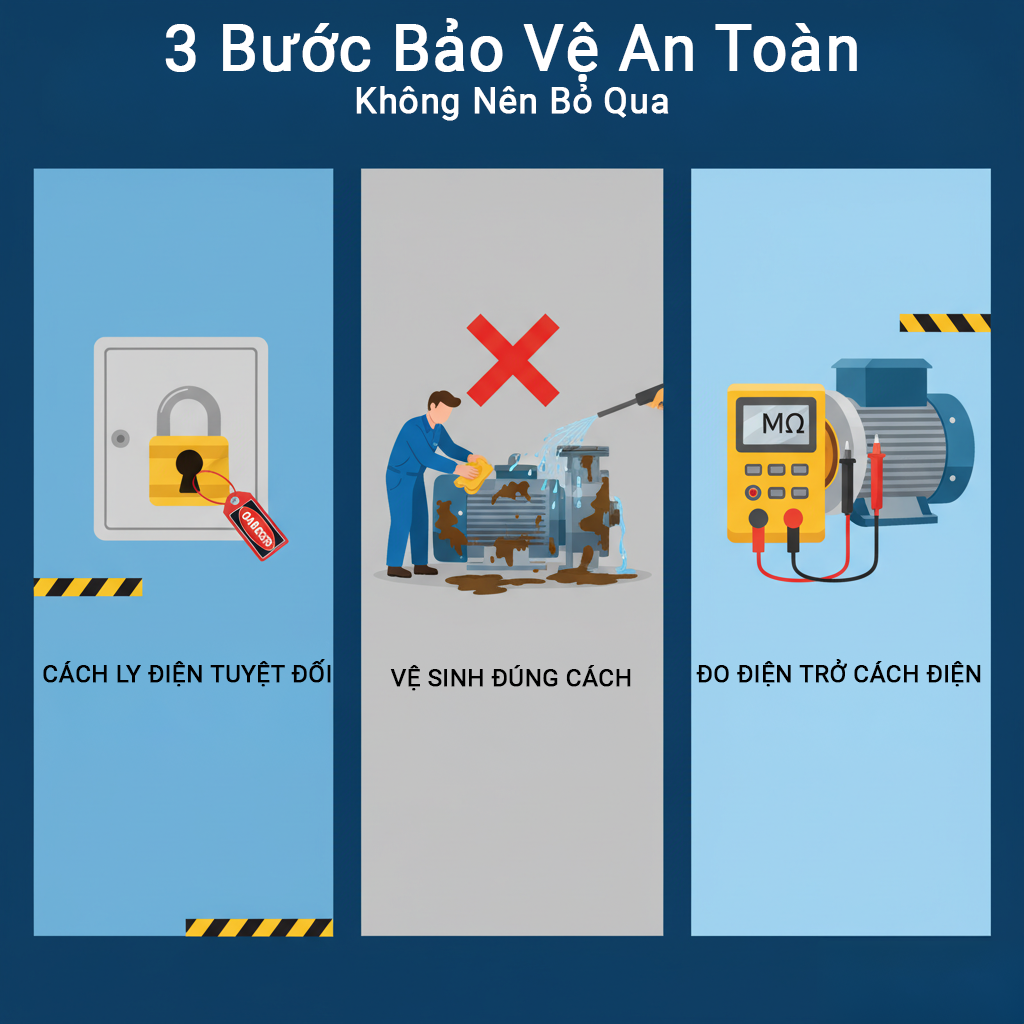
Before conducting detailed inspection, Thái Khương Services recommends these 3 CRITICALLY IMPORTANT steps:
1. ELECTRICAL ISOLATION (LOTO)
Not just switching off the circuit breaker! You must follow proper “Lock-out / Tag-out” procedures (locking the electrical panel and posting warning signs). The disconnection must be performed at the main isolator in the MCC (Motor Control Center), not just the local push-button. Afterward, it is MANDATORY to use a voltage tester or VOM meter to re-check at the motor terminal box. Ensure 100% certainty that there is no residual voltage.
2. PROPER CLEANING (Avoid Causing Additional Damage)
GOLDEN NOTE: Never use a high-pressure water jet aimed directly at “sensitive” areas such as:
- The gap of the mechanical seal.
- The bearing cap/cover (bearing).
- The motor terminal box.
This action will inadvertently PUSH WATER AND MUD RESIDUE deeper inside. Only use moderate-pressure water to clean mud and dirt from the outer casing, and use compressed air or non-flammable solvent for internal mechanical components.
3. INSULATION RESISTANCE MEASUREMENT (IR TEST)
This is the professional “Inspection” step. After cleaning mud and dirt from the stator and drying it properly (ideally using a recirculating oven at 50°C–80°C with ventilation), a Megger must be used to measure.
Safety standards (380V motor):
- < 1 MΩ (Megohm): Level “DANGEROUS”. DO NOT OPERATE. Continue drying.
- > 100 MΩ (Cold measurement): Level “GOOD”. Meets reliable operation requirements.
🔍 INSPECTION CHECKLIST FOR THE 5 MOST “SENSITIVE” LOCATIONS
Floodwater and mud/sand are “abrasive compounds”. We need to “dissect” the following 5 locations:
1. Mechanical Seal
- Issue: The seal creates a tight seal using 2 “sealing faces” (carbon/ceramic/SiC) polished to a mirror finish. Mud and sand that penetrate will act like “sandpaper”, immediately scratching these surfaces.
- Inspection method: Disassemble all components. Clean the sealing faces with a soft cloth. Use a flashlight to inspect closely: If any dull scratches, chip marks, or pitting are found (however small), that seal is damaged.
- Recommendation: Attempting to “salvage” a scratched seal is a technical error. Forcing it back = water will leak directly into the bearing and motor.
2. Bearing
- Issue: Floodwater has completely washed away the lubricating grease and caused micro-corrosion (pitting) on the ball and raceway surfaces.
- Inspection method: Fully remove the bearing from the shaft. Clean with non-flammable solvent. Use the naked eye and hand to feel the raceway and ball surfaces.
- Recommendation: Any sign of pitting, rust, or roughness means the bearing is permanently damaged. Attempting to re-grease and reuse it will almost certainly lead to shaft seizure or premature failure.
3. Pump Shaft
- Issue: The shaft is worn or corroded at critical contact points.
- Inspection method: Carefully check for “scratches” or “corrosion” at the seal and bearing seating locations.
- Recommendation: Even a small scratch on the shaft will immediately destroy a new mechanical seal.
4. Impeller
- Issue: Mud and sand cause abrasion and imbalance.
- Inspection method: Pay particular attention to closed impellers, semi-open impellers, and screw types. Carefully check for signs of mud and sand contamination inside.
- Recommendation: Abrasion may damage the impeller surface, causing pressure loss (insufficient head) and dynamic imbalance, leading to vibrations that destroy the bearing.
5. Lubrication System (Oil)
- Issue: Oil has been emulsified due to water contamination.
- Inspection method: If the oil has a “milky coffee” color, it has lost 100% of its lubrication and anti-rust properties.
- Recommendation: Simply “draining” (Drain) is not sufficient because emulsion residue remains adhered. It is MANDATORY to “FLUSH” (Flush) the entire system with dedicated flushing oil, then replace with new oil and a new filter.
A pump CAN BE SAVED if we calmly follow the proper procedure. Do not take risks on your own. Let us share this burden with you.
Stay electrically safe! Call our Thái Khương Services specialists in the Central Region now for a free consultation!