












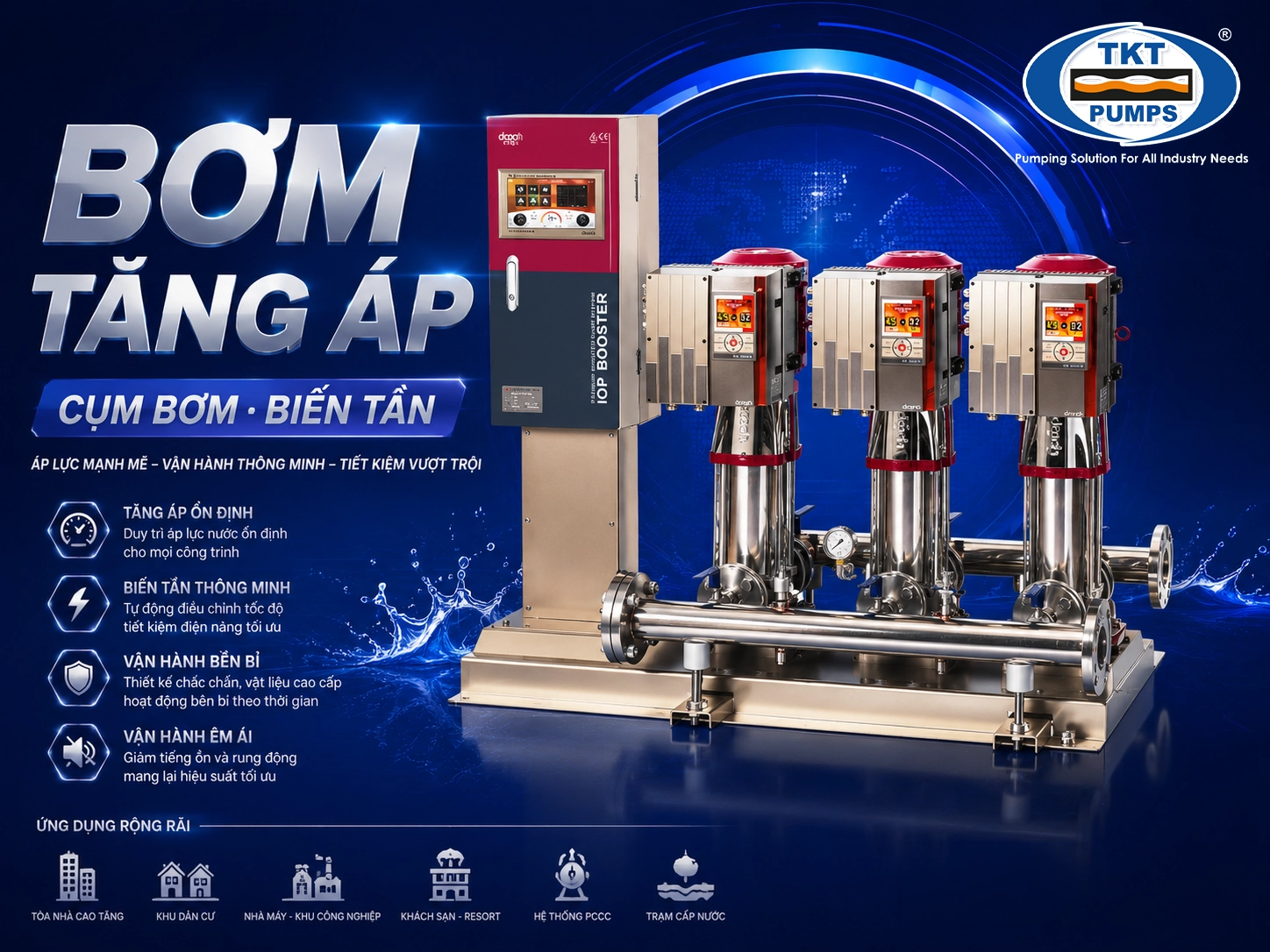


Pumps are equipment found in virtually every manufacturing facility. Knowing how to keep a pump running continuously in a production line — while saving energy, achieving good performance, and extending service life — is something not everyone is familiar with.
With more than 13 years of experience in the industry, Thái Khương is pleased to share this basic guide to pump operation and maintenance for everyone’s reference!
Pump maintenance and operationTo operate a water pump correctly, you need a clear understanding of its construction and working principle. This is essential when operating and servicing industrial equipment in general, and pumps in particular.
Pump Operation Guide
There are many different types of pumps available on the market today. They are generally divided into two groups: centrifugal pumps and positive displacement pumps. Each pump type has its own specific operation procedure. For that reason, this article cannot cover the detailed operation steps for every pump type. You may therefore treat this as a general basic guide applicable to all pump types currently available on the market.
Key Points to Note When Operating a Water Pump
Factors to check before operating any pump:
- Fluid: The pump casing must always be completely filled with liquid (water, etc.) to prevent dry running, which can damage the pump seal. This applies especially to centrifugal pumps.
- Power supply (for pumps driven by an electric motor): Connect the pump to a stable power source (3-phase, 380 V, 50 Hz or single-phase 220 V, 50 Hz depending on the pump). It is advisable to use a system of contactors, circuit breakers, and sensors to protect the pump from damage caused by an inadequate power supply.
- For centrifugal pumps, verify that the direction of rotation matches the arrow marked on the pump casing (clockwise direction).
- System and installation: Install pipework correctly, ensuring the suction and discharge heights are within the pump’s design limits and that pipe sizes meet the pump’s standard specifications. Check that the coupling between the pump shaft and the motor is properly aligned (concentric).
- Pump protection devices: Check the pressure gauge, check valve, foot valve, strainer, overload protection relay, dry-run protection device, and flexible couplings at the suction and discharge ports of the pump.
- Check the fluid outlet: Open the outlet valve before starting the pump, then adjust as needed to bring the pump to its operating point. When starting the pump, the discharge valve must be fully closed.
- Check operating parameters: Monitor the pump pressure; if it is too high, bleed air from the pump head by loosening the bleed screw. To purge air from the pipeline, slowly open the discharge valve until the pump reaches its operating point.
- Install the pump in a horizontal position to ensure proper operation; provide adequate shielding and protection, and ensure the ambient temperature is suitable.
- The diameter of the suction pipe must not be smaller than the pump suction inlet (it should be one size larger per pump standards); check that water is being pumped to verify pump operation.
- Use suction pipework made of material that is not excessively flexible. The foot valve must be positioned approximately 30 cm above the bottom of the tank or reservoir to avoid drawing in silt and sand, and a strainer should surround the valve. If the pump is specifically designed to handle fluid containing solid particles, this precaution may not be necessary.
- Always monitor the water level; take particular care when the foot valve is positioned above the water level in the tank or reservoir.
General Pump Storage and Maintenance Guide
Cleaning the water pump before storageIf a pump is to be left out of service for an extended period, it must be placed into a proper storage condition. The following are basic pump maintenance steps you can apply to any pump type on the market:
- Inspect and clean the entire pump thoroughly with clean water.
- During water cleaning, take care to prevent water from splashing onto the motor.
- Apply anti-rust oil to the coupling and pump impeller before placing the pump into storage.
Key points to check when storing a pump:
- Ensure all fixing bolts are securely tightened — flanges, couplings, baseplate, pump frame, motor, pipework, and mounting brackets. The pump must rest on a flat, level surface.
- Is any fluid still retained inside the pump casing?
- Has the power supply been completely disconnected?
We hope the information above will be helpful to you in maintaining and operating your pumps on a daily basis.
These are the fundamental concepts that every industrial pump operator should know. In upcoming articles, Thái Khương will provide more in-depth operation and usage guides specific to each industry for everyone to follow.
Thái Khương Pump