














With the influence of climate change and human activity causing the Earth to warm day by day, this is felt more clearly by those living in major cities or working in industrial zones.
This creates latent risks of fire and explosion. Beyond complying with fire prevention and firefighting regulations, the minimum essential step is to equip a fire-fighting pump — or even a complete firefighting system.
Fire-Fighting PumpThrough this article, we will provide practical notes to help you select a fire-fighting pump quickly and accurately.
Fire-Fighting Pump
First, let us look at the correct understanding of a fire-fighting pump.
What Is a Fire-Fighting Pump?
A fire-fighting pump, also known as a fire pump or firefighting system pump, has the primary function of supplying water rapidly and forcefully on demand, to quickly extinguish fires on the verge of spreading.
Fire-fighting pumps are mandatory in: residential areas and apartment buildings; industrial production zones and manufacturing plants; commercial centers, schools, hospitals, and office towers.
Fire-Fighting Pump in English
In English, a fire-fighting pump is defined as a Fire Pump. It is a key component in a firefighting system known as a Fire Protection System.
Construction of a Fire-Fighting Pump
In general, a fire-fighting pump consists of the following components:
- Motor: The component that generates motion
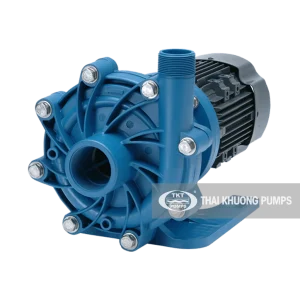
- Pump casing: The main component that generates pressure and drives water flow. Inside are components such as the shaft and impeller…
- Inlet/outlet ports: Draw water in and push water out
- Base plate: Fixes the fire-fighting pump to the system
Working Principle of the Fire-Fighting Pump
The working principle of a fire-fighting pump can be divided into 2 control scenarios:
Manual Firefighting System Operation
The operator starts the pump system via push buttons on the control panel. The primary action is switching the pumps on or off.
Automatic Firefighting System
An automatic firefighting system is activated through preset setpoint values — signals from pressure, temperature, and flow rate sensors, among others.
Example: A factory installs an automatic fire prevention and firefighting system.
Fire-Fighting Pump SystemInitially, the pressure setpoint is 8 bar. This pressure is constantly maintained in the system piping, monitored by a pressure sensor. At this point, the pump system is idle.
When a fire alarm event occurs, the discharge valves open or the piping experiences a pressure leak, dropping pipe pressure to 7 bar. The booster pump is activated immediately, restoring pressure to 8 bar, then shuts off.
When a fire occurs, discharge valves open and spray water, causing pipe pressure to drop rapidly below 6 bar. The main pump is activated, and the booster pump also operates to rapidly supply water for firefighting.
During this process, if the power supply is interrupted, the main pump can no longer operate. The diesel-driven backup pump is immediately activated to take over system operation.
– After the event, power is restored, and pipeline pressure is brought back to the original 8 bar setpoint. The system returns to its normal state.
Types of Fire-Fighting Pumps
In practice, classification varies by preference, as long as it is easy to remember and understand. The following three classification methods are recommended:
Classification by Construction
Classification by construction is based on the structural features of the fire-fighting pump. Using this method, there are 2 commonly used types:
Fire-Fighting Pump Operation- Split-shaft fire-fighting pump: The pump head and motor are separable. Any compatible models with matching specifications can be paired, regardless of manufacturer…
- Close-coupled fire pump: The pump head and motor are cast as one unit on a common shaft. This reduces flexibility in cost optimization and is generally used less frequently than the split-shaft type.
Classification by Power Source
Classification by power source is based on the energy source powering the pump.
The types include:
- Diesel-powered fire pump
- Gasoline-powered fire-fighting pump
- Electric-powered fire pump
Classification by Mobility
Additionally, firefighting system pumps can be classified by how they are moved:
- Portable fire-fighting pump: This type is highly mobile, compact, and lightweight, but at the cost of lower operating power and lower head. It is therefore used only for small, low-level fires or while awaiting the arrival of fire trucks…
- Fire truck: Can transport a high-capacity firefighting system and draw water from standpipe hydrants on the street…
- Firefighting helicopter: Also a firefighting vehicle equipped with a high-capacity pump system, used to extinguish fires at height…
Fire-Fighting Pump System
What does a fire-fighting pump system include? What regulations govern this system? How is a fire prevention and firefighting system installed? You will find the answers in this section.
Fire Prevention and Firefighting Pump SystemA fire-fighting pump system includes:
- Main pump: Typically electrically driven. It has high capacity and serves the primary role in the fire prevention and firefighting system.
- Secondary pump, also called the backup pump: A fire-fighting pump with capacity equivalent to the main pump. It handles situations where the main pump fails due to electrical issues or when grid power is cut off for safety reasons.
- Jockey pump (pressure compensation pump): A device used to compensate pressure in the piping system when the main or backup pump experiences a pressure drop due to pipe leaks or valve activation upon fire detection. In some cases, the jockey pump may be started ahead of the main pump to raise water pressure.
- Control panel: Comprises switching devices for the pump system and a controller that receives signals returned from pressure sensors in the piping.
Fire-Fighting Pump Standards
- The flow rate and pressure of the fire-fighting water pump must meet the required specifications
- Design requirements for fire-fighting water pumps per Clause 4 TCVN 8531:2010 (ISO 9905:1994).
- Material requirements for fire-fighting water pumps per Clause 5 TCVN 8531:2010 (ISO 9905:1994).
- The suction port of the pump must be compatible for connection with the suction coupling. The suction coupling inner diameter must conform to regulations and meet technical requirements per TCVN 5739:1993.
- The discharge port of the pump must be compatible with the discharge coupling. The discharge coupling inner diameter must conform to regulations and meet technical requirements per TCVN 5739:1993.
- The priming pump must meet the following requirements:
- Vacuum priming time must not exceed 30 s at a minimum suction depth of 7,000 mm;
- Maximum suction depth: not less than 7,500 mm;
- The priming pump must be capable of shutting off after the priming process is complete (manually or automatically)
Key Considerations When Selecting a Fire-Fighting Pump
There are 3 factors that make up a complete fire prevention and firefighting system:
- Pump system power
- Flow rate of the pump calculated per minute or per second
- Suction head / discharge head
Therefore, the selection of a fire-fighting pump must comply with fire prevention and firefighting standards and Vietnam National Technical Regulations (QCVN) for system design.
According to the latest published regulations: “When selecting a fire-fighting water pump, the flow rate–head characteristic curve of each pump manufacturer must be referenced so that the selected design duty point falls within the range of 90% to 140% of the rated capacity on the pump’s performance curve.
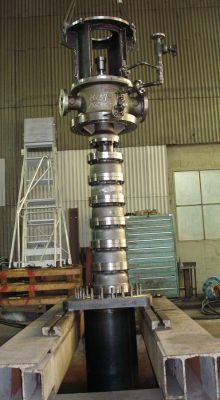
When the water source is located below the discharge pipe centerline and the supply pressure is insufficient to push water into the fire-fighting pump, a vertical turbine pump must be used. In this case, a horizontal centrifugal pump is not permitted.”
Fire-Fighting Pump supplied by Thái KhươngFire-Fighting Pump Power
Fire-fighting pump power is expressed in kW or hp — the two common units for measuring machine output.
A basic fire prevention and firefighting pump system typically has a power output ranging from tens of kW to several hundred kW, depending on the system configuration. Note that fire-fighting pumps have higher power ratings than standard pumps because they must draw large volumes of water per second or per minute to suppress fires.
Suction and Discharge Flow Rate
The suction and discharge flow rate is calculated based on the firefighting piping diagram. It depends on the system elevation, pipe diameter, and pipe length.
Suction Head and Discharge Head
The suction head and discharge head are the factors used to select the appropriate jockey pump. They affect the water velocity and flow rate delivered to the point where the fire needs to be suppressed.
In an automatic fire prevention and firefighting system, the jockey pump operates based on signals from pressure sensors returned to the control panel.
This article has shared essential information about fire-fighting pumps as well as guidance on the factors to consider when selecting the right pump for your needs.
We welcome your feedback and invite you to share this article.
Thank you!