












What is a water level float switch? Have you ever had to wait by a storage tank or reservoir just to run back and turn off the pump when it was full? Or perhaps you were filling a tank and stepped inside for a moment, only to come back and find water overflowing all over the floor? If this sounds familiar, read on to find out how to solve it!
What Is a Water Level Float Switch?
What is a water level float switch? Many of you are certainly familiar with this device. However, some readers may have only heard of it without having seen one in person.
In short, a water level float switch is a device that eliminates the need to worry about water overflow or empty tanks — whether the storage tank is underground or up on a rooftop. It contributes to process automation, even within our own homes.

How exactly do they work, and what are they made of? Read on to find out — there is a great deal to explore about these float switches and their various variants available on the market!
Construction of Water Level Float Switches
Water level float switches actually come in 2 types.
- Mechanical water level float switch
- Electric water level float switch
Each type differs slightly in construction. Specifically:
- The mechanical water level float switch requires no electricity whatsoever. It consists of a hollow float body connected to an external mechanical linkage. This linkage is typically a coupling made of plastic or metal depending on the price point.
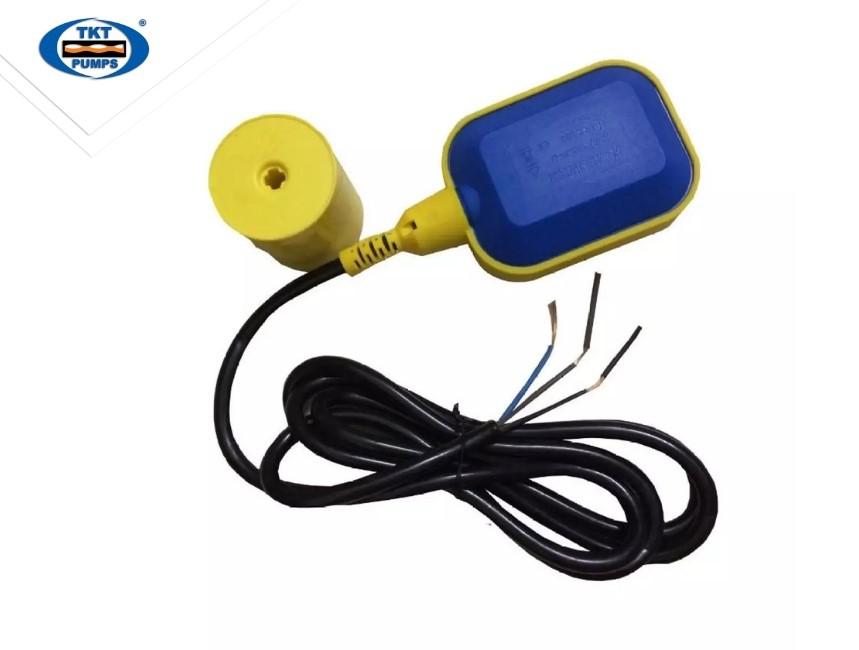
- The electric water level float switch must of course be connected to a power source. Its distinctive feature lies inside the float itself. The float is watertight and contains an internal electrical contact mechanism along with a steel ball. The wiring connects to circuit breaker contacts to open or close the circuit, thereby controlling pump operation.
Next, to better understand why they are constructed this way, let us look at their working principle.
Working Principle of Water Level Float Switches
Based on their construction, let us examine how these water level float switches operate and how they differ from each other.

For the mechanical water level float switch: It operates entirely on a mechanical basis. A spherical ball float is connected to the mechanism via a rigid rod made of metal or hard plastic. As the water level rises or falls, the float moves accordingly. When the water level in the tank drops too low, the float reaches its lowest position and acts on a latch to open the water valve, allowing water to flow in. The float then rises with the water level. When the float reaches its designed upper position, it acts on the latch again, causing the water valve to close and stopping the water supply to the tank. This process repeats continuously.
For the electric water level float switch: The operation is similar, but there are more options in terms of the number of floats used — there can be a low-level alarm float, a high-level alarm float, or a single float integrating both functions. The signal is processed electrically, and when the signal reaches the setpoint, it directly energizes or de-energizes the pump control circuit, causing the pump to start or stop.
Types of Water Level Float Switches on the Market

Water level float switches currently available on the market include:
- Mechanical water level float switch
- Electric level alarm float switch
- Rod-type water level float switch
- Float-type water level sensor
In addition, various water level sensors are commonly referred to by technicians as “water floats”, though in practice they differ greatly in construction and working principle, such as:
- Capacitive water level sensor
- Ultrasonic water level sensor
- Radar water level sensor…
In future articles, we will cover each sensor type in greater detail. These devices are now widely used in manufacturing facilities across the country — the more equipment you know, the better!
Advantages and Disadvantages of Water Level Float Switches
Considering the two types of water level float switches discussed in this article by Thái Khương, each type has its own advantages and disadvantages, suited to different use cases.
Advantages:
- Both types fulfill their high-level and low-level alarm functions
- Both are very affordable
- Primarily used in small-scale industrial and domestic applications
- Simple in construction, though when damaged they are typically discarded rather than repaired
Disadvantages:
- Generally low durability, making them unsuitable for heavy industrial use
- Relatively limited accuracy
- Mechanical linkage is prone to jamming and failure
- Construction materials are of modest quality…
For these reasons, monitoring fluid levels in storage tanks to control pump operation with greater precision calls for sensor-based solutions in industrial settings, replacing simple float-type level indicators. The sensors mentioned in the classification section above offer standout capabilities such as 4–20 mA industrial-standard signal transmission for data acquisition and remote control…
Applications of Water Level Float Switches
Water level float switches are extremely common devices. You likely have them in your own home. Why? Because they are present in toilet cisterns, in rooftop water storage tanks, and their role is to provide the conditions for pumps — such as submersible pumps — to start or stop…
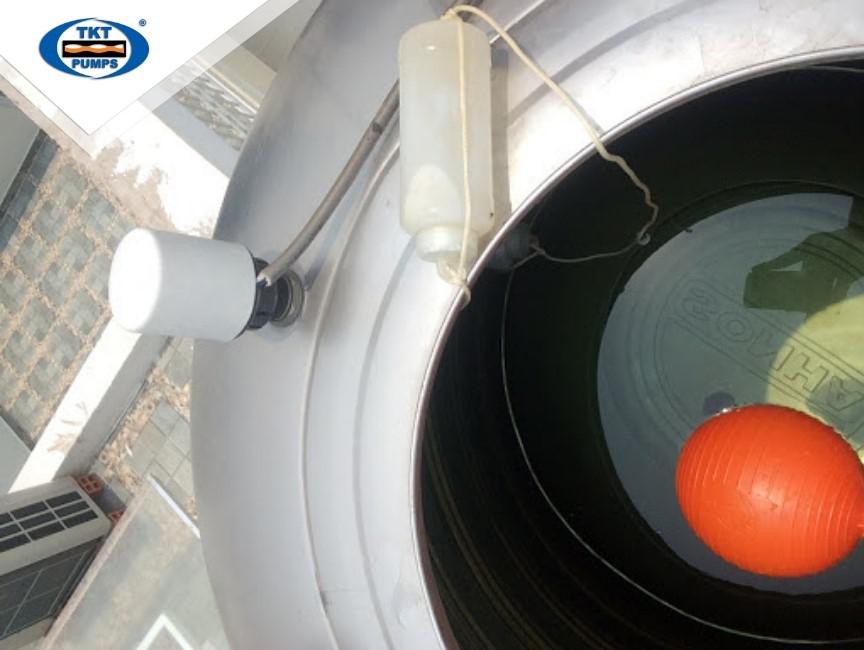
However, it is in industrial settings where these water level measurement floats are used most effectively. In industry, more advanced variants have been developed with greater features and accuracy, such as float-type water level sensors and rod-type water level float switches…
These water level sensors are always paired with pump systems for pump control. They serve as input conditions for pump operation, regardless of whether the pump is a centrifugal pump for clean water supply, a screw pump, or a vane pump for wastewater treatment… They are the device that tells the pump whether there is still fluid in the tank, so it knows whether to run or stop.
Thái Khương is a well-established pump equipment supplier in Vietnam, dedicated to delivering optimized solutions for fluid handling with pumps. If you need consultation on pump solutions, control systems, or fluid transport processes — whether for water, wastewater, or even acid chemicals — contact Thái Khương today for a solution tailored to your needs!