



What is an air-operated diaphragm pump? Why are more and more industries switching to air-operated diaphragm pumps in their control systems?
The answers are all in this article — follow along with Thái Khương!
See also: AODD air-operated diaphragm pump catalog and selection guide — configuration selection matrix by fluid, diaphragm material table (PTFE/Santoprene/Buna-N/EPDM/Viton), and 81 models.
What Is an Air-Operated Diaphragm Pump
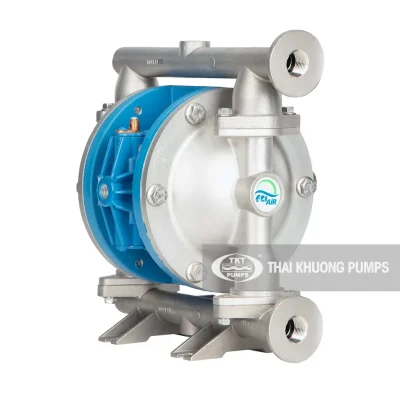
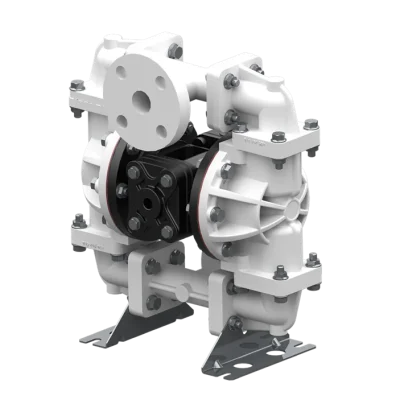
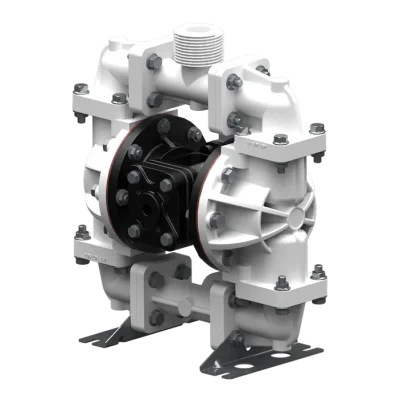
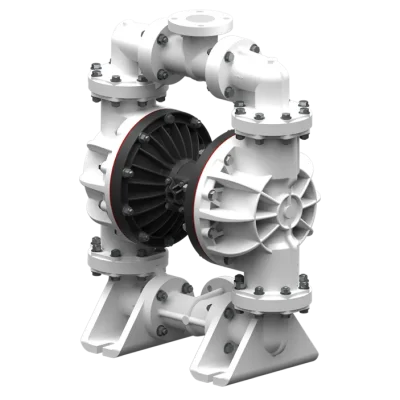
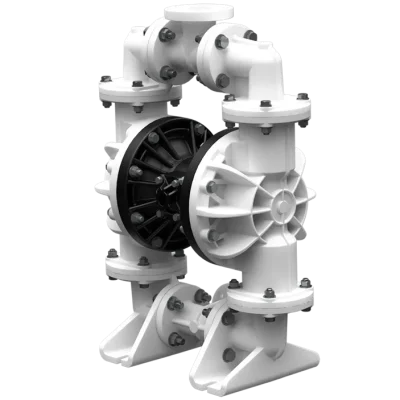
Air-operated diaphragm pumpAn air-operated diaphragm pump is a positive-displacement pump consisting of two pumping chambers. During operation, the two chambers are continuously filled and then alternately discharge fluid in accordance with the movement of the diaphragms. Compressed air is alternately introduced and vented from the air chambers on the opposite side of the diaphragms to drive the pump.
Working Principle of Air-Operated Diaphragm Pumps
Air-operated diaphragm pumps are commonly used for conveying and handling fluids such as slurries, corrosive liquids, and abrasive media. Despite their reliable performance and ease of maintenance, the pumps can generate noise during operation, and their operating range is limited in low-pressure applications.
Working principle of air-operated diaphragm pumpsAir-operated diaphragm pumps transfer fluid alternately by repeatedly cycling the two diaphragms attached to a common shaft. Alternatively, diaphragm pumps can also be driven directly, with the shaft coupled directly to a motor. Diaphragm pumps use compressed air with a sophisticated air distribution system that alternately directs airflow into the two air chambers on opposite sides of the diaphragms. A complete operating cycle of an air-operated diaphragm pump is as follows:
- The compressed air control system directs air into air chamber A.
- As the shaft moves to the left and the diaphragm motion increases the volume of pump chamber B, it simultaneously decreases the volume of pump chamber A. Valves on either side of the pump chamber ensure that the fluid flows in only one direction: from the inlet to the discharge port. The result is that fluid is drawn from the inlet into chamber B and discharged from chamber A.
- When the shaft completes its first stroke, the air distribution system vents chamber A and directs compressed air into air chamber B.
- The shaft now moves to the right, reducing the volume of pump chamber B while simultaneously expanding the volume of pump chamber A. Fluid is now discharged from chamber B and drawn into chamber A.
- Likewise, when the shaft completes its stroke, the air distribution system vents chamber B and the cycle repeats as compressed air is directed into air chamber A again.
Construction of Air-Operated Diaphragm Pumps
Air-operated diaphragm pumps are delivered to users as a complete, ready-to-install unit. However, understanding what parts and components make up the pump is equally valuable, isn’t it?
Construction of air-operated diaphragm pumpsSimply put, knowing the construction of the equipment allows us to handle situations when faults occur, diagnose issues, and carry out repairs within our capabilities — for example, stuck valves, compressed air leaks, or torn diaphragms.
The construction of an air-operated diaphragm pump is generally divided into two main sections:
- Air supply section
- Diaphragm pump section
In practice, a diaphragm pump consists of many components, including:
- Pump base
- Pump chamber
- Diaphragm
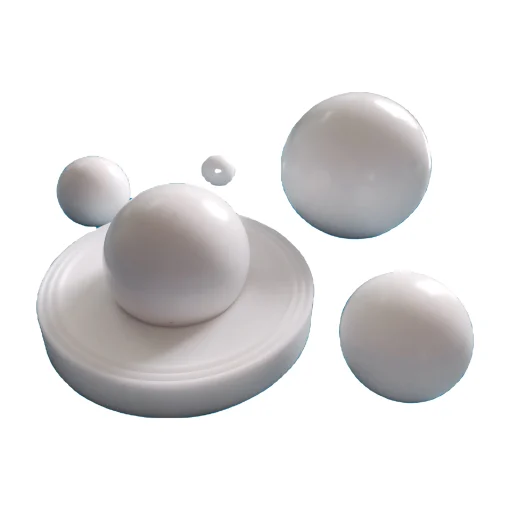
- Ball valves
- Inlet manifold
- Discharge manifold
- Compressed air supply unit
Among these, components can be selected based on the fluid being pumped:
Pump chambers, diaphragms, and ball valves are available in materials such as: stainless steel, cast iron, bronze, powder-coated steel, plastic, PTFE, etc.
For example:
- If your application involves food-grade pumping, SS316 or PTFE (Teflon) are suitable options that meet food safety and hygiene standards.
- For chemical pump applications, due to the corrosive nature and potential physicochemical reactions involved, the recommended approach is to use an all-plastic construction to address the issue.
- For general water pumping or other common media, materials such as cast iron, steel, or bronze can be selected to reduce investment costs.
Advantages and Disadvantages of Air-Operated Diaphragm Pumps
Every piece of equipment has both advantages and disadvantages, and air-operated diaphragm pumps are no exception. So how do we learn about the strengths and weaknesses of the equipment? The only way is to research and gather information about it. Fortunately, we have covered this content right below. Read on!
Air-operated diaphragm pump used in industryAdvantages of Air-Operated Diaphragm Pumps
In general, air-operated diaphragm pumps can be considered leak-free during fluid pumping operation. When leakage does occur, the issue typically lies with a diaphragm failure.
The diaphragm should be replaced regularly, in accordance with the manufacturer’s recommendations. The diaphragms of air-operated diaphragm pumps are subject to less wear compared to mechanically driven diaphragm pumps, thanks to pressure balancing by the compressed air supply.
The pump is capable of handling abrasive fluids, high-viscosity fluids, and various types of slurries and industrial sludge. The pump incorporates four internal valves (typically ball valves) or alternatively flap valves or check valves. Ball valves provide a better seal and experience less wear in service compared to flap valves.
- Ball valves wear more evenly because the ball rotates freely during pump operation.
- Flap valves have the advantage of not jamming when larger solids are carried along in the pumped fluid. However, flap valves have a hinge, and over extended use the hinge point deteriorates.
Air-operated diaphragm pumps use no internal seals and no moving parts that require lubrication or cooling. As a result, the pump can run dry for extended periods with minimal damage. The pump is self-priming, and some models have a suction head of up to 8 m.
Pneumatically driven diaphragm pumps are suitable for use in hazardous areas because they use compressed air rather than electricity. In some cases, the pump can also be used as a submersible pump — provided that the pump’s vent port remains above the fluid level.
Disadvantages of Air-Operated Diaphragm Pumps
The efficiency and stability of air-operated diaphragm pumps depend on the compressed air supply used. The compressed air supply must be at a pressure equal to or greater than the pressure of the fluid being pumped. This is why air-operated diaphragm pumps are not recommended for low-pressure applications (typically 120 psi).
Pump speed is determined by the differential pressure between the air supply and the fluid being pumped.
If the pressure from the compressed air supply increases or the pressure of the fluid being pumped decreases, the pump’s flow rate will vary. Therefore, for applications requiring a constant, stable flow rate, users must implement additional measures to control flow and pressure.
The air distribution system supplies energy and controls the operation of the diaphragm pump.
The materials used in diaphragm pump construction are relatively inexpensive, straightforward, and easy to maintain. However, in some plant environments, the exhaust air may need to be filtered to capture contaminants such as oil.
Disadvantages of air-operated diaphragm pumpsUsers should be aware that air-operated diaphragm pumps may freeze — this occurs when the air distribution system is poorly designed. The reason is that during diaphragm pump operation, continuous venting takes place, which can cause ice to accumulate in the vent port or within the air distribution system. This issue can be addressed by reducing humidity, lowering the compressed air supply pressure, or installing a heater.
The operating cycle of the diaphragm creates pulsations at the discharge port, causing the fluid to accelerate during the compression stroke and decelerate during the suction stroke. Users can moderate the pulsations of an air-operated diaphragm pump by using two cylinders:
- One cylinder is used for the compression stroke
- The other cylinder is used for the suction stroke
Note that pulsations can cause adverse vibrations in the pump, particularly at the discharge system and the outlet connections.
Air-operated diaphragm pumps can also generate noise during operation — not only due to vibrations from pulsations but also from the continuous venting of the air valves. Noise from the air valves can be reduced by installing a muffler on the vent line.
Considerations When Selecting an Air-Operated Diaphragm Pump
What should we keep in mind when selecting an air-operated diaphragm pump? Is choosing a diaphragm pump straightforward?
Rushing into a purchase decision can expose you to several risks, such as: an incompatible diaphragm pump, incorrect power rating, or incorrect material — all of which can render the pump unusable. To minimize losses, keep the following factors in mind:
- Estimate the required working capacity and select the appropriate size for the air-operated diaphragm pump
- Identify the type of fluid to be pumped
- Once the fluid is identified, you can select the appropriate construction material and diaphragm material. For example: chemical pump applications will require plastic construction.
- Brand and country of origin of the pump…
Applications of Air-Operated Diaphragm Pumps
Air-operated diaphragm pumps are reliable, easy to maintain, and relatively low-cost devices that play an important role and are widely used for transfer applications across many industries. Some common applications where air-operated diaphragm pumps are frequently encountered include:
Applications of air-operated diaphragm pumpsPumps for the Mining Industry
(Can operate in classified areas / hazardous environments)
- Dewatering above and below ground and in quarries
- Conveying slurries and abrasive slurry mixtures
- Metering
- Conveying solvents for mineral separation from ore
- Pumping fuel for vehicles and equipment
Paints and Coatings Industry
(Capable of pumping solutions and fluids with viscosity ranging from low to very high)
- Conveying, blending, and metering paints, inks, and dyes
- Pumping material into spray guns
- Flushing / cleaning with solvents
Ceramics Industry
(Capable of pumping highly abrasive slurries)
- Filling molds
- Circulating ceramic and porcelain slurries
- Conveying wastewater
Air-Operated Diaphragm Pump for Chemical Applications
(Handles corrosive and hazardous chemicals effectively)
Air-operated diaphragm pump in the chemical industry- Chemical metering with air-operated diaphragm pump
- Pumping / draining chemicals from drums, tanks, and vessels
- Chemical mixing pump
Electroplating and Anodizing
- Replenishing chemicals in plating baths and metal finishing
- Agitating cleaning solutions
- Circulating fluids to prevent sedimentation
- Filtration (filtering media for high-quality components)
- Reducing corrosive residue and solid waste
Paper and Pulp Industry
- Pumping printing ink
- Pumping adhesives
- Pumping kaolin clay
- Pumping liquid resin
- Dispersion
Oil and Gas Industry
(Can operate in classified areas / hazardous environments)
- Pumping oil and glycol
- Pumping sumps and oil storage tanks
- Oil filtration pressing
Water Treatment / Wastewater Treatment Industry
- Pumping wastewater sumps and holding tanks
- Water filtration pressing
- Pumping wastewater containing solid particles
Air-Operated Diaphragm Pump Pricing
Are air-operated diaphragm pumps expensive? This is a question many people ask. In practice, whether an air-operated diaphragm pump is expensive or not depends on several factors, including:
- Pump capacity
- Application of the air-operated diaphragm pump
- Brand and country of origin of the diaphragm pump…
These factors influence the product price. For example: two diaphragm pumps with the same working capacity but different brands and origins will be priced differently, though the gap may not be large. Depending on your budget and system requirements, you can choose an air-operated diaphragm pump of Taiwanese or EU origin. A higher-priced product will generally offer more advantages and serve your system more reliably.
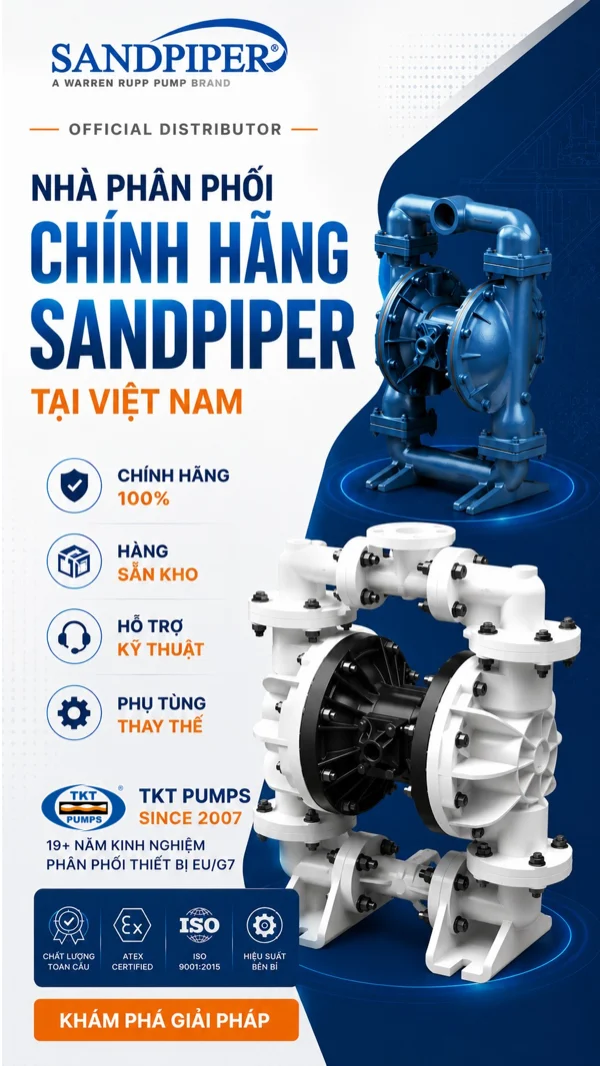
Thái Khương Pumps currently supplies diaphragm pumps from the BLAGDON brand, originating from the United Kingdom, ensuring EU and G7 quality (you may refer to the products using the information below).
If you have not yet found a suitable product, or if you have any questions requiring advice or need technical information and product pricing, please contact us immediately.
Thái Khương Pumps is always ready to listen and support you.