








Chemical Pump Solutions for Fume Scrubber & Industrial Odor Control Systems
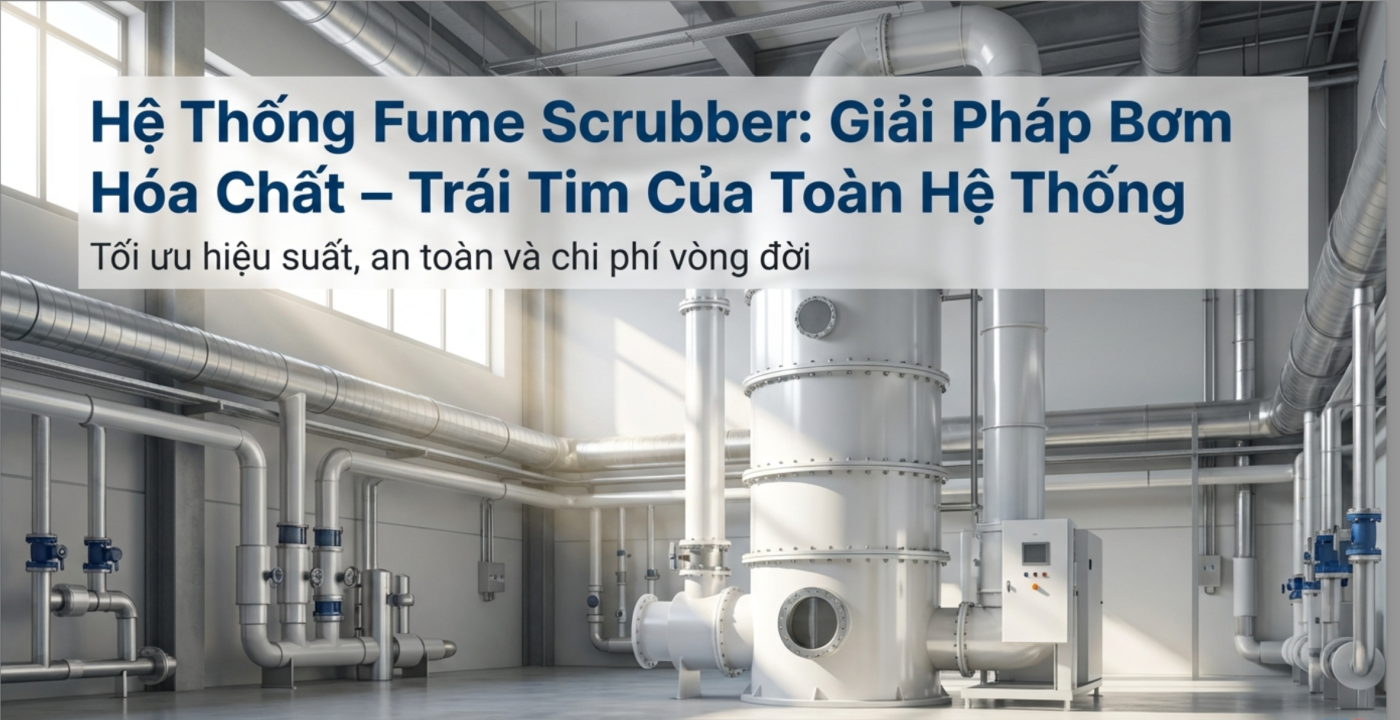
In industrial exhaust treatment and odor control systems, fume scrubbers (gas washing towers) are a widely used solution for removing toxic gases, acid/alkali vapors, VOCs, and unpleasant odors before discharge into the environment.
However, the effectiveness of the entire scrubber system depends heavily on the chemical pump system — the component responsible for circulating the absorption solution, dosing chemicals, and draining contaminated liquid.
This article helps you understand:
- The actual role of chemical pumps in fume scrubbers
- Technical challenges when selecting pumps
- Criteria for choosing suitable pumps for corrosive environments
- Chemical pump solutions that Thái Khương is deploying for scrubber systems in Vietnam

Why is the chemical pump the “heart” of the fume scrubber system?
In wet scrubber tower systems, the absorption solution (water combined with chemicals such as NaOH, NaOCl, acid, or oxidizing agents) is pumped from the storage tank up to spray nozzles or packing layers to make direct contact with the exhaust gas stream.
The chemical pump determines:
- The flow rate of the circulating solution
- Spray pressure and distribution uniformity inside the tower
- The ability to maintain treatment chemical concentration over extended periods
If the pump operates unstably or stops suddenly:
- Odor/toxic gas removal efficiency drops sharply
- The risk of exceeding emission standards increases
- Odor spreads to surrounding areas, leading to legal risks and environmental complaints
Therefore, in practical operation, the chemical pump is truly the “heart” of the entire fume scrubber system.

Key functions of chemical pumps in scrubber towers
Absorption solution circulation pump
This is the most critical pump in the scrubber system.
Function:
- Draw solution from the sump
- Pump it up to the spray nozzle system or packing layer
- Maintain continuous circulation 24/7
Technical requirements:
- High corrosion resistance (NaOH, NaOCl, acid, salts)
- Continuous, stable operation
- Tolerance for pH and temperature fluctuations, and potentially small solid particles
Chemical dosing pump (pH / ORP adjustment)
Scrubber systems commonly integrate online pH/ORP sensors to control treatment effectiveness.
Function:
- Dose NaOH, acid, NaOCl, KMnO₄… into the absorption tank
- Maintain the solution within the “optimal treatment range”
Technical requirements:
- Resistance to high-concentration chemicals
- Stable metering
- Material compatibility with piping and tank systems
Dirty liquid drain pump & transfer to wastewater treatment
After a period of operation, the absorption solution will:
- Accumulate salts
- Contain reaction by-products
- Potentially generate sediment
Function:
- Pump out a portion of the contaminated solution (bleed-off)
- Transfer to the wastewater treatment system or an intermediate tank
Technical requirements:
- Corrosion resistance
- Ability to handle flows with impurities
- Typically combined with a chemical centrifugal pump or air-operated diaphragm pump
Challenges in selecting chemical pumps for fume scrubbers
Extremely corrosive environment
When gases such as SO₂, HCl, HF, and NH₃ dissolve into solution, they create strong acid/alkali environments that rapidly corrode conventional metallic materials.
Temperature & concentration fluctuations
The absorption solution changes concentration with gas load and operating conditions, placing significant stress on pump materials.
Continuous operation with minimal downtime
Scrubbers typically run in parallel with the production line. Pump failure = gas treatment system shutdown.
Chemical leakage = safety risk
Mechanically sealed pumps are prone to leaking NaOH, NaOCl, and acid → unpleasant odors, floor corrosion, and hazards for operating personnel.
👉 This is precisely why chemical pumps for scrubbers cannot be selected the same way as ordinary water pumps.
Criteria for selecting suitable chemical pumps for scrubber towers
Chemical & material compatibility
- PP: mild to moderate alkali
- PVDF: strong acids, NaOCl, oxidizing environments
- Always cross-reference the manufacturer’s chemical compatibility chart
Flow rate & head range
For medium-sized industrial scrubbers:
- Flow rate: ~5–40 m³/h
- Head: ~10–30 m
Depends on:
- L/G ratio (liquid/gas)
- Tower height
- Pressure losses through nozzles, packing, and piping
Leak-proof design & reliability
- Preference for sealless (mag-drive) pumps
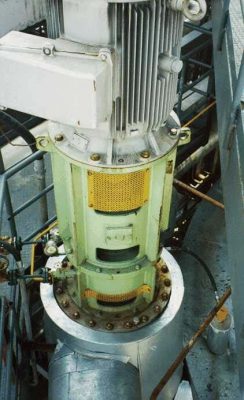
- Or vertical in-tank pumps
- Or air-operated diaphragm pumps for high-risk points
Chemical pump solutions for fume scrubbers at Thái Khương
Thái Khương approaches the scrubber problem from a total solution perspective, not merely supplying “a single pump.”
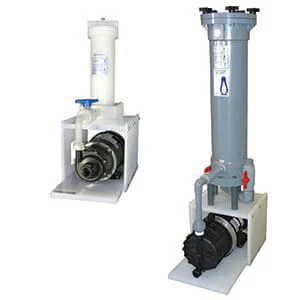
Sealless chemical pumps for scrubber circulation
- Chemical centrifugal pumps with magnetic drive (mag-drive)
- Completely eliminates mechanical seals → virtually leak-free
- PP / PVDF materials for highly corrosive environments
- Suitable for scrubbers treating acid gas, alkali gas, and VOCs
Air-operated diaphragm pumps & metering pumps
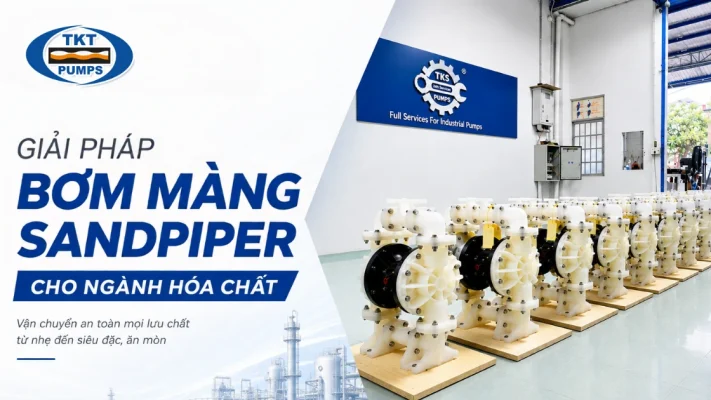
- Air-operated diaphragm pump: used for concentrated chemicals, slurry flows, and dirty liquid drainage
- Metering pump: used for precise pH/ORP chemical dosing lines
Finish Thompson – sealless pump solutions for fume scrubbers
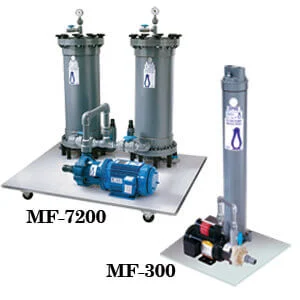
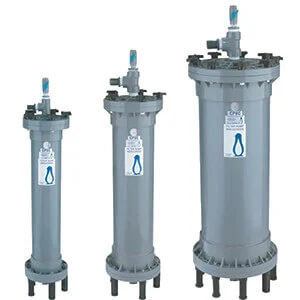
Within the sealless pump category, Thái Khương is the authorized distributor of Finish Thompson (FTI) pump lines — a globally recognized brand in mag-drive chemical pumps for:
- Fume scrubbers & odor control
- Wastewater treatment
- Chemical & corrosive industrial applications
Pump lines such as DB (horizontal), SP (self-priming), VKC (vertical) have been selected by many international scrubber manufacturers as standard configurations due to:
- High leak-safety performance
- Reliable efficiency for 24/7 operation
- Long service life and low lifecycle costs
Industries & practical applications Thái Khương is serving
- Water & wastewater treatment plants: H₂S and NH₃ odor control at sludge tanks and pump stations
- Waste, sludge & fertilizer processing: odor control at waste reception areas and sludge pressing operations
- Chemicals & metal plating: treatment of acid vapor, alkali, and solvent fumes
- Paper, food & pharmaceutical: exhaust gas scrubbers & internal WWTP systems
Thái Khương’s consultation & pump selection process
- Gather input data
Gas type, flow rate, scrubber configuration, chemicals, temperature - Calculate duty point & material selection
Determine appropriate flow rate – head – materials - Propose an optimized configuration
Circulation pump + metering pump + drain pump - Technical support & after-sales service
Installation guidance, operation support, genuine spare parts

Conclusion
The effectiveness of a fume scrubber system does not rest solely on the tower design — it depends heavily on the chemical pump solution.
Selecting the right pump type, the right material, and the right configuration will:
- Increase gas treatment efficiency
- Reduce chemical leakage risks
- Lower long-term operation & maintenance costs
👉 Are you designing a new or upgrading an existing fume scrubber / industrial odor control system?
Contact Thái Khương for consultation on a suitable chemical pump solution — from sealless mag-drive pumps to air-operated diaphragm pumps — optimized for both treatment effectiveness and lifecycle cost.
See also: Solutions implemented by Thái Khương Pumps
[wpforms id=”23098″]