










In water treatment, chlorine metering pumps and chemicals such as PAC, NaOH, and polymer must be dosed precisely according to water flow rate and sensor signals. For mid-capacity clean water supply and wastewater treatment systems, the mechanical diaphragm metering pump (motor-driven) offers a balanced configuration in terms of durability, wide flow range, and automation capability via 4–20 mA signals. The Doseuro (Italy) SR type D series addresses this application group with a range of 49–1,400 l/h, pressure 3–14 bar, and pump head material selected to match the fluid.
- Metering pump = positive displacement pump, precise dose-by-dose chemical injection
- Flow rate adjusted via stroke length and frequency
- Dosing NaOCl/chlorine, PAC coagulation, NaOH pH adjustment, polymer for settling
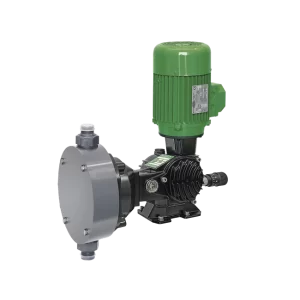
- Doseuro SR type D: mechanical diaphragm, 49–1,400 l/h, 3–14 bar, ATEX
- Automatic dosing via pH/ORP/flow rate sensor through 4–20 mA
Why Water Treatment Requires Metering Pumps
Chemical Dosing by Discrete Dose, Not Continuous Flow
Disinfection, coagulation, and pH adjustment all require chemical doses proportional to the raw water flow rate. Over-dosing leads to chlorine odor in the water, wasted chemicals, and by-product formation; under-dosing fails to achieve the required chlorine residual or results in poor coagulation. A metering pump is a positive displacement pump: each stroke delivers a fixed volume, so the dose closely tracks the set point with a metering accuracy typically within ±1–3% depending on the type.
Compared to throttle valves or manually adjusted centrifugal pumps, a metering pump allows the dose to be fixed via two independent parameters: stroke length, which sets the volume per stroke, and frequency, which sets the number of strokes per minute. When sensors and a 4–20 mA signal are integrated, the pump automatically adjusts the dose according to real-time flow rate and water quality.
Four Common Chemicals and Pump Requirements
NaOCl, PAC, NaOH, Polymer — Each with Its Own Challenge
The four chemicals below appear in the majority of water supply and wastewater treatment stations. Each imposes its own requirements on pump head material and dosing stability:
| Chemical | Role | Dosing Notes | Recommended Wetted Material |
|---|---|---|---|
| NaOCl (liquid chlorine) | Disinfection, maintaining chlorine residual | Generates gas bubbles, corrosive; requires degassing valve and stable dosing | PVC / PVDF / PTFE |
| PAC | Coagulation, flocculation of suspended solids | Dose proportional to raw water turbidity; prevent pipe sedimentation | PVC / PP |
| NaOH (caustic soda) | pH adjustment, neutralization | Dose via pH signal; avoid over-dosing causing excess alkalinity | PP / PVDF |
| Polymer | Settling aid, sludge separation aid | High viscosity; requires dilution and sufficient stroke length | Inox 316L / PVDF |
Because the fluids vary widely, the Doseuro pump head is selected according to the liquid: Inox 316L, PVC, PP, PVDF, or PTFE. This allows the same pump series to serve multiple dosing points within the same plant, simply by changing the pump head configuration.
Drive Types and the Role of the Mechanical Diaphragm
Solenoid, Mechanical Diaphragm, Hydraulic Diaphragm, Piston
Metering pumps are classified by how the pump head is driven. Each type suits a different flow rate and pressure range:
| Drive Type | Characteristics | Suitable For |
|---|---|---|
| Solenoid (electromagnetic) | Fast on-off electromagnetic coil, compact, low flow rate | Small dosing points, rapid-pulse dosing |
| Mechanical diaphragm (motor-driven) | Cam/eccentric drives diaphragm, mid-range flow rate, durable | Mid-capacity water treatment |
| Hydraulic diaphragm | Oil-actuated diaphragm, leak-proof, high-pressure rated | Hazardous chemicals, high pressure |
| Piston/plunger | Direct-contact piston, very high pressure | High-concentration chemicals, high pressure |
For most mid-capacity water supply and wastewater treatment stations, the motor-driven mechanical diaphragm type is the balanced choice: a flow range broad enough for NaOCl/PAC/NaOH/polymer dosing points, a simple diaphragm construction, easy maintenance, and available sensor signal control options. When higher pressure or more demanding fluids are required, switching to a hydraulic diaphragm or piston is an option — refer to the drive type comparison article to select the correct drive type.
Automatic Dosing via Sensors and 4–20 mA
Dose Tracking Flow Rate and Water Quality
The key advantage of metering pumps in water treatment is the ability to integrate into a control loop. Flow rate, pH, or ORP sensors send a 4–20 mA signal to the controller, which adjusts the pump frequency or stroke so that the chemical dose tracks real conditions:
- Chlorine dosing by flow rate: the raw water flow rate signal is directly proportional to the NaOCl dose, keeping the chlorine residual stable.
- pH adjustment with NaOH: the pH sensor feeds back to the caustic dose, preventing over-dosing and excess alkalinity.
- Disinfection by ORP: the ORP signal reflects oxidation capacity, regulating the chlorine dose according to microbial load.
The Doseuro SR type D supports manual control or 4–20 mA signal input, so the same pump can run manually for simple operations and switch to automatic mode when integrated with SCADA. This series holds ATEX certification, making it suitable for areas with explosion protection requirements.
Selecting the SR Type D Configuration for Each Dosing Point
Flow Rate, Pressure, and Material by Fluid
To select a configuration, three data points are needed: the required chemical flow rate (l/h), the pressure at the dosing point (bar), and the nature of the fluid (corrosiveness, viscosity). The SR type D covers the range of 49–1,400 l/h, 3–14 bar — encompassing the majority of dosing points in mid-capacity water supply stations:
| Dosing Point | Recommended Pump Head Material | Control Notes |
|---|---|---|
| NaOCl disinfection | PVDF / PTFE | 4–20 mA by flow rate or ORP |
| PAC coagulation | PVC / PP | Proportional to turbidity/flow rate |
| NaOH pH adjustment | PP / PVDF | Feedback via pH sensor |
| Polymer settling aid | Inox 316L / PVDF | Adequate stroke length for viscous fluid |
When the flow rate exceeds this range, or the dosing point pressure is higher, the configuration depends on the model and operating conditions — technical selection will be made based on the station’s actual data.
DOSEURO · ITALY SR Type D Series for Water Treatment
Doseuro (Italy) manufactures metering pumps ranging from approximately 1 l/h to 4,000 l/h, with manual or 4–20 mA control, and pump heads in Inox 316L / PVC / PP / PVDF / PTFE to match the fluid. The SR type D is a motor-driven mechanical diaphragm pump, 49–1,400 l/h, 3–14 bar, ATEX-certified — a configuration widely used for NaOCl, chlorine, PAC, NaOH, and polymer dosing points in clean water supply and wastewater treatment. TKT Pumps is the authorized Doseuro distributor in Vietnam, providing configuration selection support and spare parts.
Frequently Asked Questions
What pump head material should be selected for a chlorine metering pump?
+
NaOCl (liquid chlorine) is corrosive and generates gas bubbles, so the pump head is typically made from PVC, PVDF, or PTFE rather than metal. PVDF and PTFE offer better chemical resistance for high-concentration chlorine. Doseuro allows pump head selection to match the fluid, including PVDF and PTFE options.
How does the SR type D adjust flow rate?
+
Like all positive displacement metering pumps, flow rate is adjusted via two parameters: stroke length, which sets the volume per stroke, and frequency, which sets the number of strokes per minute. The SR type D supports manual control or 4–20 mA signal input, enabling automatic tracking of flow rate, pH, or ORP sensors.
What is the flow rate and pressure range of the SR type D?
+
The SR type D has a range of 49–1,400 l/h, pressure 3–14 bar, motor-driven mechanical diaphragm type, and holds ATEX certification. This range suits chemical dosing points in mid-capacity water supply and wastewater treatment stations. When different flow rates or pressures are required, the configuration depends on the model and conditions.
Can one pump be used for multiple chemicals?
+
The same pump series can serve multiple dosing points if the pump head configuration is changed to suit each fluid. However, each dosing point should have its own dedicated pump to prevent cross-contamination between chemicals and to allow independent dose control for each control loop.
What is the metering accuracy of the mechanical diaphragm type?
+
Metering accuracy is typically within ±1–3% depending on the pump type and operating conditions. For stringent process applications in oil and gas, the API 675 standard requires tighter accuracy (±1% steady-state) and necessitates a dedicated pump series for that purpose.
Do metering pumps for water treatment need ATEX certification?
+
ATEX is required when the installation area carries a risk of fire or explosion, such as chemical storage rooms or areas where gases are generated. The SR type D has an ATEX-certified version, making it suitable for use in explosion-protected zones. For standard areas, ATEX is not mandatory.
Source: Doseuro (Italy) technical documentation and SR type D series catalog; compiled by TKT.