












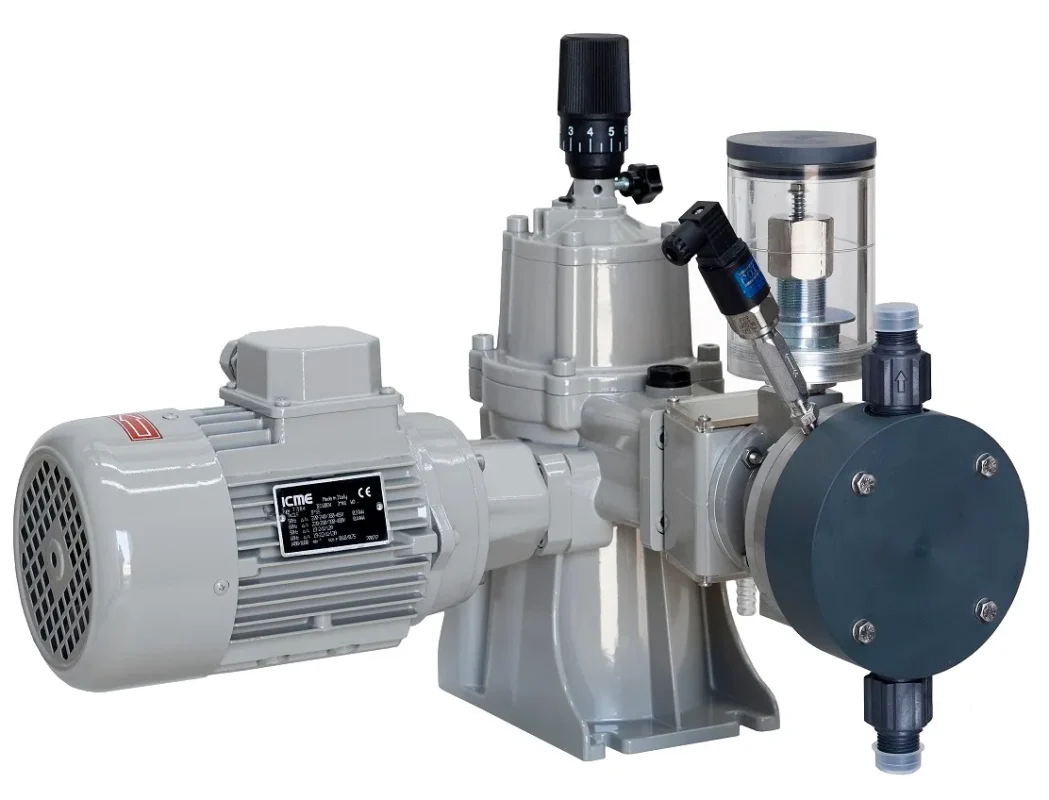
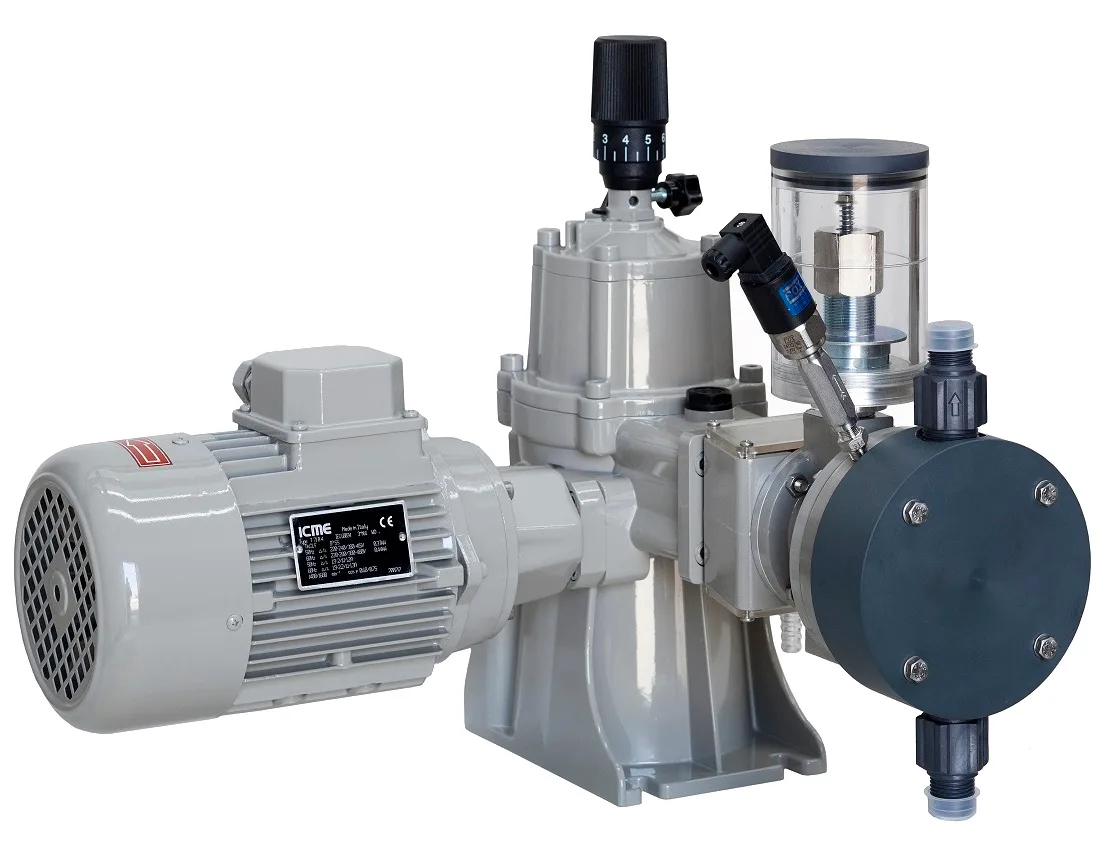
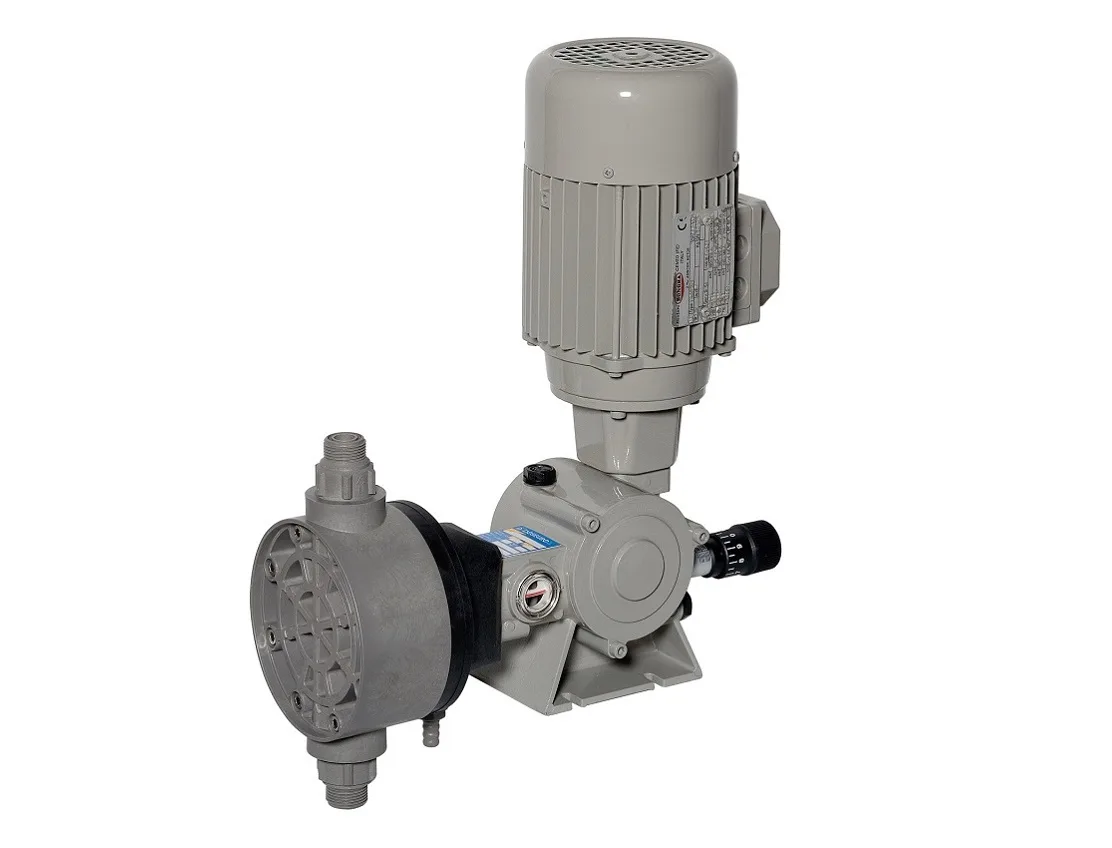
An API 675 metering pump is a positive-displacement metering/dosing pump designed to the API 675 standard published by the American Petroleum Institute, intended for process chemical injection in oil & gas, petrochemical, and LNG applications. The core requirement of API 675 is stable, high-accuracy metering (typically ±1% at steady-state), combined with tightly controlled design data, materials, and pre-delivery testing. Within the Doseuro (Italy) product range distributed by TKT, the PDP series is manufactured to the API 675 standard with ATEX certification, making it suitable for the hazardous-area environments found in oil refineries and LNG terminals.
- API 675 = the process metering pump standard for oil & gas, with steady-state accuracy typically around ±1%.
- Doseuro PDP series is manufactured to API 675 + ATEX for oil & gas, petrochemical, and LNG applications.
- Metering pumps adjust dosage via stroke length and frequency.
- Pump head material selected by fluid: SS316L / PVC / PP / PVDF / PTFE.
- Manual or 4-20mA signal control for automatic dosing based on process sensors.
What Is the API 675 Standard and Why It Matters for Oil & Gas
The Nature of the API 675 Standard
API 675 is a standard issued by the American Petroleum Institute for positive-displacement metering pumps with adjustable flow rate used in process operations within the oil & gas and petrochemical industries. Unlike conventional commercial dosing pumps, API 675 establishes a framework covering metering accuracy, pump head calculation documentation, wetted-part materials, and pre-shipment testing procedures. The objective is to ensure that each dose injected into the process line has minimal deviation and repeatable consistency, even when system pressure fluctuates.
In a refinery or petrochemical complex, process chemicals are injected at dosages calculated by the process engineer: corrosion inhibitors, demulsifiers, scale inhibitors, pH-adjusting agents, and hydrate inhibitors for gas pipelines. Dosage errors can damage product quality, accelerate equipment corrosion, or inflate chemical costs — which is why compliance with a metering standard such as API 675 becomes a technical requirement in many project specifications.
| Criterion | Conventional Dosing Pump | API 675 Metering Pump |
|---|---|---|
| Typical application context | Water treatment, general utilities | Oil & gas, petrochemical, LNG process |
| Metering accuracy | Typically ±1–3% depending on type | Steady-state framework around ±1% |
| Design documentation & testing | Per manufacturer | Per API 675 framework |
| Explosion protection | Optional | Typically supplied with ATEX |
Working Principle of Metering Pumps and Why Process Applications Favour Piston Types
Dosing via Stroke Length and Frequency
A metering pump is a positive-displacement pump: each cycle displaces a defined volume of liquid. Flow rate is adjusted through two parameters — stroke length and frequency of the displacement mechanism. This allows the operator to set very small, consistently repeatable doses — something a centrifugal pump cannot achieve.
By drive mechanism, metering pumps fall into several main families: solenoid (electromagnetic) for small doses and rapid on/off cycling; mechanical diaphragm using a cam or eccentric to drive the diaphragm; hydraulic diaphragm using hydraulic oil to actuate the diaphragm for leak-free, high-pressure operation; and piston/plunger in direct contact with the process fluid for very high pressures. In oil & gas process environments requiring high pressure and stable accuracy, piston/plunger and hydraulic diaphragm configurations are generally preferred — and this is the technical foundation of process pump series manufactured to API 675, such as the Doseuro PDP.
| Drive Mechanism | Characteristics | Suitable When |
|---|---|---|
| Solenoid (electromagnetic) | Small dose, fast response | Low-capacity chemical dosing |
| Mechanical diaphragm | Cam/eccentric drives diaphragm | Water treatment, utilities |
| Hydraulic diaphragm | Oil-actuated diaphragm, leak-free | High pressure, hazardous fluids |
| Piston/plunger | Direct fluid contact, very high pressure | High-pressure process, concentrated chemicals |
Doseuro PDP Series — API 675 + ATEX
Configuration for Oil & Gas, Petrochemical and LNG
Within the Doseuro (Italy) catalog, the PDP is the process metering pump series manufactured to the API 675 standard with ATEX certification, targeting oil & gas, petrochemical, and LNG applications. With ATEX, the pump is permitted for installation in classified hazardous areas — a typical characteristic of gas processing facilities, storage tanks, and hydrocarbon pipelines. The API 675 framework standardises the metering calculation and control approach for additive injection duties that require stable, accurate dosing.
The wetted pump head material is selected according to the chemical properties of the additive: SS316L for oil-based chemicals and moderately corrosive fluids, or engineering plastics PVC / PP / PVDF / PTFE for strongly corrosive media. For control, the pump can be operated manually or accept a 4-20mA signal to automatically adjust the dose in response to flow, pH, or ORP sensors in the system — suitable for continuously operating process lines.
| Item | PDP Doseuro |
|---|---|
| Standard | API 675 + ATEX |
| Target application | Oil & gas, petrochemical, LNG |
| Pump head material | SS316L / PVC / PP / PVDF / PTFE |
| Control | Manual or 4-20mA |
| Overall Doseuro flow range | ~1 l/h to 4,000 l/h depending on model |
Specific flow rate and pressure figures depend on the model and actual operating conditions (viscosity, back pressure, temperature), so selecting the PDP configuration must begin from the plant’s specific process requirements.
The PDP’s Position Within the Doseuro Metering Pump Range
When to Choose the PDP vs. Other Series
Doseuro offers multiple series for different applications, from chlorine dosing in water treatment to high-pressure process additive injection. Understanding the relationship between series helps select the right equipment rather than defaulting to the highest-specification series for every application. The PDP sits in the oil & gas process segment, while water treatment or high-concentration chemical dosing in standard industrial plants may be better served by the SR series at a more appropriate cost level.
| Series | Drive Type | Application Focus |
|---|---|---|
| PDP | Process API 675 | Oil & gas, petrochemical, LNG (with ATEX) |
| SR type A | Piston/plunger | High-concentration chemicals; AP-A variant up to 230 bar |
| SR type B | Hydraulic diaphragm | Leak-free; AP-B high-pressure variant up to 60 bar |
| SR type D | Mechanical diaphragm | Water treatment (chlorine, PAC, NaOH, polymer) |
| SR type FM | Compact mechanical diaphragm | Acid-resistant plastic body, compact range |
| SDP type S | Solenoid (electromagnetic) | Small doses, IP65, PTFE diaphragm |
When the requirement is oil & gas process service with explosion protection and a standardised metering framework, the PDP is a sound choice. When very high pressure is needed but the API 675 framework is not mandatory, the piston SR type A (AP-A variant up to 230 bar) may be an alternative worth considering.
Considerations for Deploying Process Metering Pumps
From Material Selection to Automated Dosing
A reliable process dosing system requires alignment across three layers: pump head material compatible with the additive, a drive mechanism that meets the pressure range requirements, and a control loop that tracks the process. For strongly corrosive additives, PVDF or PTFE is preferred; for oil-based chemicals, SS316L is generally adequate. The 4-20mA signal enables the pump to be integrated into the control system, automatically adjusting the dose in response to main-line flow rate or pH/ORP sensors, helping to reduce chemical consumption and stabilise quality.
Beyond the equipment itself, the critical factor is calculating the correct dose under actual operating conditions — back pressure, viscosity, and temperature all affect the actual flow rate delivered. This is why it is advisable to work with an experienced metering pump specialist to select the model and pump head configuration, rather than relying solely on catalog specifications.
DOSEURO · ITALY Process Metering Pump for Oil & Gas, Petrochemical & LNG
Doseuro (Italy) is a brand specialising in metering/dosing pumps with a total range of approximately 1 l/h to 4,000 l/h, pump heads in SS316L / PVC / PP / PVDF / PTFE, and manual or 4-20mA control. The PDP series is manufactured to the API 675 + ATEX standard specifically for oil & gas, petrochemical, and LNG process applications. TKT Pumps is the authorised Doseuro distributor in Vietnam, providing guidance on series selection and configuration based on the plant’s specific process requirements.
Frequently Asked Questions About API 675 Metering Pumps
How does API 675 differ from a conventional dosing pump?
+
API 675 is the American Petroleum Institute standard for process metering pumps in oil & gas, establishing a framework for metering accuracy (steady-state typically around ±1%), design documentation, materials, and testing. Conventional dosing pumps are not required to comply with this framework and are generally used for water treatment and general utilities, with accuracy of ±1–3% depending on type.
Which Doseuro series meets the API 675 standard?
+
The Doseuro PDP series is manufactured to the API 675 standard with ATEX certification, targeting oil & gas, petrochemical, and LNG applications. It is the process-grade series within the Doseuro product range distributed by TKT.
Is ATEX certification required for pumps in oil refineries?
+
In areas classified as having an explosion risk — such as gas processing zones, storage tanks, and hydrocarbon pipelines — equipment is generally required to hold ATEX certification for installation. The PDP series with ATEX satisfies this requirement, making it appropriate for oil & gas, petrochemical, and LNG environments.
Which pump head material is suitable for process chemicals?
+
Doseuro supplies pump heads in SS316L for oil-based chemicals and moderately corrosive fluids, or PVC / PP / PVDF / PTFE for strongly corrosive media. Material selection must be based on the chemical properties of the additive, its temperature, and actual concentration.
Can chemical injection with the PDP pump be automated?
+
Yes. Doseuro pumps support 4-20mA signal control, allowing integration into the control system to automatically adjust the dose in response to flow rate, pH, or ORP sensors on the process line, improving quality consistency and reducing chemical consumption.
What are the flow rate and pressure figures for the PDP series?
+
Flow rate and pressure specifications depend on the model and operating conditions (viscosity, back pressure, temperature). The overall Doseuro metering pump range spans approximately 1 l/h to 4,000 l/h. For an accurate configuration for a specific process requirement, please contact TKT for consultation based on your process data.
Need to select an API 675 metering pump for an oil & gas, petrochemical, or LNG process line? TKT’s technical team, with 19+ years of experience and over 12,000 projects, will advise on the Doseuro PDP series and the appropriate pump head configuration.
Submit Consultation Request or hotline 0941.400.488
Source: Doseuro (Italy) technical documentation and the API 675 standard by the American Petroleum Institute; compiled by TKT Pumps.