












Metering pumps can be controlled in three common ways: manual adjustment via a stroke knob for a fixed setpoint, receiving a pulse signal to dose in rhythm, and receiving an analog 4-20mA signal to vary the dose proportionally to flow rate or sensor input. With 4-20mA, you can connect the pump to a PLC together with pH/ORP/flow sensors for automatic real-time chemical dosing, eliminating the need for manual monitoring.
- Flow rate is adjusted via stroke length and frequency
- Manual control: stroke knob, fixed setpoint, no external signal required
- Pulse and 4-20mA: dose varies by rhythm or by analog signal
- 4-20mA + PLC + pH/ORP/flow sensor = closed-loop automatic dosing
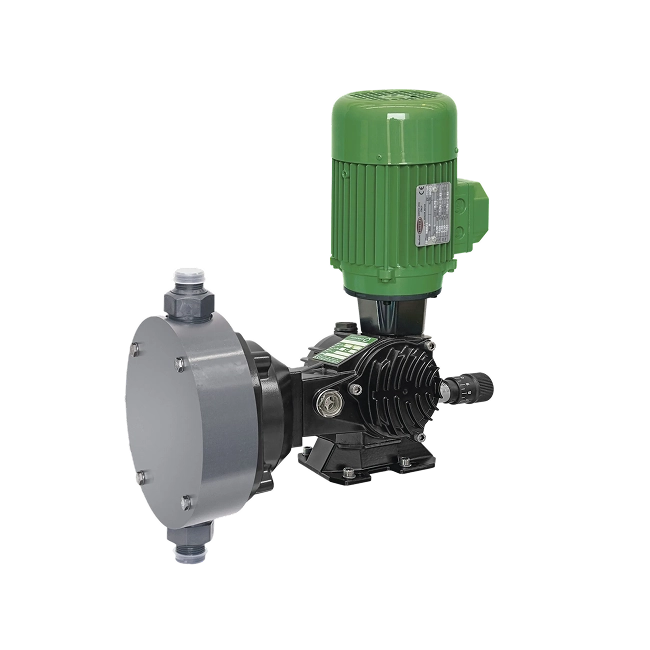
- Doseuro SR type D mechanical diaphragm supports 4-20mA and meets ATEX
How Metering Pump Flow Rate Is Adjusted
Stroke and Frequency Determine the Dose
A metering pump is a positive-displacement pump; each cycle displaces a fixed volume of liquid. Flow rate is therefore controlled by two variables: stroke length (volume per stroke) and frequency (number of strokes per minute). Increasing the stroke makes each dose larger; increasing the frequency makes dosing more frequent.
Control is essentially the act of varying these two parameters. A manual knob changes the mechanical stroke; a pulse signal changes frequency according to a pulse count; a 4-20mA signal changes stroke or frequency in proportion to the input current. Dosing accuracy is typically within ±1–3% depending on pump type and operating conditions.
| Adjustment Variable | Effect | How to Change |
|---|---|---|
| Stroke | Volume per dose | Manual knob, or actuator via 4-20mA |
| Frequency | Number of doses per minute | Pulse counter, variable frequency drive, analog signal |
Manual Control via Stroke Knob
Simple, Durable, Suited for Stable Flow Rates
This is the basic control method: the operator turns a knob to set the stroke percentage, fixing the flow rate at a single point. No external control signal is needed, no PLC is required, so installation costs are low and there are few points of failure. It is well-suited when the dosing rate is nearly constant — for example, dosing chemicals at a fixed rate for a steadily running production line.
The limitation is that any change to the setpoint requires manual on-site adjustment, and the pump does not automatically respond when load or incoming water quality changes. When the dose needs to vary continuously with actual conditions, pulse or 4-20mA signals should be used instead.
Pulse Signal and 4-20mA
Dose Varies by Rhythm or by Current
Pulse signal: each electrical pulse triggers the pump to execute one or more strokes. The pulse source is typically a flow meter that emits pulses — the more water flows through, the more frequent the pulses, and the more the pump doses. This method maintains a stable chemical-to-water ratio without complex calculations.
4-20mA signal: this is an industrial analog standard in which 4mA corresponds to the minimum and 20mA to the maximum of the configured range. The pump changes its dose linearly in proportion to the current. The 4-20mA signal may come directly from a pH/ORP controller, an analog flow meter, or a PLC. Its advantages include good noise immunity over long cable runs and easy standardization when connecting to an existing control system.
| Control Mode | Dose Depends On | Suitable When |
|---|---|---|
| Manual | Fixed setpoint | Setpoint rarely changes |
| Pulse | Pulse count / water flow rate | Maintaining chemical-to-water ratio |
| 4-20mA | Analog signal (pH/ORP/PLC) | Closed-loop control, long cable runs |
Automation: PLC and Sensor Integration
Closed-Loop pH/ORP/Flow Automatic Chemical Dosing
When dosing must respond to actual process conditions, the metering pump is integrated into a closed control loop. Sensors measuring parameters (pH, ORP, conductivity, flow rate) send values to a controller or PLC; the PLC compares them against the setpoint and outputs a 4-20mA or pulse signal to adjust the pump. The chemical dose then increases or decreases automatically to maintain the target parameter, reducing human error and minimizing chemical waste.
A typical example is clean water supply: an ORP/residual chlorine sensor controls a pump dosing NaOCl; a pH sensor controls a pump dosing NaOH or acid to balance pH; a flow meter emits pulses to control a pump dosing PAC proportionally to raw water flow. For applications in potentially explosive atmospheres, the pump must meet the ATEX standard — both the SR type D mechanical diaphragm and type B hydraulic diaphragm series are available in ATEX-certified versions.
| Application | Controlling Sensor | Signal to Pump |
|---|---|---|
| Disinfection (residual chlorine) | ORP / residual chlorine | 4-20mA |
| pH balancing | pH | 4-20mA |
| Coagulation (PAC) | Flow meter | Pulse |
Selecting a Control Method for Your Application
Balancing Operational Requirements Against Investment
A practical rule of thumb: stable flow rates at small scale are well served by manual control; maintaining a chemical-to-water ratio calls for pulse control; responding to fluid quality or connecting to a SCADA system calls for 4-20mA with PLC integration. For corrosive chemicals, pump head material is selected based on the fluid — Stainless Steel 316L, PVC, PP, PVDF, or PTFE — independently of the control method.
Regarding drive type, solenoid-driven pumps such as the SDP type S switch on and off rapidly, making them well-suited for small flow rates and responsive to pulse control. Motor-driven mechanical diaphragm pumps such as the SR type D are appropriate for higher flow rate ranges and support both 4-20mA and ATEX. When very high pressure or oil-and-gas process standards are required, piston (type A) and PDP series pumps conforming to API 675 also accept similar control signals for integration into automated systems.
DOSEURO · ITALY Metering Pumps Adaptable to Any Control Signal
Doseuro (Italy) supplies a range of metering pumps from approximately 1 l/h to 4,000 l/h, controllable manually or via 4-20mA, with pump heads selected to match the fluid (Stainless Steel 316L / PVC / PP / PVDF / PTFE). The SR type D mechanical diaphragm series (49–1,400 l/h, 3–14 bar) supports 4-20mA and meets ATEX, making it well-suited for automated water treatment stations dosing chlorine/PAC/NaOH. The SDP type S solenoid-driven series (≤22 l/h, ≤20 bar, IP65) is suited for low flow rates under pulse control. TKT Pumps is the authorized distributor of Doseuro in Vietnam, providing consultation on control method selection and PLC/sensor wiring for each specific system.
Frequently Asked Questions
What does a 4-20mA signal mean on a metering pump?
+
4-20mA is an analog current signal in which 4mA corresponds to the minimum level and 20mA to the maximum of the configured range. The pump changes its dose in direct proportion to this current, so it can receive commands directly from a pH/ORP controller, a flow meter, or a PLC to adjust the dose in real time.
What is the difference between pulse control and 4-20mA?
+
Pulse control is based on counting pulses — each pulse triggers a set number of strokes, typically sourced from a flow meter to maintain the chemical-to-water ratio. By contrast, 4-20mA is a continuous analog signal; the dose changes linearly with current and offers good noise immunity over long cable runs, making it suitable for closed-loop control.
When should manual control be used instead of automatic?
+
Manual control is appropriate when flow rate and chemical dosing rate are nearly constant, the scale is small, and connection to a control system is not required. When fluid quality or load changes continuously, or when SCADA connectivity is needed, switching to pulse or 4-20mA signals enables the pump to respond automatically.
Do Doseuro metering pumps support 4-20mA and ATEX?
+
Yes. Doseuro pumps can be controlled manually or via 4-20mA signal. The SR type D mechanical diaphragm series (49–1,400 l/h, 3–14 bar) supports 4-20mA and meets ATEX certification; the SR type B hydraulic diaphragm series is also available in an ATEX version, suitable for areas with explosion risk.
How do I set up a metering pump to dose chemicals automatically based on pH?
+
Install a pH sensor that sends values to a controller or PLC; the controller compares the reading against the setpoint and outputs a 4-20mA signal to the pump. When pH deviates from the target, the pump automatically increases or decreases the acid/alkali dose to bring pH back to the setpoint, forming a closed control loop.
Does changing the control method require replacing the pump?
+
It depends on the model. Many metering pump series offer manual, pulse, and 4-20mA control as configurable options from the outset; in some cases only a control board or stroke actuator needs to be added. It is advisable to discuss signal requirements and the desired level of automation when selecting the pump to ensure the correct configuration.
Need advice on selecting a metering pump control method and wiring it to your PLC/sensors?
Send a Consultation Request or call hotline 0941.400.488
Source: Doseuro (Italy) technical documentation on metering pumps and control methods; compiled by TKT Pumps.