












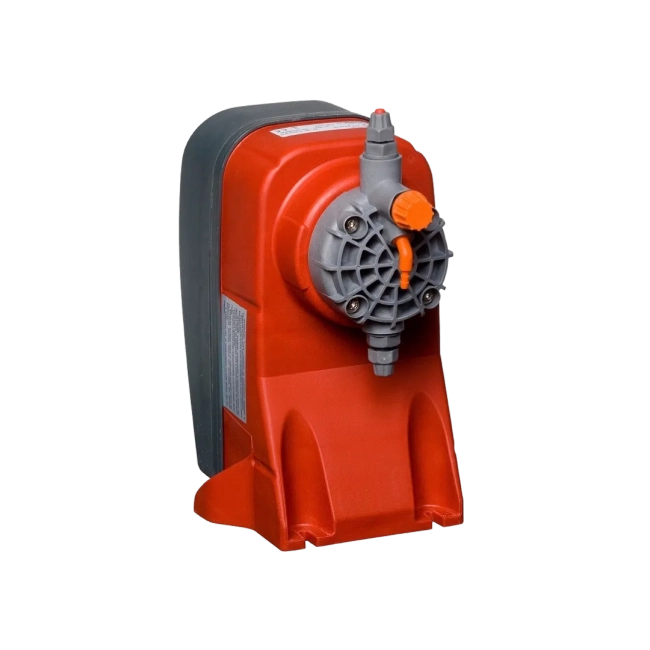
A solenoid metering pump is a positive-displacement pump that uses an electromagnetic coil to generate impulses driving the diaphragm, dosing chemicals in very small, precise increments. It is a suitable choice for low flow rate dosing applications — typically below 22 l/h, with pressure up to approximately 20 bar — such as chlorine dosing, pH dosing, water treatment chemical dosing, or additive dosing triggered by control signals. Compared with motor-driven mechanical diaphragm pumps or piston pumps, the solenoid type is more compact, switches on and off rapidly, and requires no lubricating oil, making it convenient for small systems with flexible installation requirements.
- Driven by an electromagnetic coil that generates impulses to actuate the diaphragm — dosing in precise small increments.
- Low flow rate range, typically ≤ 22 l/h; pressure up to ≤ 20 bar.
- Dose adjustment via diaphragm stroke length and pulse frequency.
- Advantages: compact, fast on/off switching, no lubricating oil required, easy to automate.
- Reference series: Doseuro SDP type S — solid PTFE diaphragm, IP65, 6 sizes.
What Is a Solenoid Metering Pump?
Electromagnetic Coil Drive Principle
A metering pump is, in general, a positive-displacement pump — each cycle displaces a defined volume of liquid, so flow rate is directly proportional to cycle count. In a solenoid metering pump, the drive element is an electromagnetic coil (solenoid). When an electrical pulse is applied, the magnetic field pulls a steel core attached to the pump diaphragm in a linear stroke to displace liquid through a check valve; when the pulse is cut off, a spring returns the diaphragm to draw in the next charge.
This on/off mechanism occurs rapidly and discretely, enabling control of each dose at a very small level. Because the driving force comes from an electrical pulse rather than a continuously rotating cam mechanism, a solenoid pump requires no gearbox or lubricating oil, keeping the pump body compact with fewer mechanical components to maintain.
| Component | Function |
|---|---|
| Electromagnetic coil (solenoid) | Generates impulse force to pull the core and pump diaphragm |
| Pump diaphragm | Separates the liquid from the drive mechanism; performs push/pull strokes |
| Check valve pair | Directs flow on suction and discharge strokes |
| Microprocessor controller | Adjusts stroke length and pulse frequency to set the dose |
Flow Rate Adjustment and Accuracy
Stroke Length and Pulse Frequency Adjustment
The flow rate of a solenoid metering pump is set by two parameters: the diaphragm stroke length (volume displaced per pulse) and the pulse frequency (number of pulses per minute). Combining these two variables provides a wide adjustment range while maintaining a stable dose. The metering accuracy of a positive-displacement pump typically falls within ±1–3%, depending on the model and operating conditions.
Many solenoid models incorporate a microprocessor and can accept external control signals. When connected to a pH/ORP sensor or a flow sensor with a 4-20 mA signal, the pump automatically adjusts the dosing rate based on actual water or process conditions — rather than running at a fixed set point.
When Should You Use a Solenoid Pump?
Low Flow Rate, Moderate Pressure, Flexibility Required
Solenoid pumps are suitable when the required dosing flow rate is low (typically a few l/h up to approximately 22 l/h) and the system pressure is not excessive (up to approximately 20 bar). This is the operating range for small-scale water treatment stations, chlorine/pH dosing for swimming pools and potable water treatment, precision additive dosing in processing applications, or discrete chemical dosing points that need flexible on/off control based on signals.
When a higher flow rate, higher pressure, or dense/high-viscosity fluid is required, motor-driven mechanical diaphragm pumps, hydraulic diaphragm pumps, or piston pumps should be considered. The table below places the solenoid pump in context within the metering pump family.
| Drive type | Characteristics | Suitable range |
|---|---|---|
| Solenoid (electromagnetic) | Compact, fast on/off, no oil required | Low flow rate, moderate pressure |
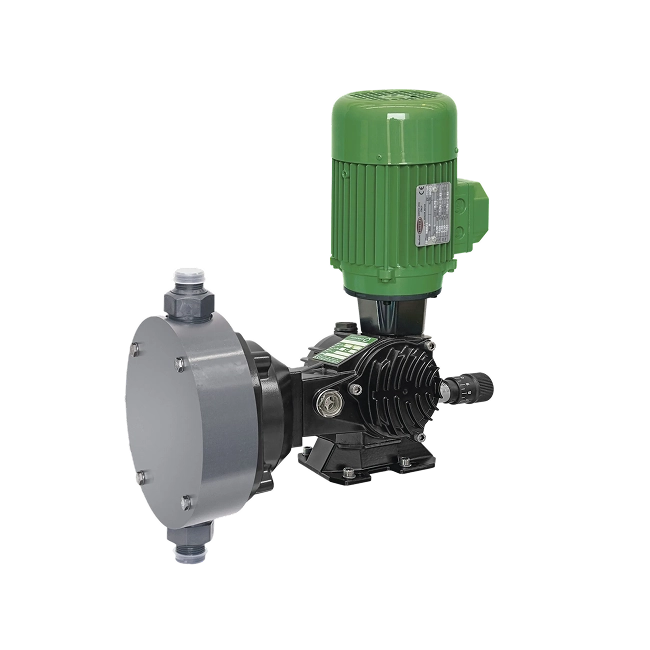
| Motor-driven mechanical diaphragm | Cam/eccentric drives diaphragm continuously | Medium flow rate |
| Hydraulic diaphragm | Oil-driven diaphragm, leak-resistant | High pressure, difficult fluids |
| Piston/plunger | Piston in direct contact with fluid | Very high pressure, concentrated fluids |
Wetted Materials and Fluid Compatibility
Selecting Pump Head Material for the Chemical
The wetted parts comprise the pump head, diaphragm, and valves — these are the determining factor for longevity when dosing corrosive fluids. Common materials for metering pumps include SS316L, PVC, PP, PVDF, and PTFE, selected according to the chemical’s properties and concentration. In solenoid pump designs, a solid PTFE diaphragm is typically used because PTFE is chemically inert to most acids, alkalis, and oxidizing solutions.
| Pump head material | Compatible with |
|---|---|
| PVC / PP | Aqueous solutions, moderate-concentration chemicals |
| PVDF | Strong acids, oxidizing solutions |
| PTFE | Highly corrosive chemicals, broad chemical inertness |
| SS316L | High pressure, specialty industrial fluids |
Declaring the correct chemical name, concentration, temperature, and flow rate/pressure from the outset helps select the appropriate diaphragm-and-head material combination, preventing premature failure due to chemical incompatibility.
DOSEURO · ITALY SDP type S Series for Small-Scale Dosing
Doseuro (Italy) is a metering pump brand distributed by TKT, covering a total range from approximately 1 l/h to 4,000 l/h with manual or 4-20 mA signal control options. For the small-dosing segment, the SDP type S series is a solenoid metering pump: flow rate ≤ 22 l/h, pressure ≤ 20 bar, protection class IP65, solid PTFE diaphragm, no lubricating oil required, and available in 6 sizes to suit specific requirements. When higher flow rates or pressures are needed, Doseuro also offers motor-driven mechanical diaphragm series (SR type D, SR type FM), hydraulic diaphragm (SR type B), and piston (SR type A) series, as well as the PDP series complying with API 675 for oil and gas applications — TKT provides selection guidance based on the actual fluid and operating conditions.
Frequently Asked Questions
How does a solenoid metering pump differ from a motor-driven mechanical diaphragm pump?
+
A solenoid pump uses a coil to generate impulses that actuate the diaphragm, switching on and off rapidly with no lubricating oil required, suitable for low flow rates. A motor-driven mechanical diaphragm pump uses a continuously rotating cam or eccentric to drive the diaphragm, handling higher flow rates. The two types complement each other across different flow rate and pressure ranges.
What flow rate and pressure can a solenoid pump handle?
+
Solenoid pump series typically operate at low flow rates — for example, the Doseuro SDP type S achieves ≤ 22 l/h and pressure ≤ 20 bar. When these limits must be exceeded, switching to a hydraulic diaphragm pump or piston pump is recommended, depending on the model and conditions.
Can chemical dosing be automated based on sensor feedback?
+
Yes. Many solenoid models incorporate a microprocessor and accept 4-20 mA signals, enabling integration with pH/ORP sensors or flow sensors for automatic dose adjustment based on actual water or process conditions.
How do I select the diaphragm and pump head material?
+
Select based on the chemical and its concentration: PVC/PP for standard aqueous solutions, PVDF for strong acids and oxidizing solutions, PTFE for highly corrosive fluids, SS316L for high pressure. Solenoid pump series commonly use a solid PTFE diaphragm for its broad chemical inertness.
What is the metering accuracy of a solenoid pump?
+
Positive-displacement metering pumps typically achieve accuracy within ±1–3%, depending on the model and conditions. For oil and gas processes with stricter requirements, metering pumps complying with API 675 are used instead of small solenoid models.
What other metering series does Doseuro offer besides solenoid?
+
In addition to the solenoid SDP type S series, Doseuro offers motor-driven mechanical diaphragm pumps SR type D and SR type FM, hydraulic diaphragm SR type B, piston SR type A, and the PDP series compliant with API 675 for oil and gas applications, covering a total range from approximately 1 l/h to 4,000 l/h.
Need to select the right metering pump series for your chemical and flow rate? TKT — with 19+ years of experience, 12,000+ projects, and 24/7 support — provides Doseuro configuration guidance tailored to your fluid, pressure, and control method.
Submit a Consultation Request or call hotline 0941.400.488
Source: Doseuro (Italy) technical documentation and SDP type S series specifications; compiled by TKT.