Hotline
Hotline 24/7 0941 400 488 Call now — free
Zalo
Free consultation Chat Zalo Response within 5 minutes
Operation & maintenance

Metering pump types: mechanical diaphragm vs hydraulic vs solenoid vs piston — which one to choose?

marketing 19/06/2026 8 min read
Chia sẻ
Bơm dẫn động từ Finish Thompson UC cấu hình ATEX
Nhà phân phối chính hãng Sandpiper tại Việt Nam — Thái Khương Pumps

There are four groups of metering pumps by drive mechanism: solenoid (electromagnetic) for small doses at low pressure, mechanical diaphragm for medium flow rates in water treatment, hydraulic diaphragm when leak-tightness and higher pressure are required, and piston/plunger for very high pressure or concentrated chemicals. Selection is based on four parameters: required dosing flow rate, pipeline pressure, required accuracy, and fluid corrosiveness. This article compares each type against the Doseuro (Italy) product range to help you narrow down your choice quickly.

Quick Summary
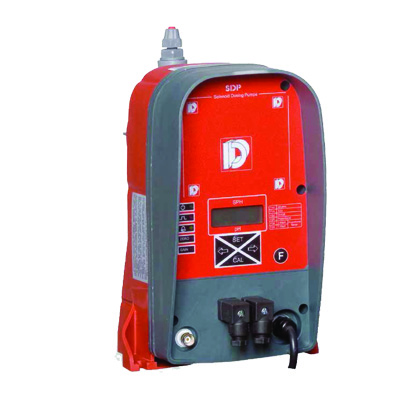
  • Solenoid (SDP type S): small doses ≤22 l/h, pressure up to 20 bar, IP65 — dosing diluted chemicals.
  • Mechanical diaphragm (SR type D): 49–1.400 l/h, 3–14 bar, ATEX — water treatment, chlorine, NaOH, polymer.
  • Hydraulic diaphragm (SR type B): 108–1.068 l/h, leak-tight, AP-B version up to 60 bar.
  • Piston (SR type A): 156–1.458 l/h, AP-A version up to 230 bar, SS316L — concentrated chemicals.
  • Oil & gas process: PDP series meets API 675 + ATEX for petrochemical/LNG.

Solenoid Metering Pump

01

Small doses, fast switching, no lubrication required

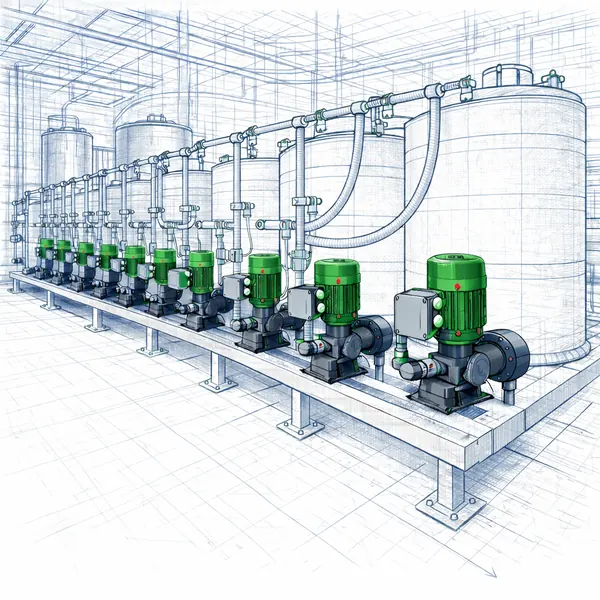
Solenoid pumps use a solenoid coil to drive the diaphragm in rapid on-off pulses, making them suitable for dosing points with diluted chemicals at low flow rates. Flow rate is adjusted via stroke length combined with pulse frequency. Advantages include compact construction, no lubrication required, and immediate response to control signals — convenient for dosing systems controlled by pH/ORP sensors.

Within the Doseuro range, the SDP type S series represents this group: flow rate up to 22 l/h, pressure up to 20 bar, IP65 protection rating, solid PTFE diaphragm, available in 6 sizes. This is the option when the dosing point requires small, stable doses at moderate pressure with simple installation.

Parameter Solenoid Pump
Flow rate Small (SDP-S ≤22 l/h)
Pressure Up to 20 bar
Suitable for Dosing diluted chemicals, small systems
Features Compact, IP65, no lubrication

Mechanical Diaphragm Metering Pump

02

The primary option for water treatment and medium flow rates

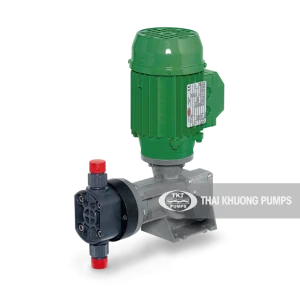
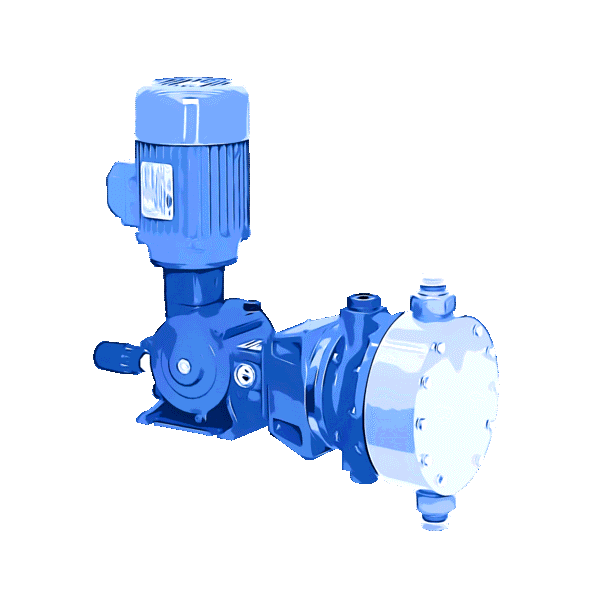
Mechanical diaphragm pumps use a motor-driven cam or eccentric mechanism to drive the diaphragm cyclically. Compared to solenoid types, these deliver higher flow rates and stable continuous operation, making them a familiar choice in drinking water and wastewater treatment. Pump head material is selected according to the fluid: SS316L, PVC, PP, PVDF, or PTFE.

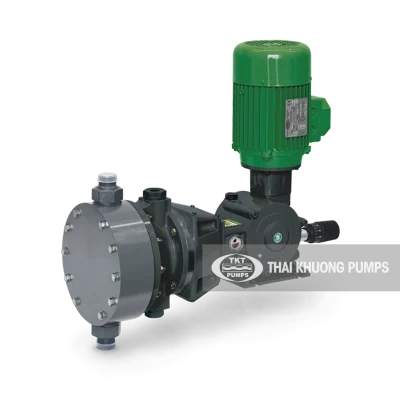
The Doseuro SR type D series covers 49–1.400 l/h, pressure 3–14 bar, with ATEX versions available for hazardous areas. Common applications include dosing NaOCl/chlorine, PAC, NaOH, and polymer. When a compact plastic body resistant to acids is needed at lower flow rates, the SR type FM series (14–47 l/h, 5–10 bar) is the compact variant of the mechanical diaphragm group.

Series Flow rate Pressure Features
SR type D 49–1.400 l/h 3–14 bar ATEX, water treatment
SR type FM 14–47 l/h 5–10 bar Acid-resistant plastic body, compact

Hydraulic Diaphragm Metering Pump

03

Better leak-tightness and higher pressure than mechanical diaphragm

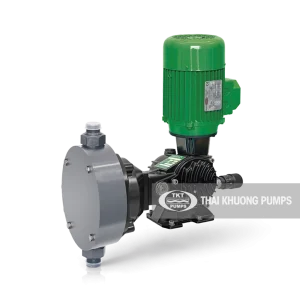
In a hydraulic diaphragm pump, the piston does not push the diaphragm directly but acts through a layer of oil. The oil distributes force evenly across the diaphragm, reducing localized stress and enabling higher working pressure. This sealed construction limits fluid leakage — critical when metering hazardous chemicals.

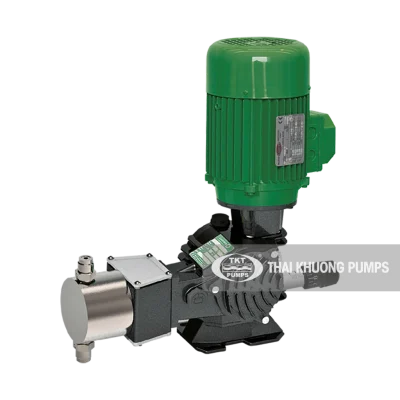
The SR type B series (including B and BR) covers 108–1.068 l/h, standard pressure up to 20 bar, with the high-pressure AP-B version reaching 60 bar, and ATEX options available. The BR version adds a relief valve to protect the diaphragm from overpressure. This series bridges mechanical diaphragm and piston pumps: retaining the sealed, safe advantage of the diaphragm while reaching higher pressure ranges.

Parameter SR type B
Flow rate 108–1.068 l/h
Pressure Up to 20 bar (AP-B up to 60 bar)
Advantages Leak-tight, BR includes relief valve
Options ATEX

Piston/Plunger Metering Pump

04

Very high pressure for concentrated chemicals

Piston (plunger) pumps allow the piston to come into direct contact with the fluid inside the pump chamber. Without the diaphragm layer, this type achieves significantly higher pressure and good metering accuracy at high pressures. In return, the seal contacts the fluid directly, so material selection must match the chemical.

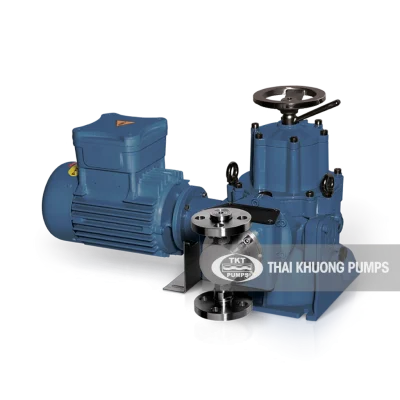
The SR type A series covers 156–1.458 l/h, standard pressure up to 20 bar, with the high-pressure AP-A version reaching 230 bar with SS316L pump heads — for concentrated chemicals. For oil & gas, petrochemical, and LNG processes requiring specific standards, Doseuro offers the PDP series designed to API 675 with ATEX.

Series Flow rate Pressure Application
SR type A 156–1.458 l/h Up to 20 bar (AP-A 230 bar) Concentrated chemicals, SS316L
PDP Model-dependent Per API 675 Oil & gas, petrochemical, LNG

Comparison Table and Selection Guide

05

Narrow down by flow rate — pressure — fluid

The selection process comes down to four steps. First, determine the required dosing flow rate to eliminate groups that do not cover the range. Then check the pipeline pressure: below 20 bar there are many options; above this threshold, a high-pressure version (AP-A/AP-B) or piston pump must be used. Next, consider accuracy and leak-tightness requirements — hydraulic diaphragm and API 675 process pumps have an advantage here. Finally, select the pump head material (316L/PVC/PP/PVDF/PTFE) based on fluid corrosiveness. Actual metering accuracy is typically within ±1–3% depending on type; the API 675 standard requires ±1% at steady state.

Type Doseuro Series Flow rate Max pressure Choose when
Solenoid SDP type S ≤22 l/h 20 bar Small doses, simple system
Mechanical diaphragm SR type D / FM 14–1.400 l/h 14 bar Water treatment, medium flow rate
Hydraulic diaphragm SR type B / AP-B 108–1.068 l/h 60 bar Leak-tight, high pressure
Piston SR type A / AP-A 156–1.458 l/h 230 bar Concentrated chemicals, very high pressure
Process PDP Model-dependent API 675 Oil & gas, petrochemical, LNG

All four groups can be controlled manually or via 4-20mA signal, combined with pH/ORP/flow sensors for automatic dosing according to operating conditions. The total flow rate range of the Doseuro series spans from approximately 1 l/h to 4.000 l/h, covering most industrial metering requirements.

DOSEURO · ITALY Metering pumps distributed by TKT Pumps

Doseuro (Italy) is a metering pump brand with 6 series covering from solenoid small-dose to high-pressure piston and API 675 process pumps. TKT Pumps provides consultation on type selection, pump head material, and control configuration for specific fluids, along with spare parts and maintenance. Contact us for a dosing point assessment and model recommendation.

Frequently Asked Questions

How many main types of metering pumps are there?

+

There are four main types by drive mechanism: solenoid (electromagnetic), mechanical diaphragm (motor-driven), hydraulic diaphragm, and piston/plunger. Each covers a different flow rate and pressure range; selection is based on fluid type and accuracy requirements.

What is the difference between a mechanical diaphragm and a hydraulic diaphragm pump?

+

The mechanical diaphragm drives the diaphragm directly via a cam or eccentric mechanism, suitable for medium flow rates at moderate pressure. The hydraulic diaphragm acts through a layer of oil, distributing force evenly, providing better leak-tightness and handling higher pressure — such as the Doseuro SR type B AP-B version up to 60 bar.

When should a piston pump be chosen over a diaphragm pump?

+

Choose a piston pump when very high pressure is required or when metering concentrated chemicals. The Doseuro SR type A AP-A version reaches 230 bar with SS316L pump heads. In return, the piston contacts the fluid directly, so seal material must be selected appropriately.

How is metering pump flow rate adjusted?

+

Flow rate is adjusted via two parameters: stroke length and pulse frequency. Control can be manual or via 4-20mA signal, combined with pH/ORP/flow sensors for automatic dosing based on actual operating conditions.

What metering accuracy can be achieved?

+

Accuracy is typically within ±1–3% depending on pump type and operating conditions. For oil & gas process applications, the API 675 standard requires ±1% at steady state — the Doseuro PDP series is designed to this standard.

How is metering pump head material selected?

+

Selection is based on the fluid’s corrosiveness. Doseuro provides pump heads in SS316L, PVC, PP, PVDF, or PTFE — for example, acid-resistant plastic bodies for corrosive chemicals, and SS316L for high-concentration chemicals at high pressure.

Need to select the right metering pump type for your dosing point? The TKT Pumps technical team assesses flow rate, pressure, and fluid to recommend the appropriate Doseuro series.

Submit a Consultation Request or hotline 0941.400.488

Source: Doseuro (Italy) technical documentation on metering pump series SR type D/FM/B/A, SDP type S and PDP API 675. Compiled by TKT.


Cần tư vấn chọn bơm cho ứng dụng của bạn?Kỹ sư Thái Khương Pumps tư vấn kỹ thuật miễn phí, phản hồi trong 24h. 28+ thương hiệu bơm EU/G7 sẵn kho.
Tư vấn chuyên gia · 24h

Cần tư vấn hoặc đăng ký nhận tin kỹ thuật?

Để lại thông tin — đội ngũ kỹ sư Thái Khương sẽ liên hệ tư vấn dòng bơm, tính toán thông số, hoặc gửi bạn nội dung kỹ thuật mới nhất.

  • Phản hồi trong vòng 24 giờ làm việc
  • Kỹ sư có kinh nghiệm thực tế dự án bơm công nghiệp
  • Thông tin được bảo mật, không spam

Để lại thông tin

Chọn mục đích — chúng tôi sẽ phản hồi đúng yêu cầu của bạn.

Hoặc gọi trực tiếp 0941 400 488 — luôn có chuyên gia trực 24/7.