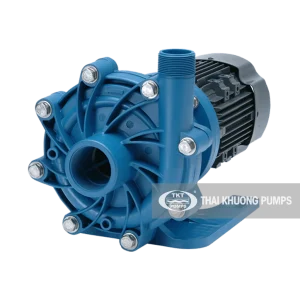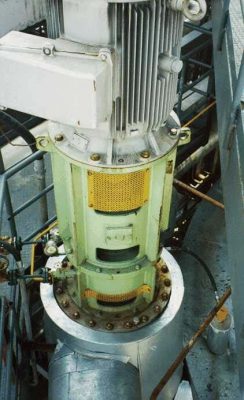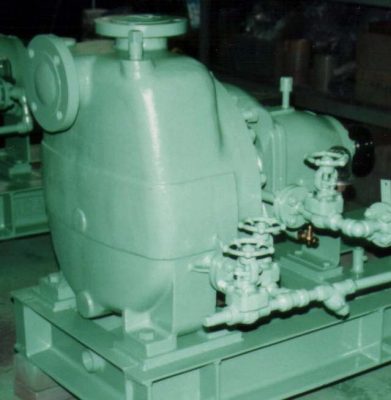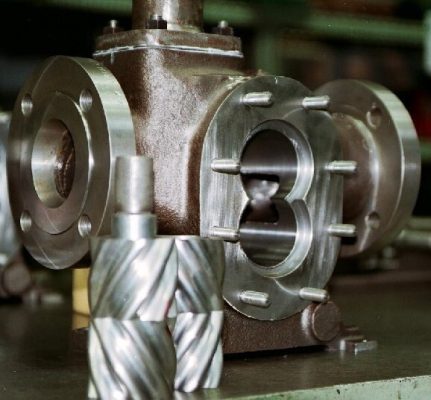













A progressive cavity pump (also called a cavity pump or single-screw pump) is a positive displacement pump in which a helical steel rotor rotates eccentrically inside a rubber stator, forming sealed cavities that travel steadily along the axis. This mechanism delivers a stable flow rate proportional to speed, with smooth, low-pulsation, low-shear operation — making it well suited for high-viscosity fluids, fluids containing solids, or shear-sensitive fluids. In Vietnam, TKT Pumps distributes the Nova Rotors (Italy) Diamond range with flow rates up to 420 m³/h, pressure up to 48 bar, and solid content up to 28%.
- Single-screw positive displacement pump: helical rotor rotates eccentrically inside a rubber stator
- Sealed cavities travel along the axis → steady flow rate, low pulsation, self-priming
- Low shear: preserves the structure of shear-sensitive fluids, handles solids/fibres
- Reversible operation, handles high-viscosity fluids
- Rotor-stator is the wear element — must never run dry
What Is a Progressive Cavity Pump?
Definition and Positive-Displacement Nature
A progressive cavity pump belongs to the positive displacement category. Unlike a centrifugal pump, which imparts kinetic energy to the fluid through an impeller, a progressive cavity pump conveys a fixed volume of fluid per revolution. The two main components that form the pumping mechanism are the rotor (rotating part) and the stator (stationary elastic element).
The name “progressive cavity” derives from the series of successive sealed cavities that form between the rotor and stator. As the rotor turns, these cavities “progress” sequentially from the suction port to the discharge port, carrying fluid in a steady, uniform manner. As a result, the flow is nearly continuous with minimal pressure fluctuation — in sharp contrast to the pulsating delivery of an air-operated diaphragm pump.
| Criterion | Progressive Cavity Pump | Centrifugal Pump |
|---|---|---|
| Operating Principle | Positive displacement (sealed cavities along the axis) | Kinetic energy (impeller) |
| Suitable Viscosity | Low to very high | Primarily low-viscosity fluids |
| Flow Characteristics | Steady, low pulsation | Steady with low-viscosity fluids |
| Solids / Fibres | Capable | Limited |
How Does the Rotor-Stator Working Principle Operate?
Single-Start Rotor Geometry, Double-Start Stator
The heart of the pump is the rotor-stator pair. The rotor is a metal helical shaft with a single-start helix profile, typically manufactured from steel. The stator is a molded rubber sleeve whose inner bore has a double-start helix profile. The difference of one pitch between the rotor and stator is the key factor that creates the sealed cavities.
As the shaft rotates, the rotor’s center does not remain stationary but moves eccentrically in a small orbit inside the stator. The sealing contact line between the two surfaces continuously shifts, causing each fluid cavity to be “pushed” progressively along the axis from suction port to discharge port without back-mixing. This is why the flow is stable and pressure builds gradually and uniformly with each successive cavity stage.
The stator material is selected according to the fluid: NBR for oils and petroleum-based fluids, EPDM for water-based chemicals, Viton (FKM) for corrosive or high-temperature environments. Choosing the correct elastomer determines the service life and chemical compatibility of the pump.
Advantages and Limitations to Consider
When to Choose and When to Exercise Caution
The core advantage of a progressive cavity pump lies in its smooth, low-shear pumping action. Because the fluid is gently lifted within sealed cavities rather than being struck by a high-speed impeller, shear-sensitive fluids such as cream, sauce, gel, starch paste, or fermentation broth retain their structure. The pump is also self-priming, reversible, and capable of handling fluids containing solids or fibres.
Flow rate is directly proportional to rotational speed, making it highly convenient for metering applications: adjusting the flow rate simply requires changing the speed via a variable frequency drive.
On the limitation side, the rotor-stator pair is a wear element requiring periodic replacement. Important: the pump must never run dry under any circumstances. Without fluid to lubricate and cool the interface between the steel rotor and rubber stator, friction will burn the stator elastomer within a very short time. Systems therefore typically require sensors or operating procedures to ensure fluid is always present in the pump.
| Advantages | Limitations |
|---|---|
| Steady flow rate, low pulsation | Must not run dry |
| Low shear, preserves fluid structure | Rotor-stator is the wear element |
| Handles high-viscosity fluids and solids | Correct stator elastomer selection required |
| Self-priming, reversible | Flow rate depends on rotor-stator seal integrity |
Applications and Wobble Variants
From Food Processing to Wastewater
Thanks to its wide operating range, the progressive cavity pump is used in food and beverage processing (viscous liquids, jams, sauces), chemical handling, wastewater and sludge treatment, pharmaceuticals, and industrial metering. For fluids containing large solids, a twin-screw grinder/macerator is typically integrated at the inlet to reduce particle size before pumping.
A notable variant is the wobble pump with a floating stator. This design has fewer components, a compact construction, and is suited for viscous fluids and light solid content. Within the Nova Rotors range, wobble pumps include the R compact version and the RL with a separate shaft end and coupling, broadening the selection for simpler applications compared to the standard progressive cavity range.
NOVA ROTORS · Italy Progressive Cavity Pump Range at TKT
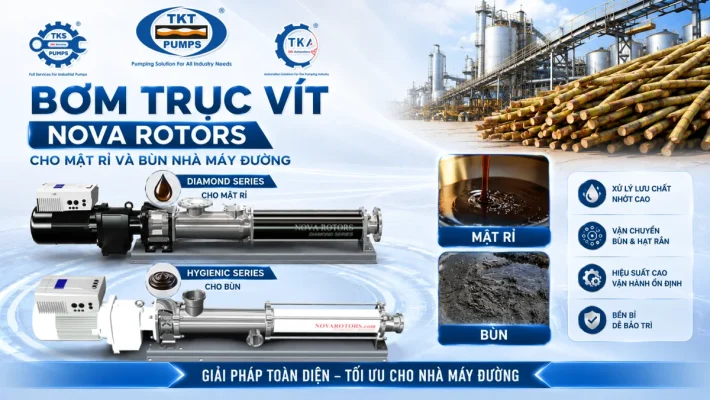
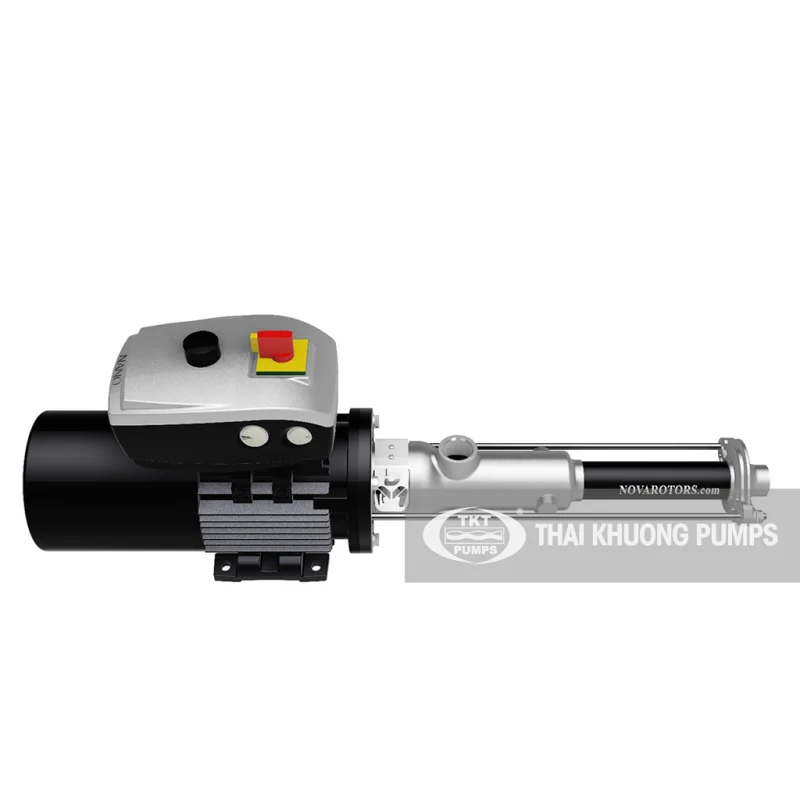
Nova Rotors (Italy) is a specialist manufacturer of progressive cavity pumps, wobble pumps, metering pumps, and grinders. The Diamond range achieves flow rates up to 420 m³/h, pressure up to 48 bar, handles solid content up to 28%, and operates with very high viscosity fluids (the sanitary twin-screw variant up to 1,000,000 cps at pressures up to 25 bar). The Diamond series includes DN-JN standard multi-purpose models (solid content up to 18%), DH-JH with a hopper for thick products (up to 28%), HE with hopper and trolley for food and wine, DV vertical-shaft for high-viscosity fluids and environmental applications, DX-JX sanitary models meeting EHEDG/3A with CIP/SIP capability, and XF with a titanium body for severely corrosive environments. Also available are the wobble R/RL range, metering pump DM, and twin-screw grinders. TKT advises on rotor-stator pairing and elastomer selection (NBR/EPDM/Viton) to match each specific fluid.
Frequently Asked Questions
Are a progressive cavity pump and an eccentric screw pump the same thing?
+
Yes. “Bơm trục vít lệch tâm” is the Vietnamese term for a progressive cavity pump, also referred to as a cavity pump or single-screw pump. All three names refer to the same type of positive displacement pump with a helical rotor rotating eccentrically inside a rubber stator.
Why must a progressive cavity pump never run dry?
+
The fluid acts as lubricant and coolant between the steel rotor and the rubber stator. When run dry, direct friction heats and burns the stator elastomer within a very short time, causing the rotor-stator pair to fail. It is therefore essential to ensure fluid is always present in the pump during operation.
Can a progressive cavity pump handle high-viscosity fluids and fluids with solids?
+
Yes. This is a key capability of this pump type. The Nova Rotors Diamond series handles very high viscosity and solid content up to 28% with the DH-JH hopper variant. For fluids with large solids, a twin-screw grinder can be integrated to reduce particle size before pumping.
Which rubber stator material should I select?
+
Selection depends on the fluid: NBR for oils and petroleum-based fluids, EPDM for water-based chemicals, Viton (FKM) for corrosive or high-temperature environments. Choosing the correct elastomer determines stator service life and chemical compatibility, so the fluid parameters must be clearly defined before ordering the pump.
What is the difference between the progressive cavity range and the wobble range?
+
The standard progressive cavity range uses a helical rotor and a fixed stator, suitable for a wide operating range. The wobble range uses a floating stator, has fewer components and a more compact construction, and is aimed at viscous fluids with light solid content. Nova Rotors offers the wobble R compact and RL separate shaft-end versions.
What are the flow rate and pressure ranges of Nova Rotors pumps?
+
The Nova Rotors Diamond range achieves flow rates up to 420 m³/h and pressure up to 48 bar, handling solid content up to 28% and very high viscosity fluids. To select the appropriate model and configuration for your specific application, please submit your fluid parameters to TKT for technical consultation.
Need advice on selecting the right Nova Rotors progressive cavity pump for your fluid and flow rate? TKT’s technical team, with 19+ years of experience and 12,000+ projects, is ready to assist.
Submit a Consultation Request or hotline 0941.400.488
Source: Nova Rotors (Italy) technical documentation and Diamond/Wobble/Metering range catalogs. Compiled by TKT.