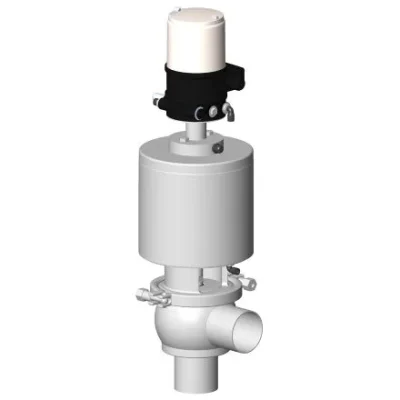




The sanitary butterfly valve is a hygienic shut-off valve for food, dairy, beverage, and pharmaceutical pipelines, featuring an SS316L body, no dead zones, food-grade seals, and clean-in-place (CIP/SIP) capability. The Definox DPX/DPX3 butterfly valve series (France) serves shut-off and flow diversion duties, covering a size range of DN8–150, with clamp/weld/threaded connections, EPDM/FKM/PTFE seals, manual or pneumatic actuation, and the optional Sorio control head for position feedback — meeting EHEDG/3-A standards per product line.
- Sanitary butterfly valve = fast shut-off, compact, cost-effective for F&B pipelines
- Definox DPX/DPX3: SS316L body, EPDM/FKM/PTFE seals, DN8–150
- Clamp, weld, or threaded connections; manual or pneumatic actuation
- Sorio head for valve position feedback + automated CIP process control
- EHEDG/3-A hygiene certification per product line; clean-in-place without dismounting
What Is a Sanitary Butterfly Valve and When to Use It?
Definition and Role in the Production Line
The sanitary butterfly valve (hygienic butterfly valve) is a shut-off valve that uses a disc rotating around a central shaft inside the valve body. When the disc rotates 90 degrees, the flow is quickly opened or closed. Unlike standard industrial butterfly valves, the sanitary butterfly valve is engineered for food and pharmaceutical service: body and disc in SS316L, smooth surfaces with no dead zones, self-draining design, and seals made from food-contact-grade materials.
These characteristics allow the sanitary butterfly valve to meet the stringent hygiene requirements of the dairy, soft drink, brewing, juice, edible oil, cosmetics, and pharmaceutical industries. The valve supports clean-in-place (CIP) and sterilize-in-place (SIP) without disassembly, reducing contamination risk and shortening cleaning time between production batches.
The butterfly valve is a suitable choice when fast shut-off is required, installation space is limited, and budget optimization is a priority. It is the common valve type for pipelines carrying thin to medium-viscosity fluids where the higher pressure ratings of ball valves are not required.
Definox DPX/DPX3 Butterfly Valve: Technical Specifications
Configuration and Selection Range
The Definox DPX and DPX3 butterfly valve series is designed for shut-off and flow diversion duties in sanitary pipelines. The valve offers a wide size range with multiple connection, seal, and actuation options to suit each installation position.
| Parameter | DPX/DPX3 Butterfly Valve Specification |
|---|---|
| Function | Shut-off and flow diversion |
| Body material | AISI 316L stainless steel, smooth surface with no dead zones |
| Size range | DN8 to DN150 |
| Connection | Clamp, weld, or threaded |
| Seal material | EPDM, FKM, or PTFE |
| Actuation | Lever or pneumatic |
| Automation | Optional Sorio control head with position feedback |
| Hygiene standard | EHEDG, 3-A per product line |
Seal material selection depends on the fluid: EPDM suits aqueous fluids and hot steam; FKM handles oils, fats, and certain solvents; PTFE offers resistance to chemicals and a wide temperature range. Clamp connections enable quick disassembly for cleaning and maintenance, while weld connections are appropriate for permanently fixed pipe sections.
Comparing Sanitary Butterfly Valves and Ball Valves
Selecting the Valve Type by Fluid Characteristics
Both butterfly and ball valves serve shut-off duties, but each type has its own strengths. The table below helps pipeline engineers make an initial selection before reviewing detailed technical requirements.
| Criterion | Butterfly Valve DPX/DPX3 | Ball Valve DBX |
|---|---|---|
| Primary duty | Fast shut-off and flow diversion | Tight shut-off, higher pressure rating |
| Size | Compact, space-saving | Larger than an equivalent butterfly valve |
| Working pressure | Suitable for thin to medium-viscosity fluids | Up to 20 bar; viscous or particle-laden fluids |
| Cost | Cost-effective for standard shut-off duty | Higher; for specialized requirements |
In practice, sanitary butterfly valves account for the majority of shut-off positions in dairy, water, and thin-fluid pipelines. Ball valves are used where tight sealing, viscous or particle-laden fluids, or higher pressures are required. Combining both valve types on the same production line is a common arrangement to optimize cost and reliability.
Automation and Clean-in-Place with the Sorio Head
Position Feedback and CIP Integration
When a production line requires automation, the DPX butterfly valve can be fitted with the Sorio control head. The Sorio head provides valve position feedback so the central control system knows whether the valve is open or closed, while also supporting automatic coordination of the CIP process.
The Sorio head supports AS-i and IO-Link communication protocols, provides IP67 protection rating, and offers an ATEX option for hazardous areas. This allows automation engineers to monitor the status of each valve, schedule cleaning cycles, and record operating data for traceability — a requirement that is increasingly common in food and pharmaceutical plants.
Integrating a control head into the butterfly valve reduces manual operations, minimizes valve open/close errors during CIP cycles, and shortens downtime. This represents the transition from manual operation to batch or continuous automated plant operations.
Installation and Maintenance Notes for Sanitary Butterfly Valves
Extending Service Life and Maintaining Hygiene Standards
To ensure stable operation and maintain hygiene standards for sanitary butterfly valves, the following points should be observed during installation and maintenance:
| Item | Recommendation |
|---|---|
| Mounting orientation | Install to allow self-draining; avoid fluid pooling at the pipe bottom |
| Seals | Select EPDM/FKM/PTFE matched to the fluid; inspect at regular intervals |
| Cleaning | Apply CIP/SIP routinely without removing the valve |
| Clamp connection | Check clamp torque and clamp seal to prevent leakage |
| Spare parts | Stock seals and valve discs for fast replacement |
Seals are wear components that require close monitoring because they directly affect leak-tightness and food safety. Having replacement spare parts on hand helps reduce production line downtime during maintenance. TKT Pumps supplies genuine seals and spare parts for the Definox valve range.
DEFINOX · FRANCE Definox Sanitary Valves at TKT Pumps
Definox is a French sanitary valve manufacturer serving the food, beverage, and pharmaceutical industries with SS316L bodies and EHEDG/3-A hygiene standards. The Definox range includes butterfly valves DPX/DPX3, ball valve DBX, diverter valves DCX4/DMX, check valve CAR, mixproof valve groups VEOX/NEOS, regulating valve DCX3, the Sorio control head, and the Starmotion pigging system. TKT Pumps is the authorized distributor of Definox in Vietnam, offering valve selection advisory, genuine seals and spare parts, and 24/7 technical support.
Frequently Asked Questions about Sanitary Butterfly Valves
How does a sanitary butterfly valve differ from a standard industrial butterfly valve?
+
Sanitary butterfly valves use an SS316L body and disc, smooth surfaces with no dead zones, self-draining design, and food-grade seals, allowing CIP/SIP procedures. Standard industrial butterfly valves do not meet these hygiene requirements and are therefore not suitable for food or pharmaceutical applications.
What size range is available for the Definox DPX butterfly valve?
+
The Definox DPX/DPX3 butterfly valve series covers sizes from DN8 to DN150, with clamp, weld, or threaded connection options, suitable for most sanitary pipelines in food and pharmaceutical plants.
Which seal should I choose — EPDM, FKM, or PTFE — for a butterfly valve?
+
EPDM suits aqueous fluids and hot steam; FKM handles oils, fats, and certain solvents; PTFE offers resistance to chemicals and a wide temperature range. Seal selection depends on the fluid type, temperature, and hygiene requirements of each application.
When should a ball valve be used instead of a butterfly valve?
+
The sanitary ball valve DBX is appropriate when tight sealing, viscous or particle-laden fluids, or higher working pressures are required — ball valves can handle up to 20 bar. Butterfly valves are suitable for fast shut-off of thin to medium-viscosity fluids at a more cost-effective price point.
Can the Definox butterfly valve be automated?
+
Yes. The DPX butterfly valve can be fitted with the Sorio control head for valve position feedback and automated CIP process control. The Sorio head supports AS-i and IO-Link, provides IP67 protection, and offers an ATEX option for hazardous areas.
What hygiene standards does the sanitary butterfly valve meet?
+
The Definox DPX/DPX3 butterfly valve series meets EHEDG and 3-A standards per product line. These are international hygiene standards for food-contact equipment, ensuring a cleanable design that does not allow bacterial buildup.
Need advisory on selecting the right sanitary butterfly valve size, seal material, and automation configuration for your production line?
Submit an Advisory Request or hotline 0941.400.488
Source: Definox (France) technical documentation on the DPX/DPX3 sanitary butterfly valve, compiled by TKT.