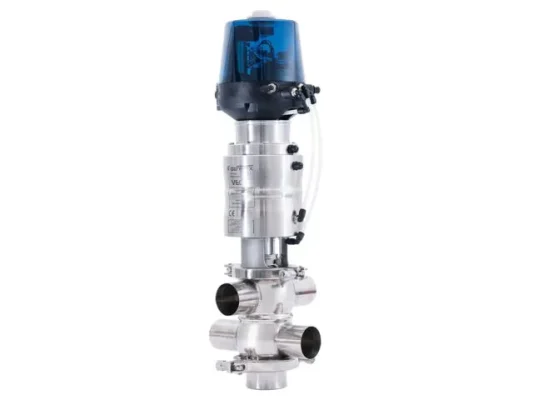




A hygienic ball valve is a shut-off valve that uses a 90-degree rotating spherical ball, providing full sealing capability and higher pressure resistance than a butterfly valve — suitable for high-pressure pipelines, viscous fluids, or particle-laden fluids in the F&B and pharmaceutical industries. The Definox DBX (France) hygienic ball valve range is manufactured from AISI 316L stainless steel with food-grade seals, certified to EHEDG/3-A, available in DN8–150 and rated to 20 bar, with clamp/weld/threaded connections, and manual or pneumatic actuation.
- Hygienic ball valve = 90° rotating ball, full shut-off, full-bore opening
- Rated to 20 bar — higher than butterfly valves, suitable for high-pressure pipelines
- AISI 316L stainless steel body, food-grade seals, EHEDG/3-A certified
- DN8–150 range, clamp/weld/threaded connections, manual or pneumatic actuation
- Suitable for viscous fluids, particle-laden fluids, and products prone to deposit build-up
What Is a Hygienic Ball Valve and How Does It Differ from an Industrial Ball Valve?
Construction and Hygienic Features
A ball valve opens and closes using a spherical ball with a bore through its centre, rotating 90 degrees to allow or block flow. When fully open, the bore is nearly equal to the pipe diameter, resulting in low resistance and stable flow. The distinguishing feature of a hygienic ball valve compared to a standard industrial ball valve lies in its sanitary requirements: the body and wetted surfaces are AISI 316L stainless steel, with a low surface roughness, a design that minimises dead pockets, food-grade seals, and the ability to clean-in-place (CIP) or sterilise-in-place (SIP).
Because the ball seals the entire cross-section when closed, ball valves provide tighter shut-off and withstand higher pressures than butterfly valves. This is why hygienic ball valves are typically selected for pipeline sections that require reliable shut-off at high pressure, or where the fluid is viscous or contains solid particles that could jam other valve types.
| Criterion | Industrial Ball Valve | DBX Hygienic Ball Valve |
|---|---|---|
| Body material | Cast iron, steel, SS304 | AISI 316L stainless steel |
| Internal surface | May trap deposits | Smooth, minimal dead pockets |
| Seals | Industrial grade | Food grade (EPDM/FKM/PTFE) |
| Cleaning | Manual disassembly | CIP/SIP compatible |
| Certification | Application-specific | EHEDG/3-A |
Definox DBX Hygienic Ball Valve: Specifications and Capabilities
Key Technical Specifications
The Definox DBX hygienic ball valve range is designed for tight shut-off duties in food, beverage, and pharmaceutical processing lines. The valve body is AISI 316L stainless steel; seals are available in EPDM, FKM, or PTFE depending on the fluid and temperature. The range covers DN8 to DN150 and is rated to 20 bar — a higher pressure rating than the corresponding butterfly valve family, making it suitable for high-pressure pipeline sections.
For connections, the DBX ball valve is available in clamp (quick-connect), weld, or threaded configurations, providing flexibility for integration into existing piping systems. The actuator can be a lever handle or pneumatic head for integration into automated control systems. Depending on the variant and configuration, the valve meets EHEDG and 3-A hygienic standards.
| Parameter | Definox DBX Ball Valve |
|---|---|
| Function | Tight shut-off, 90° rotation |
| Body material | AISI 316L stainless steel |
| Size range | DN8 – DN150 |
| Working pressure | Up to 20 bar |
| Seals | EPDM / FKM / PTFE |
| Connection | Clamp / weld / threaded |
| Actuation | Manual or pneumatic |
| Certification | EHEDG / 3-A (depending on variant) |
When to Choose a Ball Valve vs. a Butterfly Valve?
Comparison to Select the Right Valve for the Application
Hygienic butterfly valves (such as the Definox DPX/DPX3 range) are compact, lightweight, cost-effective, and fast-acting — a familiar choice for most medium-pressure pipelines handling thin fluids. However, when the pipeline operates at high pressure or the fluid is viscous or contains solid particles, ball valves provide better sealing and mechanical durability, because the ball seals the full cross-section when closed and the bore is fully open when in service.
| Factor | Butterfly Valve (DPX/DPX3) | Ball Valve (DBX) |
|---|---|---|
| Suitable pressure | Medium pressure | High pressure (up to 20 bar) |
| Fluid | Thin fluids | Viscous, particle-laden fluids |
| Sealing | Good | Full shut-off |
| Flow resistance when open | Disc remains in flow path | Full bore |
| Cost & weight | Low, compact and lightweight | Higher |
A simple principle: favour butterfly valves for fast, economical shut-off on medium-pressure pipelines; choose ball valves when high sealing integrity is required, when operating at high pressure, or when pumping viscous fluids and particle-laden fluids that could erode or jam the butterfly disc.
Typical Applications of Hygienic Ball Valves
Installation Points in the Processing Line
Hygienic ball valves are typically installed at points requiring reliable shut-off at high pressure: the discharge side of high-pressure pumps, concentrated-product transfer lines, viscous raw material feed lines, or pipeline sections pumping particle-laden fluids such as fruit jams, sauces, and suspensions. In the dairy, beverage, brewing, edible oil, and pharmaceutical industries, ball valves ensure leak-free isolation between batches and withstand repeated CIP/SIP cycles.
When integrated with a pneumatic head and automation controller, the ball valve becomes a shut-off element within the plant’s automated system, working alongside other Definox valve families such as butterfly shut-off valves, mixproof valves, and aseptic sampling valves to form a complete hygienic piping line.
DEFINOX · FRANCE DBX Hygienic Ball Valve in the Definox Valve Range
Definox (France) specialises in hygienic valves for the food, beverage, and pharmaceutical industries, with AISI 316L stainless steel bodies and EHEDG/3-A hygienic certifications. In addition to the DBX ball valve, the Definox range includes butterfly and divert valves (DPX/DPX3, DCX3/DCX4), mixproof valves (VEOX/NEOS/VDCI MC), control and safety valves, the Sorio automation head, the Starmotion pigging system, and aseptic sampling valves (PEX/PEAX/PEV). TKT is the Definox distributor in Vietnam, providing support for selecting seal materials, connection types, and actuator configurations to suit each processing line.
Frequently Asked Questions About Hygienic Ball Valves
What is the maximum working pressure of a hygienic ball valve?
+
The Definox DBX hygienic ball valve range is rated to 20 bar working pressure, higher than the corresponding butterfly valve family. This pressure rating is suitable for high-pressure pipelines, pump discharge lines, and viscous-product transfer lines in F&B and pharmaceutical plants.
Should I choose a hygienic ball valve or a butterfly valve?
+
Choose a butterfly valve for fast, compact, and economical shut-off on medium-pressure pipelines handling thin fluids. Choose a ball valve when high sealing integrity is required, when operating at high pressure, or when the fluid is viscous or contains solid particles that could jam the butterfly disc.
What sizes are available for the DBX ball valve?
+
The Definox DBX ball valve covers DN8 to DN150, accommodating everything from small branch lines to main pipelines. Connections can be specified as clamp, weld, or threaded to match the existing piping system.
Can hygienic ball valves be cleaned with CIP/SIP?
+
Yes. Hygienic ball valves use AISI 316L stainless steel, food-grade seals, and a design that minimises dead pockets, making them compatible with clean-in-place (CIP) and sterilise-in-place (SIP). Depending on the variant, the valve meets EHEDG and 3-A hygienic standards.
What seal materials are used in the DBX ball valve?
+
Definox ball valve seals are available in EPDM, FKM, or PTFE depending on the fluid and working temperature. TKT provides technical support to select the appropriate seal material based on the chemical compatibility, temperature, and certification requirements of each processing line.
Can the DBX ball valve be operated automatically?
+
Yes. The DBX ball valve can be actuated by a lever handle or a pneumatic head. When automation is required, the valve can be fitted with a control head for position feedback and CIP cycle coordination, connecting into the plant’s central control system.
Need to select the right hygienic ball valve for your processing line — the correct pressure rating, size, and seal material? TKT’s technical team, with 19+ years of experience and over 12,000 projects, is ready to assist.
Submit a Consultation Request or call hotline 0941.400.488
Source: Definox (France) technical documentation on the DBX hygienic ball valve; compiled by TKT.