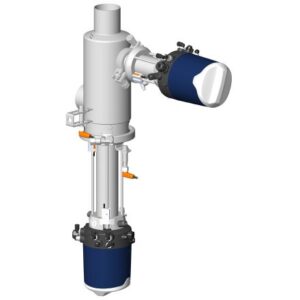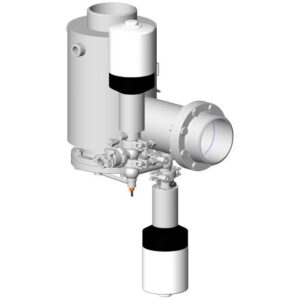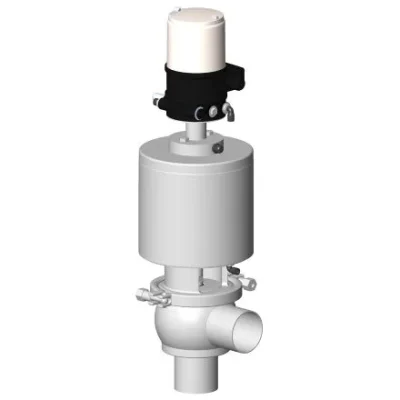




An aseptic sampling valve is a specialized hygienic valve designed to withdraw a small quantity of product directly from a pipeline or tank for quality control (QC) inspection, without cross-contaminating the sample and without stopping the production line. For food, beverage, and pharmaceutical applications, the Definox range includes PEX/PEAX for liquids, PEV for solid and powder products, and DMX-PE in diaphragm configuration — all in AISI 316L stainless steel, dead-leg-free, self-draining, and compliant with 3-A/EHEDG hygienic standards.
- In-line/in-tank QC sampling without disassembly or process shutdown.
- Aseptic design: 316L stainless steel, dead-leg-free, self-draining, food-grade seals, CIP/SIP cleanable.
- PEX/PEAX for liquid media; PEV for solids/powders; DMX-PE uses a diaphragm to isolate the fluid.
- Cross-contamination control between sampling events — compliant with 3-A, EHEDG, and FDA standards.
- Solution provider: Definox (France) sampling valve range distributed and supported by TKT.
What Is an Aseptic Sampling Valve and Why Is It Necessary?
Hygienic Sampling to Ensure Reliable QC Results
In food, beverage, and pharmaceutical plants, every product batch must be sampled to verify microbiological, physicochemical, and organoleptic parameters. When standard valves or open-handling procedures are used, samples can easily be contaminated by the environment, by residual fluid retained in the valve body from a previous sampling event, or by exposing the running pipeline. The result is skewed QC data and a safety risk for the entire batch.
Aseptic sampling valves address this through a hygienic design: AISI 316L stainless steel body, smooth dead-leg-free surfaces, self-draining geometry to prevent fluid retention, and a sampling port that can be steam-sterilized (SIP) or cleaned in place (CIP) between sampling events. Each sample therefore accurately represents the product in the pipeline, free of carry-over from previous samples and external cross-contamination.
| Criterion | Standard Valve | Aseptic Sampling Valve |
|---|---|---|
| Contact material | Varied, may not comply | 316L stainless steel, food-grade seals |
| Dead legs / fluid retention | Typically present | Dead-leg-free, self-draining |
| Sampling port sterilization | Difficult or not possible | CIP/SIP capable |
| Cross-contamination risk | High | Controlled |
| Hygienic standard | Not defined | 3-A, EHEDG, FDA |
PEX/PEAX, PEV, and DMX-PE: Selection by Product Type
Each Fluid Type Has Its Own Sampling Valve
The state and nature of the product determines the appropriate sampling valve type. Liquid fluids such as milk, fruit juice, beer, and pharmaceutical solutions require one valve configuration; powders or loose granules require a different design to allow the sample to discharge without blockage; while sensitive fluids requiring complete isolation call for a diaphragm type.
| Valve series | Product type | Typical application |
|---|---|---|
| PEX / PEAX | Liquid | Sampling milk, beverages, fermented liquids, pharmaceutical solutions |
| PEV | Solid / powder | Sampling dry raw materials, powders, and granules from silos or conveying lines |
| DMX-PE | Diaphragm | Sensitive fluids requiring complete isolation between the valve mechanism and the product |
All three series share the same aseptic design principle: 316L stainless steel product-contact materials, surfaces that do not provide microbial harboring points, and the ability to clean between sampling events. Selecting the correct series ensures the sample accurately represents the actual product — particularly important for batch traceability.
Aseptic Retention Mechanism and Cross-Contamination Prevention
Self-Draining, In-Place Cleaning, and Fluid Isolation
Cross-contamination during sampling originates from two sources: residual fluid left from the previous sampling event, and the external environment entering when the valve is opened. Aseptic sampling valves control both. Self-draining geometry expels all fluid after each sampling so no carry-over accumulates. CIP/SIP capability allows the sampling port to be flushed or steam-sterilized, restoring aseptic conditions before the next event.
In the DMX-PE diaphragm series, a membrane completely separates the valve mechanism from the product, preventing sensitive fluids from contacting any mechanical components and minimizing contamination risk. Equally important is that sampling occurs without stopping the production line: the valve opens to withdraw the sample then closes again, while the main product flow continues uninterrupted, maintaining throughput and avoiding the need to restart the sterilization process.
Applications in Food, Beverage, and Pharmaceutical Production
From the QC Laboratory to Batch Traceability
In dairy and beverage plants, aseptic sampling valves are installed at storage tanks, downstream of pasteurizers, and upstream of filling stations so the QC laboratory can verify microbiological and physicochemical parameters at each process stage. In pharmaceutical manufacturing, aseptic sampling is a mandatory requirement for GMP quality control, particularly for injectable solutions and active pharmaceutical ingredients (API), where any cross-contamination is unacceptable.
For dry raw materials such as milk powder, sugar, and additives, the PEV series enables direct sampling from silos or conveying lines without compromising the system’s closed conditions. When integrated with hygienic shutoff valves and mixproof valves in a shared CIP assembly, the sampling valve becomes a complete link in a closed-loop production line, serving both quality control and batch traceability documentation.
DEFINOX · FRANCE Aseptic Sampling Valves for Hygienic Process Lines
Definox (France) specializes in hygienic valves for the food & beverage and pharmaceutical industries. Within the sampling range, the product offering includes PEX/PEAX for liquids, PEV for solid and powder products, and DMX-PE in diaphragm configuration. All use AISI 316L stainless steel, food-grade EPDM/FKM/PTFE seals, dead-leg-free self-draining design, and CIP/SIP compatibility, meeting 3-A and EHEDG standards. These sampling series are part of the Definox hygienic valve ecosystem alongside butterfly valves, ball valves, mixproof valves, and Sorio actuators — convenient when synchronizing an entire valve assembly. TKT is the Definox distributor in Vietnam, providing support for series selection, connection configuration, and integration into existing CIP systems.
Frequently Asked Questions About Aseptic Sampling Valves
How does an aseptic sampling valve differ from a standard sampling valve?
+
Aseptic sampling valves use 316L stainless steel, dead-leg-free surfaces, self-draining geometry, and CIP/SIP support for sterilization between sampling events. This ensures samples are free of cross-contamination from residual fluid or external sources, in compliance with 3-A and EHEDG standards. Standard sampling valves do not guarantee these attributes, which can lead to inaccurate QC results.
Does sampling require stopping the production line?
+
No. Aseptic sampling valves are designed to withdraw a small quantity of product directly from the pipeline or tank while the main flow continues. The valve opens for sampling then closes again, without exposing the system and without requiring the sterilization process to be restarted, maintaining productivity.
Which should I choose — PEX/PEAX, PEV, or DMX-PE?
+
Select based on product type: PEX/PEAX for liquids such as milk, beverages, and pharmaceutical solutions; PEV for solid and powder products such as milk powder, sugar, and additives; DMX-PE diaphragm type when complete isolation of sensitive fluids from the valve mechanism is required. TKT can advise on the appropriate series based on fluid type and installation conditions.
Which hygienic standards do Definox sampling valves meet?
+
Definox sampling valve series use AISI 316L stainless steel with dead-leg-free, self-draining, CIP/SIP-compatible design, meeting 3-A and EHEDG hygienic standards. Product-contact seals use food-grade materials such as EPDM, FKM, or PTFE in compliance with FDA requirements.
Can sampling valves be CIP-cleaned as part of the equipment assembly?
+
Yes. The sampling port supports clean-in-place (CIP) and steam-in-place (SIP) sterilization, so it can be incorporated into the line’s general cleaning cycle. When combined with Definox hygienic shutoff valves and mixproof valves, the entire assembly is cleaned synchronously, facilitating operation and quality control.
Does TKT support integration of sampling valves into existing systems?
+
Yes. With over 19 years of experience and 12,000+ projects, TKT provides support for Definox sampling valve series selection, advice on clamp/weld/threaded connections, and integration into existing CIP systems, pipelines, or tanks in operation. Contact the TKT technical team for a site assessment and configuration recommendation.
Source: Definox (France) hygienic valve technical documentation — PEX/PEAX/PEV/DMX-PE sampling valve series; compiled by TKT.