













Metering pumps come in several types — piston metering pumps, diaphragm metering pumps, hydraulic metering pumps, and electronic metering pumps — all capable of pumping liquids with high precision and adjusting the composition of the fluid to the user’s requirements.
What is a metering pump
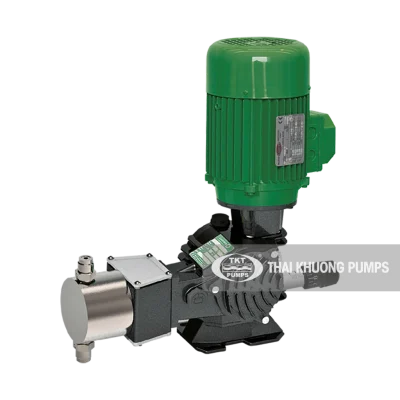
A metering pump is a small-sized positive-displacement pump designed to inject liquids or chemicals with high accuracy into water, steam, or gas. The operating principle of a metering pump is to draw a precisely measured volume of liquid into a chamber and then discharge that volume into a pipeline or tank. In industry, metering pumps are indispensable in automated chemical dosing processes and are widely used across sectors ranging from wastewater treatment to food processing, agriculture, and pharmaceuticals.
Metering pumps are driven by small electric motors or pneumatic drives. They can be operated by an external control system (automatic) or by the pump’s own built-in system (manual). On the control side, users can freely adjust the pump’s operation to suit their needs — including flow rate, pump run time, dry-run alarm, degassing, and flow quality monitoring.
Types of industrial metering pumps
There are 4 common types of metering pumps on the market: piston metering pumps, diaphragm metering pumps, hydraulic metering pumps, and electronic metering pumps. They differ in operating mechanism and are suited to a wide range of applications, pressures, and chemicals.
Piston metering pump
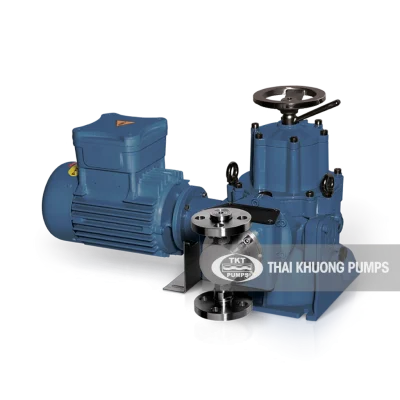
This type has a pump chamber operated by a piston and diaphragm, with integrated check valves at the inlet and outlet. When the chamber is filled with liquid by retracting the piston, the volume of liquid corresponding to the set dosage is pumped into the main flow at a consistent flow rate. This pump type is highly accurate and delivers a nearly constant flow rate in the range of 6–250 l/h.
Piston metering pumpDiaphragm metering pump
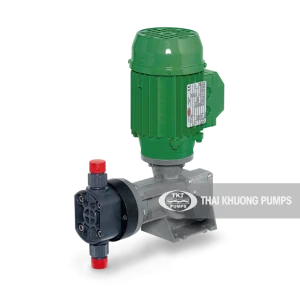
This pump type uses a diaphragm mechanism controlled by a solenoid coil that draws and discharges chemicals in pulses; the interval between pulses determines the flow rate. This metering pump type does not achieve the same accuracy as other types because the liquid must be pumped in pulses and is limited by the time between injections into the main flow. An additional characteristic is its simple mechanical construction, low energy consumption, and low cost.
Diaphragm metering pumpHydraulic metering pump
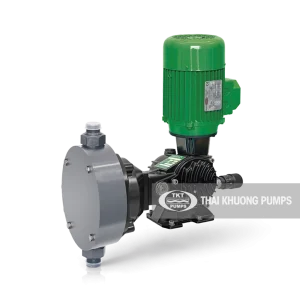
This type has an operating mechanism driven by a piston that functions as a hydraulic cylinder. The hydraulic metering pump combines two notable characteristics: the high-pressure capability of a piston metering pump and the tight sealing of a diaphragm metering pump. The pump chamber is divided into two sections by a flat partition (the pump diaphragm) made of rubber or plastic. The first section is the auxiliary chamber, located between the diaphragm and the piston, and is filled with oil. Displacement of the piston causes a corresponding deformation of the diaphragm. The second section is the main chamber, located between the pump head and the diaphragm, and functions as the diaphragm pump chamber. Movement of the diaphragm generates suction or discharge force on the pumped liquid.
Hydraulic metering pumpElectronic metering pump
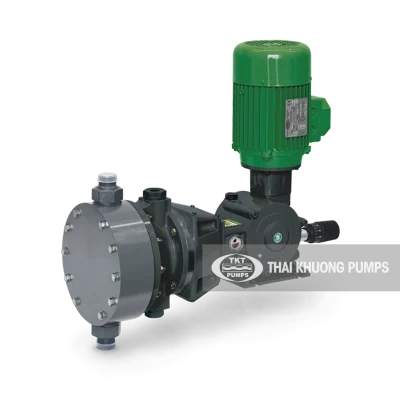
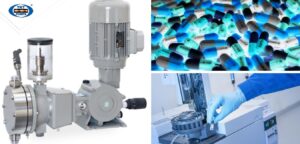
This type of metering pump comes in two control modes: automatic and manual. The automatic metering pump includes a sensor module that enables the pump to send a signal to the controller when the chemical dosage is insufficient or exceeds the set level. The manual chemical metering pump typically includes a flow-rate adjustment knob, allowing users to easily set the desired flow rate.
Electronic metering pumpWorking principle of metering pumps
Metering pumps come in many types, each with its own operating method, which will be discussed in the sections below. In general, however, the common working principle of a metering pump is to draw a measured volume of liquid into a chamber and then pump that chemical into a pipeline or tank that is being dosed.
# First: The pump begins the self-priming process; the unit automatically draws liquid in to fill the pump chamber.
# Next: Once the pump chamber is filled with chemical, the pump opens the check valve and draws liquid in, then closes the valve to complete the suction stroke.
# Then: Once the liquid in the chamber has been metered, the pump opens the check valve and pushes the liquid out through the discharge pipe.
# Finally: This is the dosing system control routine — users can operate the pump manually or automatically depending on their requirements.
Construction of metering pumps
*Chemical storage tank: Stores the chemical to be dosed.
*Foot valve: A check valve integrated on the suction line that enables the pump to self-prime. The valve is sometimes fitted with a float switch to alarm on liquid-related faults.
*Pump head: Available in many types that vary in size and material, but the most commonly used materials are chemical-resistant plastics (PVC, PE, or equivalent), rubber, or stainless steel. The pump has one suction port at the inlet and a dosing tube connected at the suction port. Users should note that pump head mechanisms may vary.
*Dosing tube: Typically rigid PVC or PE tubing, or reinforced tubing. In applications involving steam, hot water, or very high pressures, stainless steel tubing may be used. Users may also fit a range of pressure-relief valves and air-release valves along the dosing line.
*Injection point: At the location where the dosed liquid is injected into the main flow, there is an injection point — commonly considered a check valve — so that when the pump discharges a metered volume of liquid into the pipeline, it can overcome the pressure in the distribution line and allow the liquid to enter the flow stream. Once the pump stops, the check valve prevents the pumped liquid from flowing back into the dosing tube, avoiding potential pump damage.
*Control system: Typically, a control system is installed directly on the metering pump to ensure accurate operation and to switch the pump on/off at specific times. This includes pH sensors, chlorine sensors, and flow controllers that can increase or decrease the dosing level.
Metering pump installation
First, users must ensure that all pump components are compatible with the liquid and chemicals to be dosed. Note that highly corrosive liquids or those at high pressure and temperature require metering pump materials specifically suited to the application to prevent melting or corrosion.
Once all components are compatible, users should select a good location for the dosing point. The key point to note is that the pump must be installed so that the liquid can be mixed uniformly without affecting any other pipe components.
Once the dosing point has been determined, users need to install the pump in the appropriate position. Although metering pumps can handle corrosive liquids and chemicals, the units are generally not weather-resistant due to a relatively low IP-rated housing. Therefore, the pump sometimes needs to be protected from water, dust, sunlight, or temperature extremes by installing it in an enclosure or inside a plant building to maximize service life.
Another factor to consider is the liquid storage tank — this relates to the characteristics of the liquid, how much liquid needs to be dosed, and how much liquid needs to be stored at the pump.
The self-priming mechanism of metering pumps
When a metering pump is primed, all air is expelled from the pipeline up to the injection nozzle, after which the pump automatically establishes the required liquid flow rate — or is manually adjusted to do so — after receiving the liquid signal from the inlet.
If there is any issue with the liquid or a fault occurs, the alarm system activates to alert the operator. Similarly, when the liquid supply runs out, the system automatically stops or triggers an alarm.
Thanks to the self-priming function, a metering pump — when set up correctly — will operate smoothly on its own and deliver stable, long-term performance.
Metering pump applications
Beyond water treatment and the food industry, metering pumps — often referred to as chemical metering pumps — are widely used in industrial plants, agriculture, manufacturing facilities, medical laboratories, and mineral mining operations. For example, a metering pump used in the food industry may dose corrosive chemicals or acids into a water tank to neutralize pH, or it may dose chlorine to eliminate bacteria.
Metering pumps can also be used in coagulant applications to drive solids out of liquids or to alter the composition of a substance. They are used to dose chemicals into a stream to produce the desired product in manufacturing applications, and to ensure consistent adhesive or additive ratios in fiberboard production, or to dose brine in meat processing. Metering pumps are also suitable for applications requiring high pressure and temperature, such as dosing boiler feedwater with corrosion inhibitors.
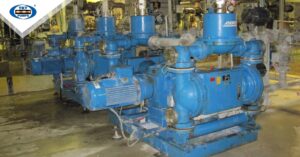
Complete metering pump system for chemical pump applicationsBecause some chemicals can pose a hazard to operators and affect the surrounding environment during pumping, it is necessary to thoroughly review the MSDS data for the chemical in question. It is advisable for users to seek guidance from a technical team or industry specialists to identify the appropriate fluid handling method.
Thái Khương Pumps currently supplies chemical metering pumps from the Doseuro brand, manufactured in Italy, meeting EU and G7 quality standards.
If you have not yet found a suitable drum pump product, or if you have any questions requiring consultation or need technical information and pricing, please contact us immediately.
Thái Khương Pumps is always ready to listen and support you.