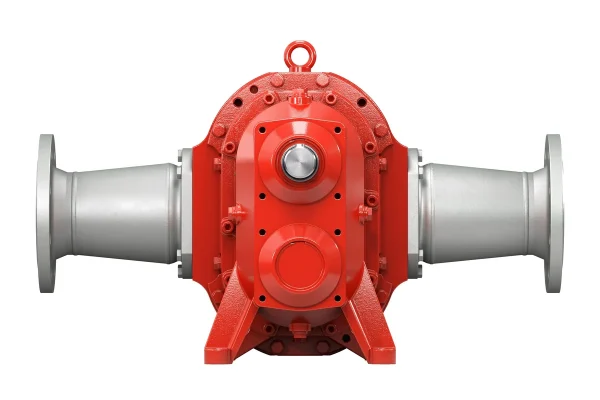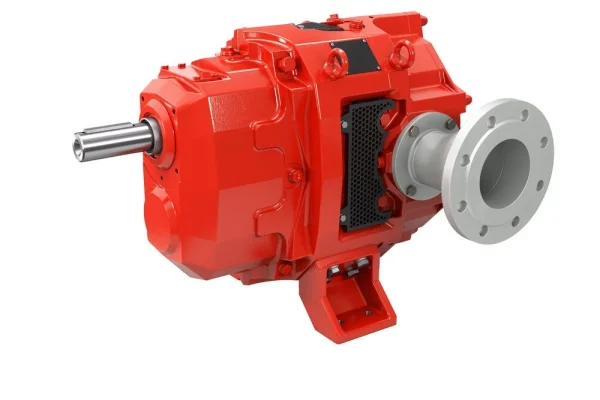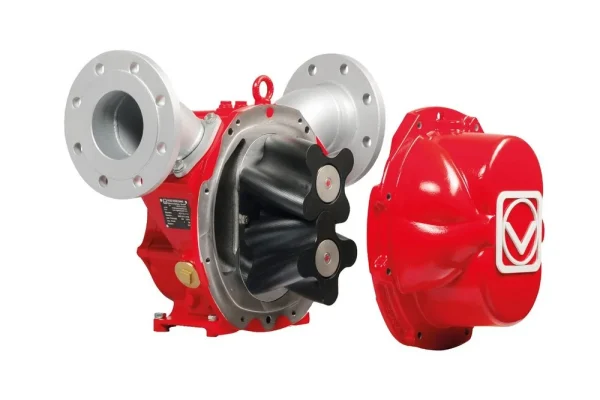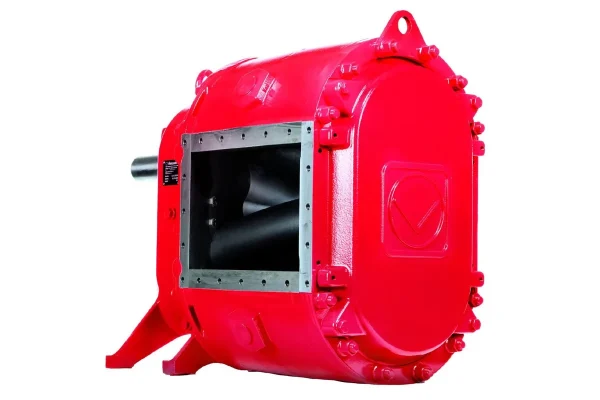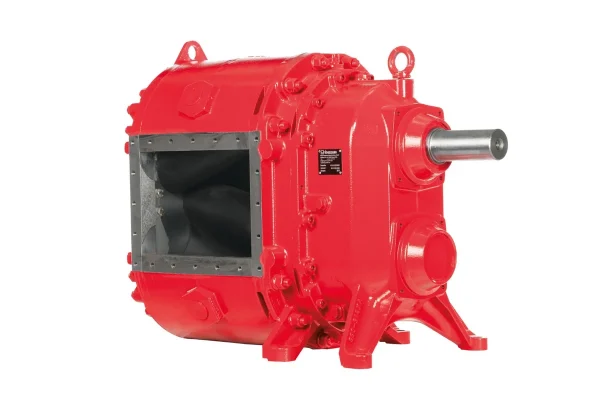


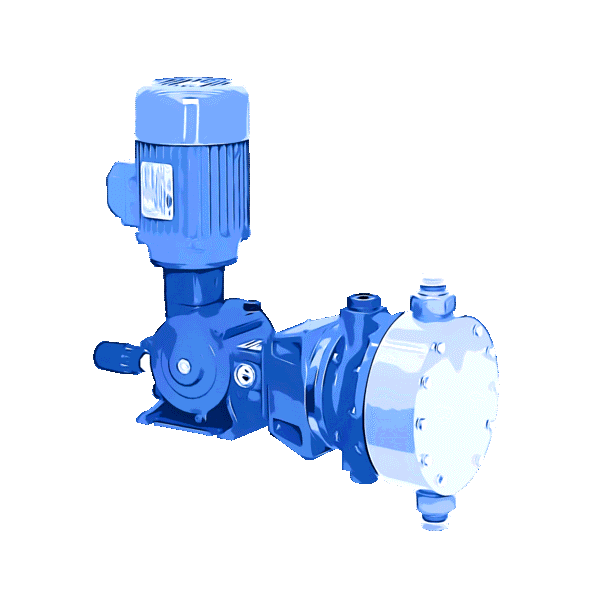




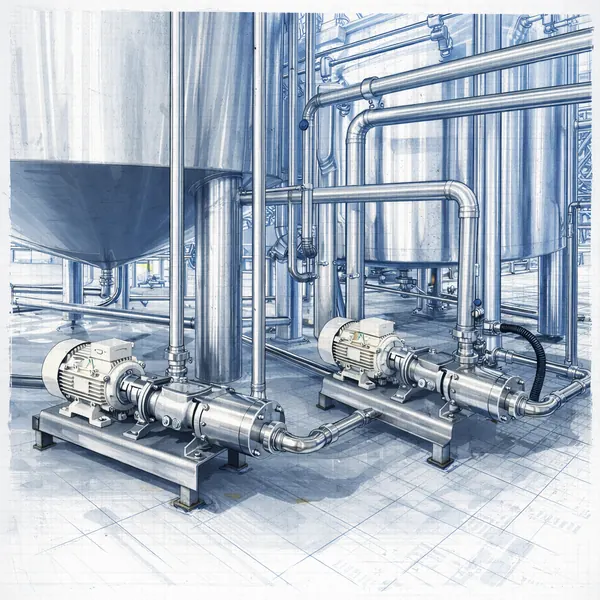

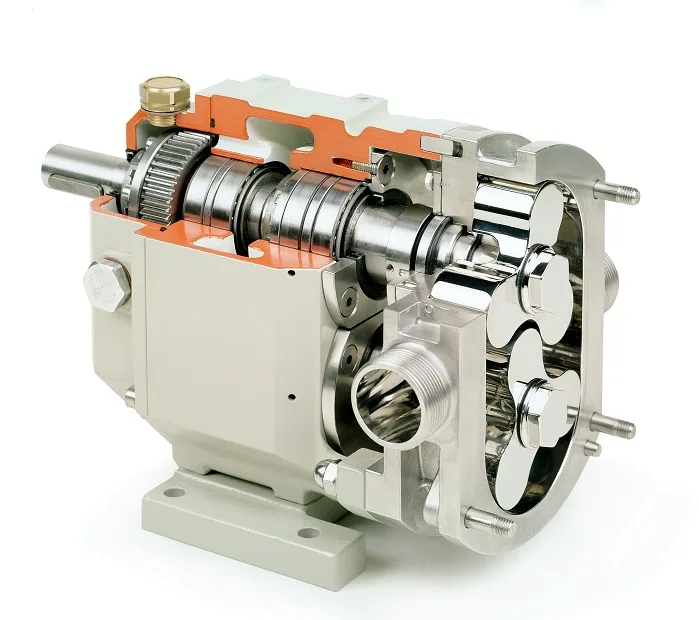
For fluids that are both viscous and shear-sensitive — such as ice cream, sauce, yogurt, butter, or jam — the rotary lobe pump is a suitable choice because its two lobe-shaped rotors rotate synchronously and never contact each other, producing a smooth, low-pulsation flow that minimizes product shear. As a result, gel structures, air bubbles, and solid pieces within the fluid are kept nearly intact. The OMAC B series (Italy) is a rotary lobe configuration with an AISI 316L wetted end designed for food applications, with flow rates up to 315 m³/h and pressures up to 20 bar, supplied and supported by TKT Pumps for the food & beverage and personal-care industries.
- Rotary lobe pump = positive displacement pump, 2 non-contacting lobe rotors → smooth flow, low shear
- Suitable for high-viscosity, shear-sensitive, and particulate fluids: ice cream, sauce, yogurt, butter, jam
- OMAC B: AISI 316L, 17 sizes B100–B680, up to 315 m³/h, pressure up to 20 bar
- Reversible operation, dosing-capable, CIP/SIP cleanable
- Primary wear components: mechanical seal and rotor clearance
Why Shear-Sensitive Fluids Require a Rotary Lobe Pump
Low-Shear Mechanism Preserves Product Structure
The rotary lobe pump belongs to the positive displacement category: two lobe-shaped rotors counter-rotate synchronously via a timing gearbox at the rear, maintaining a very small clearance without touching each other. With each rotation, the chambers between the rotors and the pump casing capture a fixed volume of fluid and transfer it to the outlet, producing a nearly continuous flow.
Unlike a centrifugal pump, which uses high-speed impellers that shear the fluid, lobe rotors turn slowly and displace fluid volumetrically. The shear force acting on the product is low, so sensitive structures — such as fat crystals in butter, the gel network of yogurt, or the emulsion of ice cream and mayonnaise — remain stable. This is why shear-sensitive fluids typically favor rotary lobe pumps over centrifugal pumps.
| Criterion | Rotary Lobe Pump | Centrifugal Pump |
|---|---|---|
| Product shear | Low | High |
| High-viscosity fluid | Suitable | Limited |
| Fluid with solid particles | Handled | Prone to clogging / breakage |
| Flow proportional to speed | Yes | No |
Fluid Types and Suitable Applications
From Ice Cream and Sauce to Yogurt and Fruit Jam
The large pump chamber and smooth flow allow the rotary lobe pump to transfer high-viscosity fluids and fluids containing soft solid pieces with minimal deformation. This makes it suitable for processing stages where sensory quality and product homogeneity must be maintained.
| Fluid Category | Examples | Key Requirement |
|---|---|---|
| Emulsions & creams | Fresh cream, mayonnaise, salad dressing | Low shear, preserve emulsion and aeration |
| Fermented products | Yogurt, sour cream | Preserve gel structure, prevent syneresis |
| Solid fats | Butter, chocolate, cream cheese | Handle high-viscosity fluid, gentle heating |
| Jams & toppings | Chunky fruit jam, pastry filling | Preserve intact pieces, no breakage |
In personal-care manufacturing, the same low-shear mechanism is applied to moisturizing creams, gels, shower gels, and emulsion systems that require consistent smoothness.
OMAC B Series Specifications
Flow Rate, Pressure, and Material Range
The OMAC B series is a rotary lobe configuration with an AISI 316L wetted end mounted on a cast-iron gearbox, available in 17 sizes from B100 to B680. Rotors come in tri-lobe, bi-lobe, or Acteon profiles, paired with various mechanical seal types to match the viscosity and fluid characteristics.
| Parameter | Value |
|---|---|
| Number of pump sizes | 17 sizes (B100–B680) |
| Maximum flow rate | Up to 315 m³/h |
| Maximum pressure | Up to 20 bar |
| Wetted-end material | AISI 316L |
| Rotor profile | Tri-lobe / bi-lobe / Acteon |
The pump operates in both directions, providing flexibility in suction and discharge according to the pipe layout, while also enabling metering based on shaft speed when dosing or blending at fixed ratios is required.
Hygiene, Maintenance, and Configuration Selection
CIP/SIP and Hygienic-Standard Variants
Because the rotors do not contact each other and no lubrication is required inside the pump chamber, the fluid is not contaminated by metal-on-metal friction. The AISI 316L configuration combined with a clean-in-place-compatible design allows integration into food-plant CIP/SIP procedures. The primary wear components to monitor are the mechanical seal and rotor clearance, so the maintenance plan centers on these two items.
For higher hygiene requirements, OMAC offers specialized variants selectable by grade:
| Series | Key Features | Suitable When |
|---|---|---|
| BA / BB | Self-draining, 7KFO seal, BA complies with 3-A, BB per 3-A Std 02-10 | Dairy, yogurt, pharmaceutical, strict CIP/SIP required |
| BE | IEC flange-mounted monobloc, bi-lobe, handles particles 10–19 mm, compact and cost-efficient | Fluid with solid pieces, optimized investment |
| BF | Full stainless steel Tri-Clamp, surface roughness Ra 0.8–2 µm | High surface hygiene, quick disassembly |
| C / CF | EHEDG + 3-A + ATEX, front-pull mechanical seal for quick replacement | Hazardous-area (explosion-proof) zones, rapid maintenance |
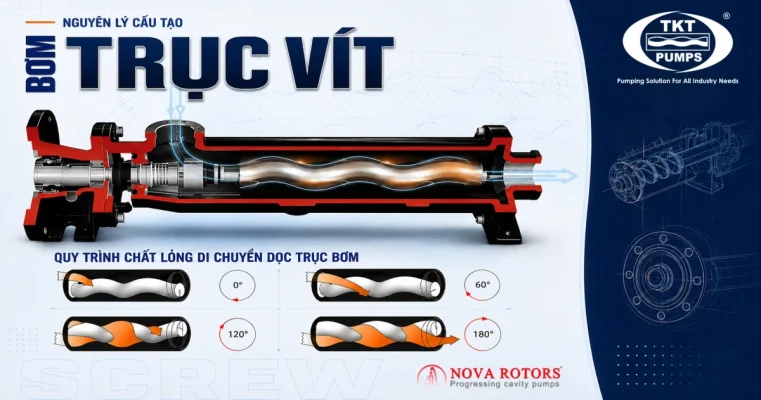
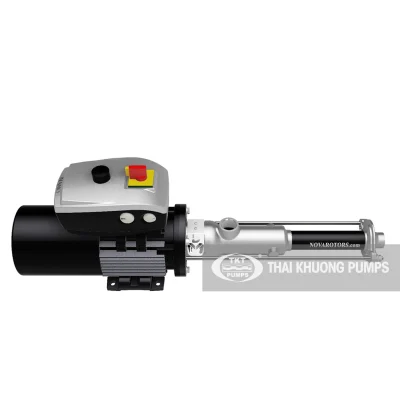
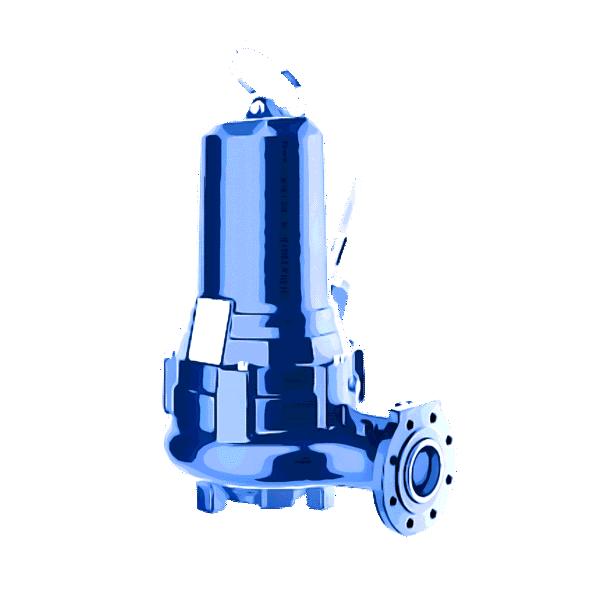
For fluids with viscosity too high for the lobe pump range, an eccentric screw pump is worth considering; for thin fluids at high flow rates, a CSF centrifugal pump remains more economical. Selecting the right pump category should be based on actual viscosity, particle size, and hygiene requirements.
OMAC · Italy Sanitary Rotary Lobe Pump for Shear-Sensitive Fluids
OMAC (Italy) specializes in sanitary rotary lobe pumps with AISI 316L wetted ends for food, beverage, chemical, and personal-care applications. Non-contacting rotors ensure smooth operation, low wear, and product integrity. TKT Pumps is the authorized distributor of OMAC in Vietnam, providing selection support for the B/BA/BB/BE/BF/C/CF series based on fluid characteristics, along with spare parts and 24/7 technical service backed by 19+ years of experience and 28+ brands in the portfolio.
Frequently Asked Questions
Does a rotary lobe pump damage the structure of ice cream, sauce, or yogurt?
+
Lobe rotors turn slowly and displace fluid volumetrically, so shear force is low and the emulsion of ice cream, sauce, or the gel network of yogurt is rarely disrupted. This is why shear-sensitive fluids typically favor rotary lobe pumps over high-speed centrifugal pumps.
What flow rate and pressure does the OMAC B pump achieve?
+
The OMAC B series has 17 sizes from B100 to B680, with flow rates up to 315 m³/h and pressure up to 20 bar, with an AISI 316L wetted end. The specific size is selected based on actual system flow rate, viscosity, and pressure.
Can a rotary lobe pump handle fluids containing fruit pieces or toppings?
+
Yes. The large pump chamber and smooth flow enable transfer of fluids carrying soft solid pieces with minimal breakage. For larger solid particles, the BE monobloc variant handles particles up to 10–19 mm.
Is the OMAC pump CIP/SIP cleanable?
+
The AISI 316L wetted end combined with a hygiene-compatible design allows CIP/SIP integration. The BA/BB variants feature self-draining design per the 3-A standard, while the C/CF variants additionally carry EHEDG certification for stringent hygiene requirements.
Which parts of a rotary lobe pump require regular maintenance?
+
Because the rotors do not contact each other, the two primary components to monitor are the mechanical seal and the rotor clearance. The maintenance plan should focus on inspecting the seal and clearance to maintain performance and leak-tightness.
When should a centrifugal pump be used instead of a rotary lobe pump?
+
For thin, high-flow, non-shear-sensitive fluids, a centrifugal pump such as the CSF series is typically more economical. A rotary lobe pump is appropriate when the fluid is highly viscous, shear-sensitive, or contains particles that must retain their structure.
Need to select the right size and configuration of rotary lobe pump for your viscous, shear-sensitive fluid? The TKT Pumps technical team provides guidance based on actual viscosity, flow rate, and hygiene requirements.
Send a Consultation Request or call hotline 0941.400.488
Source: OMAC (Italy) technical documentation for rotary lobe pumps, B/BA/BB/BE/BF/C/CF series; compiled by TKT Pumps.