




Pumps for the cosmetics industry — creams, gels & shear-sensitive emulsions
Positive-displacement pumps low-shear — lobe, sinusoidal rotor and peristaltic — transferring cream, gel, lotion and emulsion in cosmetics manufacturing: protecting emulsion structure, handling high viscosity and delivering steady feed to filling machines. Product-contact wetted parts inox 316L vi sinh, supporting CIP/SIP for clean product changeover between batches.
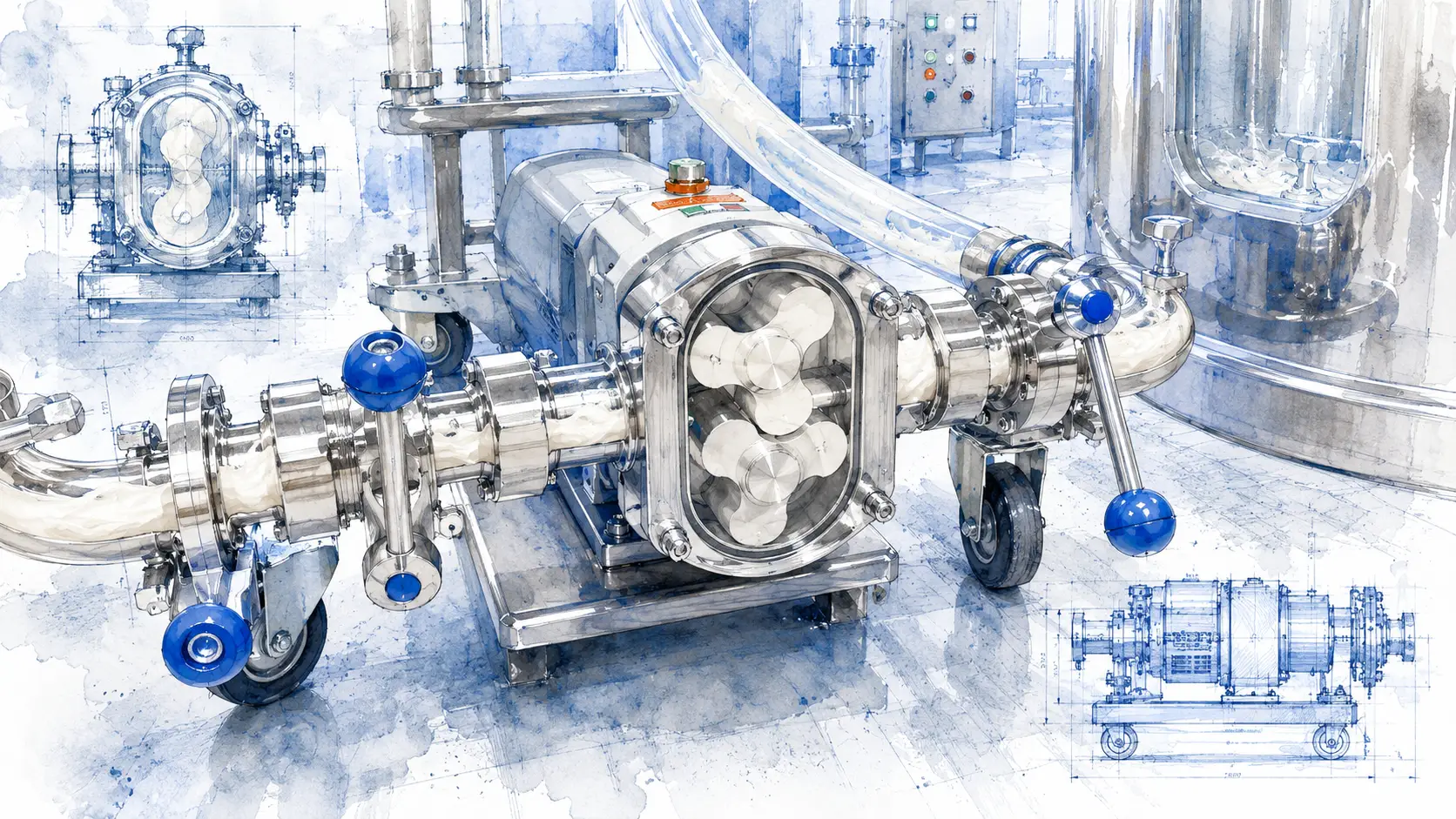
The Vietnamese cosmetics market has reached a size of ~2.4 billion USD (2024) and the domestic OEM/ODM contract manufacturing wave is growing rapidly — production to the standard of cGMP ASEAN (Decree 93/2016/NĐ-CP) requires product-contact equipment to meet hygienic requirements: 316L stainless, CIP, FDA elastomers. (per market report · Ministry of Health — Drug Administration of Vietnam)
Where does the pump fit in the cosmetics manufacturing process?
Each process stage involves different fluids and requirements — from dilute water phase to shear-sensitive high-viscosity cream/gel. The diagram below maps pump types and suggested model series for each pump point; heating/cooling and homogenization are process equipment (not pumps).
Raw liquid material transfer
Water phase, base oil, solvent, dilute surfactant → mixing tank.
Heating oil phase & water phase
~70–80°C to dissolve wax / emulsifier.
Blending & emulsification
Creating fine, stable O/W emulsion — high-pressure homogenization.
Emulsion transfer → aging tank
Shear-sensitive O/W emulsion — low-shear mandatory, gentle circulation.
Viscous semi-finished product transfer
High-viscosity cream / gel → storage tank / filling tank.
Filling machine feed & metering
Steady, pulse-free flow for accurate fill volume.
CIP / product changeover cleaning
Flushing pump + pipelines between batches, meeting hygienic requirements.
7 pump application points in cosmetics manufacturing: raw liquid transfer · warm emulsion transfer · gentle circulation / agitation in aging tanks · viscous semi-finished transfer · filling machine feed · precise metering · CIP/pipeline cleaning. Matching models to each real-world operating point — contact for datasheet
Three challenges in cosmetics manufacturing — and how to address them
Shear-sensitive emulsions, high viscosity of cream/gel, and hygienic requirements during product changeover are three recurring problem groups. Each card below explains the mechanism causing the problem and the corresponding technical approach.
High shear forces disrupt the emulsion
High-speed centrifugal pumps generate intense shear forces that break emulsion droplets → oil–water phase separation, viscosity changes and structural defects in cream/gel.
Positive-displacement pumps low-shear — lobe, sinusoidal rotor, peristaltic — gentle pumping, steady flow with low pulsation, maintaining emulsion structure stability.
High viscosity of thick cream & gel
Centrifugal pumps lack torque for highly viscous fluids (thick cream, paste) → unable to prime/discharge, loss of flow rate and overload.
Progressive cavity pumps (PCP) and sinusoidal rotor pumps handle high viscosity — per CSF manufacturer data, PCP series up to ~800,000 cP, sinusoidal rotor series up to ~1,000,000 cP.
Hygiene & clean product changeover
Rotating mechanical seals and dead zones are difficult to clean — points of leakage & contamination risk; batch/product changeover is prone to cross-contamination of formula, color and fragrance.
Sanitary pumps with CIP/SIP design, quick-release Tri-Clamp connections, low Ra surface finish (OMAC BF: Ra 0.8–2 µm); sealless peristaltic pumps with no dead zones are easy to flush clean.
OMAC lobe pumps & CSF positive displacement pumps for cosmetics
OMAC lobe pumps are the go-to series for transferring shear-sensitive cream/gel/emulsions; CSF adds sinusoidal rotor (SN), progressive cavity (PCP) and MFE metering assemblies. CSF high-viscosity series are currently being updated on the product page — see brand page.

Series B lobe pump — OMAC
Suitable process stage: transferring cream / gel / shear-sensitive emulsion, high viscosity. Q 0.05–200 m³/h depending on viscosity; AISI 316/316L.
View products
3-A hygienic lobe pump Series BA/BB — OMAC
Suitable process stage: sanitary lines, CIP support. 3-A certified — suitable for contact with personal care products.
View products
Full stainless steel lobe pump Series BF/F — OMAC
Suitable process stage: high-sanitary lines, clean product changeover. Tri-Clamp connections, surface finish Ra 0.8–2 µm; pressure up to ~20 bar.
View products
Premium lobe pump Series C/CF — OMAC
Suitable process stage: high-end hygienic applications. EHEDG / 3-A / ATEX certified; pressure up to ~17 bar.
View productsSinusoidal rotor pump — CSF SN
Suitable process stage: shear-sensitive emulsion / cream — smooth flow, no pulsation, no foam; viscosity up to ~1,000,000 cP (per manufacturer data).
View CSF brandCSA sanitary centrifugal pump — CSF
Suitable process stage: water-phase / dilute solution transfer, CIP — high flow rate. EHEDG / 3-A certified, stainless steel 316L.
View productsCSF & OMAC model range, selector by process stage & viscosity
Flow rate / pressure / viscosity data sourced from manufacturer-verified data on Thái Khương Pump's CSF & OMAC pages. Specific operating points (Q × H × viscosity) for each process stage are noted as "contact for datasheet".
| Series / Line | Type | Specifications (per manufacturer data) | Material / certification | Cosmetic application |
|---|---|---|---|---|
| CSF CS / CSA | Sanitary centrifugal | up to ~300–500 m³/h | 316L · EHEDG / 3-A | Water-phase / dilute solution transfer · CIP |
| CSF SN | Rotor sin | viscosity up to ~1,000,000 cP | 316L (rotor) | Shear-sensitive emulsion / cream — low-shear, no foam |
| CSF M-Series | Eccentric screw (PCP) | viscosity up to ~800,000 cP | 316L | Thick cream / paste with very high viscosity |
| CSF MFE | Screw metering assembly | contact for datasheet | 316L | Metering for semi-/automatic filling lines |
| OMAC B | Lobe rotor | 0.05–200 m³/h · up to 20 bar (HP) | AISI 316/316L | Transfer of cream / gel / shear-sensitive emulsion |
| OMAC BF · C/CF | Lobe hygienic | pressure up to ~17–20 bar | Tri-Clamp · Ra 0.8–2µm · EHEDG/3-A | High-sanitary lines, CIP |
| OMAC Peristaltic | Peristaltic (seal-less) | metering ±1% | seal-less | Accurate metering / filling feed |
Pump selection guide by process stage
- Water-phase / dilute solution transfer / CIP (high flow rate): CSF CS / CSA (sanitary centrifugal pump).
- Transfer of shear-sensitive emulsion / cream / gel: CSF SN (sinusoidal rotor) or OMAC lobe B / C / CF.
- Very high viscosity (thick cream, paste): CSF M-Series PCP (~800,000 cP) or SN (~1,000,000 cP).
- Accurate metering / filling feed: OMAC peristaltic (±1%) or CSF MFE assembly.
- Exact model match for each actual operating point — contact for datasheet
Centrifugal or low-shear positive displacement?
Flow-per-hour efficiency for low-viscosity fluids requiring high flow rate (water phase, dilute solutions, CIP). CSF CS / CSA.
Lobe / sinusoidal / peristaltic for shear-sensitive emulsion, high viscosity, metering. Gentle pumping, smooth flow — protects emulsion structure.
Material & sanitary standard selector
Wetted materials
- Inox 316L
- Inox 304
- Titanium
- Hastelloy
- Monel
Wetted parts / body AISI 316L standard; OMAC offers Titanium/Hastelloy/Monel options for corrosive active ingredients — confirm per formulation.
Elastomer / seal
- FKM
- EPDM
- PTFE
- FDA
- USP Class VI
Contact elastomer should comply with FDA / USP Class VI (CSF) for personal care products; select grades compatible with specific active ingredients / solvents.
When to use peristaltic / seal-less
When requiring precision metering and eliminating leak/contamination points, the seal-less peristaltic pump — fluid contacts only the tube — delivers approximately ±1% accuracy (per OMAC) and easy cleaning between batches.
Precise material matching for each cream/gel/solution formulation — contact for datasheet · Chemical Compatibility Guide
Low-shear emulsion protection
Non-contacting lobe rotation, sinusoidal creates smooth flow — reduced shear, preserves O/W emulsion structure, minimizes phase separation and cream/gel texture defects.
Handling high viscosity
PCP and sinusoidal rotor handle highly viscous cream/gel/paste that centrifugal pumps cannot — per manufacturer data up to ~800,000–1,000,000 cP.
Vi sinh 316L & CIP
3-A / EHEDG certified hygienic series, stainless steel 316L, Tri-Clamp connections, CIP/SIP support — meets GMP sanitary requirements for cosmetics.
Reference pumps: CSF & OMAC (Italy)
Two Italian pump brands covering all pump application points in a cosmetics plant — from water-phase transfer, shear-sensitive emulsion, high-viscosity cream/gel to metering for filling lines and CIP circuits.
Low-shear positive displacement lobe pumps (Series B/BF/C/CF) and seal-less peristaltic pumps for cream/gel/shear-sensitive emulsion transfer and ±1% metering. 316/316L body, CIP/SIP, series certified 3-A / EHEDG / ATEX.
View OMAC brandStainless steel sanitary pump range: CS/CSA centrifugal for high-flow water phase, SN sinusoidal rotor for shear-sensitive emulsion (viscosity up to ~1,000,000 cP per manufacturer), M-Series progressive cavity for thick cream, MFE metering assembly. 3-A / EHEDG certified, FDA / USP Class VI elastomers.
View CSF brandHomogenization & heat exchange — process equipment, not pumps
Beyond fluid transfer pumps, a complete cosmetics production line also requires emulsion homogenization and heating / cooling. The two equipment groups below distributed by TKT are process equipment — mentioned here to give you a complete picture of the production line, not pumps for fluid transfer.
View related hygienic food solutionsParticle dispersion & homogenization at high pressure to stabilize emulsion, prevent layer separation, and refine texture in the emulsification stage. Pressure / flow rate specifications per model — contact for datasheet
Xem BertoliTubular heat exchanger for heating the oil/water phase (~70–80°C) prior to emulsification and cooling semi-finished products; scraped-surface type (Hercules) suitable for viscous fluids. Data per model — contact for datasheet
Xem MBSCosmetic segments served
Site-wide links — catalog, solutions, services & spare parts
From the cosmetics industry solution page, continue to the pump catalog, related hygienic industry solutions, technical services, and spare parts inventory — everything needed for a complete pump project.
Pump catalog
Related solutions
Technical services (TKS)
Pump spare parts
Q&A on pumps for the cosmetics industry
Which pumps are suitable for transferring high-viscosity cream, gel, and lotion in a cosmetics plant?
Why should high-speed centrifugal pumps not be used for cosmetic emulsions?
Do pumps for cosmetics need to meet sanitary standards (3-A/EHEDG) and stainless steel 316L?
Can pumps handle very high viscosity fluids such as thick cream and paste?
How should pumps be cleaned during product/batch changeover to prevent cross-contamination between formulas?
Is Bertoli a pump?
What is MBS used for in a cosmetics plant?
Which pump is suitable for the filling machine feed stage?
Get pump selection advice for your cosmetics plant
Provide process stage, fluid, viscosity, flow rate, and wetted materials — enough for us to recommend the right model series and configuration. Call directly, send a Zalo message, or submit a request via the form.
- Process stage
- Fluid & viscosity
- Flow rate
- Wetted materials
- Sanitary standard (3-A/EHEDG)