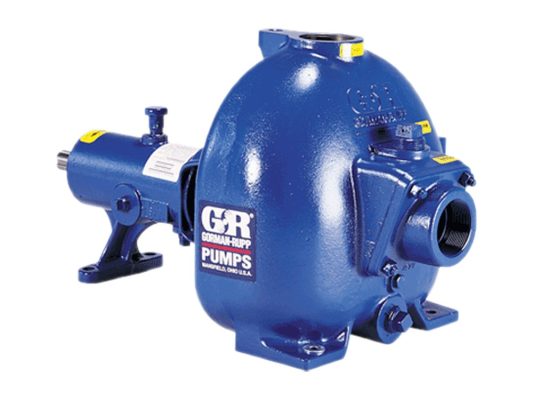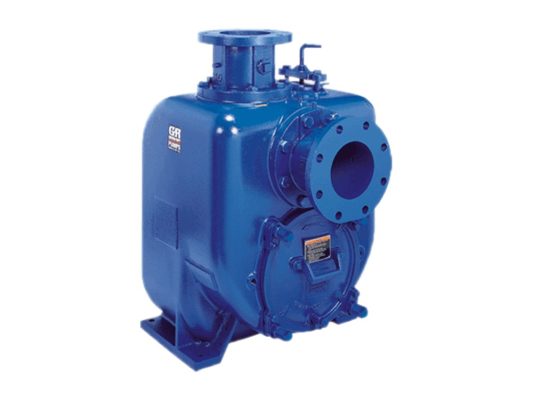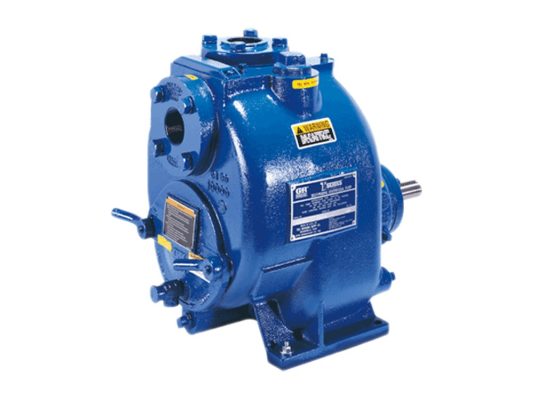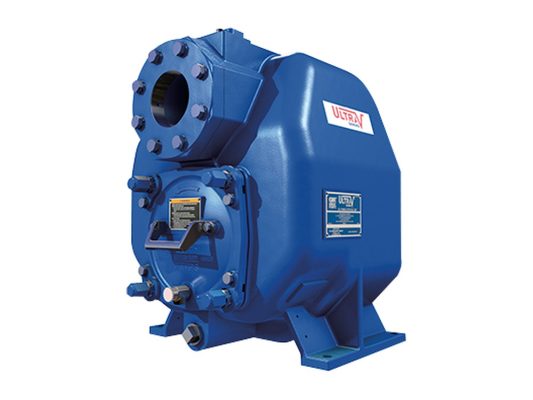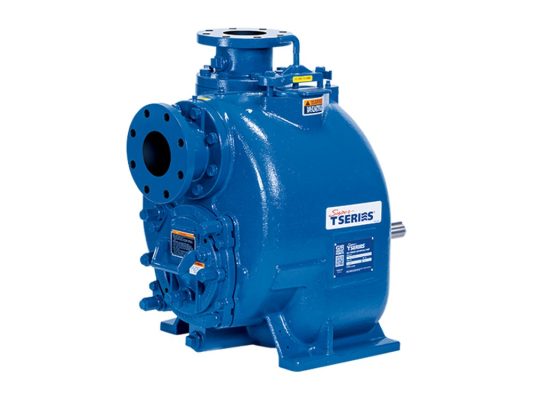




A self-priming centrifugal pump is a pump capable of expelling air from the suction line and re-establishing fluid flow on its own, without manually adding priming water before each start. Thanks to a water-retention chamber integrated inside the pump casing, after the initial prime the pump can draw fluid from a position lower than the suction flange — making it suitable when the pump is installed above the fluid level (negative suction head) or when the suction line regularly contains entrained air.
- Self-priming = the pump expels air from the suction line on its own, with no need to add priming water before each run.
- Mechanism: a water-retention chamber inside the pump casing mixes water with air, separates the air, and discharges it through the outlet.
- Required when the pump is installed above the fluid level, the suction line is long, or air entrainment is common.
- The first run still requires filling the priming chamber; subsequent starts are self-primed automatically.
- Salvatore Robuschi offers the RACM self-priming side-channel series, rated up to 16 bar and ≤90°C (optional 120°C).
What Is a Self-Priming Centrifugal Pump?
Definition and Differences from Standard Centrifugal Pumps
A standard centrifugal pump cannot self-evacuate air: if the suction line contains air, the impeller merely spins in the air without generating enough vacuum to draw fluid upward. As a result, the suction line must be filled with water before start-up, or the pump must be installed below the fluid level (positive suction head).
A self-priming centrifugal pump overcomes this limitation through a water-retention chamber integrated directly inside the pump casing. When the pump starts, the water in this chamber is mixed with the air present in the suction line by the rotating impeller; the air–water mixture is directed into a separation chamber, the air escapes through the discharge line, and the water returns to the priming chamber to continue the cycle. The process repeats until all air in the suction line has been expelled and the fluid is drawn up steadily.
| Criterion | Standard Centrifugal Pump | Self-Priming Centrifugal Pump |
|---|---|---|
| Pre-start priming | Must be filled with water each time | Priming chamber filled only once |
| Installation position | Positive suction head preferred (pump placed low) | Can be installed above the fluid level |
| Air in suction line | Prone to loss of prime | Expels air and re-establishes flow automatically |
| Water-retention chamber | None | Integrated in the pump casing |
How Does the Self-Priming Working Principle Operate?
Air-Separation and Water-Recirculation Cycle
The core of a self-priming pump is the volume of water retained inside the casing after each shutdown. When the pump restarts, this water acts as the working medium to entrain and separate air. In a side-channel design, energy is imparted to the fluid flow along multiple stages through the channel, enabling the differential pressure required to evacuate air from the suction line even at high air-to-liquid ratios.
Basic steps of a self-priming cycle:
| Step | What Happens Inside the Pump |
|---|---|
| 1. Start-up | The impeller rotates, mixing water in the priming chamber with air in the suction line. |
| 2. Mixture formation | The air–water mixture is directed into the separation chamber inside the pump casing. |
| 3. Air separation | Lighter air escapes through the discharge line; heavier water falls back into the priming chamber. |
| 4. Repetition | The cycle continues until all air has been expelled from the suction line and fluid is drawn in. |
| 5. Steady operation | The pump transitions to continuous fluid pumping, operating like a standard centrifugal pump. |
Because a volume of “seed” water in the chamber is required, a self-priming pump must still have its priming chamber filled with water at the time of initial installation. Thereafter, provided the design and installation are correct, this water is retained and the pump self-primes on subsequent starts.
When Is a Self-Priming Pump Needed?
Situations Where a Self-Priming Pump Is the Right Choice
A self-priming pump is typically considered when installation conditions make it difficult for a standard centrifugal pump to maintain its prime:
| Situation | Why Choose Self-Priming |
|---|---|
| Pump installed above the fluid level | Negative suction head required; standard pumps lose prime easily, self-priming pumps re-establish flow automatically. |
| Suction from a sump, pit, or well | Fluctuating fluid level causes the suction line to frequently entrain air. |
| Long suction line or multiple bends | Air accumulates in the line; self-priming expels it without manual intervention. |
| Fluid prone to air entrainment or foaming | The pump must handle air–liquid mixtures. |
| Intermittent operation with frequent restarts | Eliminates the need to manually prime before each run. |
Conversely, if the pump is always installed below the fluid level (positive suction head) and the suction line remains filled at all times, a standard centrifugal pump is typically simpler and sufficient. The decision to use a self-priming pump should be based on installation geometry, fluid characteristics, and the specific operating regime.
Installation & Operation Notes
Key Factors to Maintain Self-Priming Capability
Self-priming capability depends heavily on installation quality and maintenance. Common points to watch:
| Factor | Note |
|---|---|
| Initial priming chamber fill | Fill the chamber with the required volume of water before the first run, per the manufacturer’s documentation. |
| Suction-line airtightness | Leaking joints or gaskets allow air infiltration, prolonging priming time or causing complete loss of prime. |
| Suction lift height | The greater the suction lift, the longer the priming time; observe the rated limit for each model. |
| Temperature & pressure | Select materials and seal systems suited to the temperature–pressure range of the application. |
| Fluid characteristics | Viscosity, air content, and particulates affect priming time and efficiency. |
In practice, a self-priming pump that is installed airtight and correctly primed will reduce start-up time and minimize manual intervention for the operator.
Typical Applications
Where Self-Priming Pumps Deliver Value
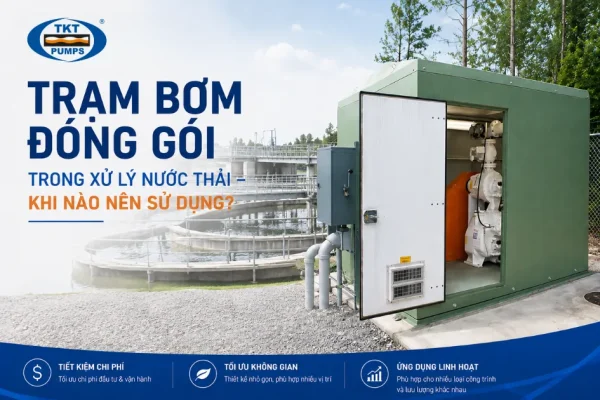
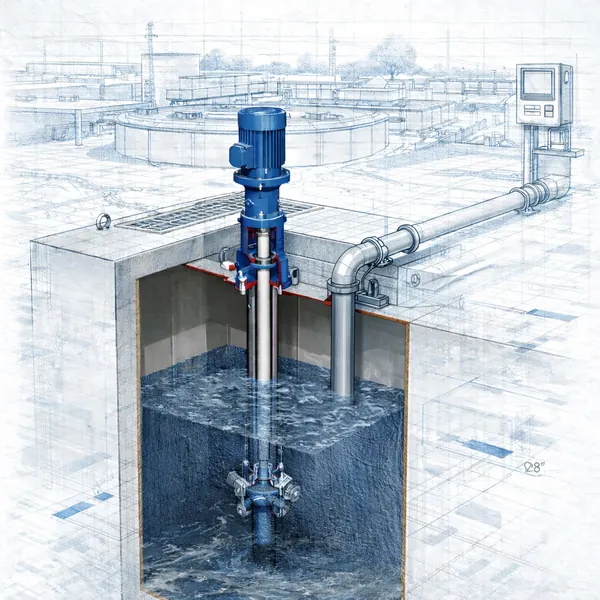
Self-priming centrifugal pumps appear in many sectors sharing a common characteristic: suction lines that are difficult to keep primed or fluids prone to air entrainment. These include wastewater treatment stations and sumps, recirculation systems in process plants, fluid transfer from low-set storage tanks, and intermittent pumping duty points. For applications requiring a high degree of sealing and vacuum capability — such as recirculating air–liquid mixtures — the self-priming side-channel pump is a sound engineering choice.
| Industry / Application | Role of the Self-Priming Pump |
|---|---|
| Wastewater treatment | Suction from sumps and pits with fluctuating fluid levels. |
| Food & beverage processing | Transferring fluids between tanks, batch operation. |
| Industrial chemicals | Pumping fluids prone to outgassing, requiring corrosion-resistant materials. |
| Recirculation & evaporation systems | Recirculating air–liquid mixtures requiring sealing integrity and vacuum capability. |
SALVATORE ROBUSCHI · ITALY RACM Self-Priming Pump Series
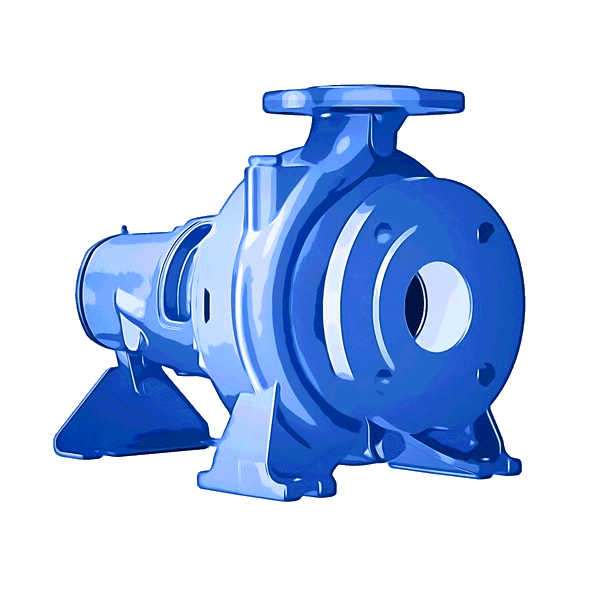
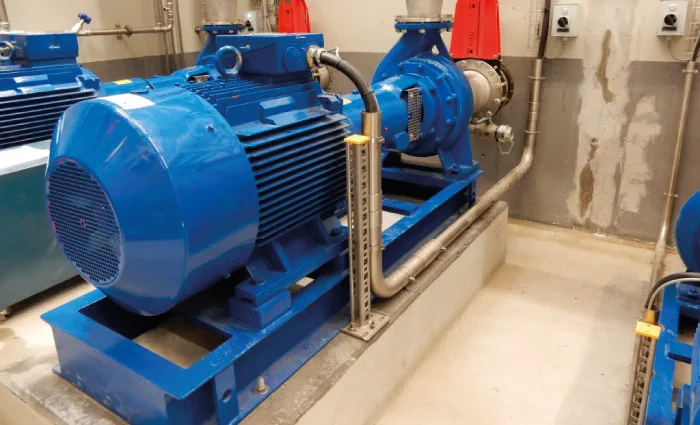
Salvatore Robuschi (Italy, part of Gruppo Aturia) manufactures centrifugal pumps across a broad range of industrial applications. Within the self-priming category, the RACM is a side-channel self-priming pump rated up to 16 bar and temperatures of ≤90°C (optional up to 120°C). The side-channel design enables handling of air–liquid mixtures and delivers the differential pressure required to evacuate air from the suction line.
In terms of materials, Salvatore Robuschi pumps can be configured in cast iron, AISI 316, Superduplex, or 904L depending on the operating environment (with ATEX options available), along with multiple mechanical seal configurations to suit the fluid characteristics. When a self-priming pump is needed for fluids prone to air entrainment or difficult suction conditions, the RACM is the solution TKT recommends based on actual site conditions — with material selection, seal system, and operating point matched to each specific model.
Frequently Asked Questions About Self-Priming Centrifugal Pumps
Does a self-priming pump still need priming water?
+
Yes, but only at initial installation: you need to fill the integrated priming chamber inside the pump casing with water. After that, provided the installation is airtight and carried out correctly, this water is retained so the pump self-primes on subsequent starts without any manual water addition.
How does a self-priming pump differ from a standard centrifugal pump?
+
A standard centrifugal pump requires a suction line that is always filled with water and is typically installed below the fluid level. A self-priming pump has an internal water-retention chamber that allows it to expel air from the suction line, to be installed above the fluid level, and to re-establish flow automatically after losing prime.
When should I choose a self-priming pump over a standard pump?
+
Consider a self-priming pump when the pump must be installed above the fluid level, when drawing from a sump or pit with a fluctuating fluid level, when the suction line is long and prone to air accumulation, or when the pump restarts frequently and manual priming is undesirable.
Why won’t my self-priming pump draw fluid?
+
Common causes include insufficient water in the priming chamber, air leaks at joints or gaskets in the suction line, a suction lift that exceeds the model’s rated limit, or fluid characteristics that extend priming time. Check suction-line airtightness and the priming chamber water level per the manufacturer’s documentation.
What are the specifications of the Salvatore Robuschi RACM series?
+
The RACM is a side-channel self-priming pump from Salvatore Robuschi, rated up to 16 bar and temperatures of ≤90°C (optional up to 120°C). The pump can be configured in cast iron, AISI 316, Superduplex, or 904L depending on the operating environment, with multiple mechanical seal options available.
Can a self-priming pump be used for wastewater?
+
Yes, self-priming pumps are well suited for suction points from sumps and pits with fluctuating fluid levels and suction lines prone to air entrainment — characteristics commonly found in wastewater treatment. Material selection and seal configuration should be based on the fluid composition and specific operating conditions.
Need guidance on selecting the right self-priming centrifugal pump for your suction conditions and fluid? TKT’s engineering team with over 19 years of experience and 12,000+ projects is ready to assist with model selection, materials, and seal systems.
Submit a Consultation Request or call hotline 0941.400.488
Sources: Salvatore Robuschi (Italy, Gruppo Aturia) technical documentation and centrifugal pump engineering knowledge. Compiled by TKT.