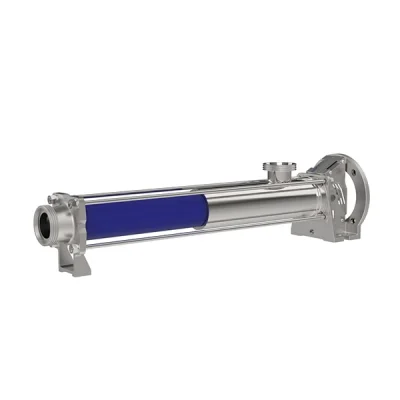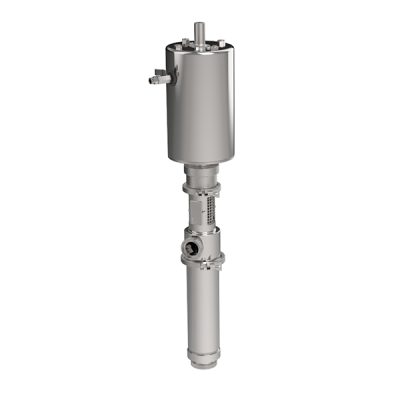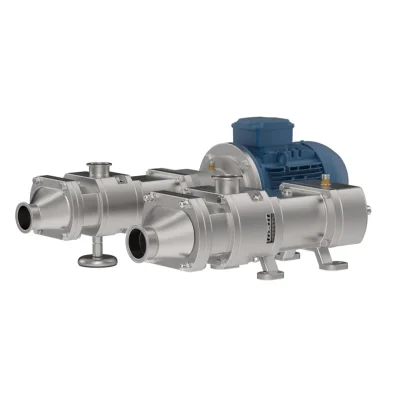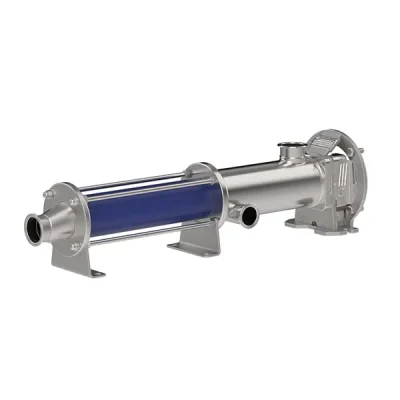




An aseptic (sterile) pump is a sanitary centrifugal pump upgraded to eliminate all contamination risks in the sterile zones of pharmaceutical, biotechnology, and certain sensitive food processing applications. Compared to standard sanitary pumps, aseptic pumps use AISI 316L material, product-contact surfaces polished to very low roughness values, dead-zone-free construction, full self-draining capability, and — most critically — an aseptic seal assembly (with a sterile barrier chamber) to protect the pumped fluid from environmental microorganisms. Within the CSF Inox (Italy) product range, the CSK series is the aseptic variant of the CS centrifugal pump family, designed specifically for sterile zone applications.
- Aseptic pump = sanitary pump + sterile protection for sterile zones (pharmaceutical, biotechnology).
- CSK is the aseptic version of the CS series — same family as CSD, AISI 316L material.
- Core differentiator: aseptic seal with barrier chamber, no dead zones, full self-draining.
- Compatible with CIP (clean-in-place) and SIP (sterilization-in-place).
- Referenced hygienic standards: EHEDG, 3-A, FDA; food-grade EPDM/FKM/silicone seals.
How Aseptic Pumps Differ from Standard Sanitary Pumps
The Boundary Between “Hygienic” and “Sterile”
A sanitary/hygienic pump already meets hygienic requirements: AISI 316L body, product-contact surfaces polished to a surface roughness Ra typically ≤0.8µm to minimize bacterial adhesion, no dead zones, full self-draining, and quick-disconnect fittings. This level is suitable for most F&B production lines.
An aseptic (sterile) pump goes one step further. In the sterile zones of pharmaceutical and biotechnology processes, not only must the pumped fluid be clean — the boundary between the fluid and the external environment must also be controlled. Aseptic pumps therefore focus on the seal assembly: an aseptic seal with a barrier chamber prevents microorganisms from entering along the pump shaft, combined with thorough CIP/SIP cleaning and sterilization capability without disassembling the pump.
| Criterion | Standard Sanitary Pump | Aseptic (Sterile) Pump |
|---|---|---|
| Contact material | AISI 316L | AISI 316L |
| Surface finish | Polished, low Ra | Polished, low Ra, more tightly controlled |
| Seal assembly | Sanitary mechanical seal | Aseptic seal with barrier chamber |
| Dead zones | Minimized | Eliminated, full self-draining prioritized |
| Cleaning | CIP | CIP and SIP (steam sterilization) |
| Typical application | F&B, dairy, brewing, water | Pharmaceutical, biotechnology, sterile zones |
CSF Inox CSK Aseptic Series for Sterile Zones
CSK: The Sterile Version of the CS Centrifugal Pump Family
Within CSF Inox’s sanitary centrifugal pump lineup, the CS family forms the foundation: single-stage centrifugal pump, AISI 316L body, polished surfaces, and sanitary connections. Building on this same platform, CSF Inox developed two variants within the same family: CSK as the aseptic version for sterile zones and CSD as an additional variant in the same group.
A key advantage of the CSK sharing its platform with the CS is consistency in hydraulics and spare parts: the same dead-zone-free, self-draining design philosophy and the same quick-disconnect fitting system, allowing facilities to standardize maintenance procedures across hygienic and aseptic areas within the same plant. The critical difference lies in the aseptic seal assembly fitted to the CSK to meet sterile zone requirements.
| Series | Role | Key Features |
|---|---|---|
| CS | Foundational sanitary centrifugal pump | Single-stage, AISI 316L, polished, sanitary connections |
| CSK | Aseptic (sterile) version | Aseptic seal, no dead zones, for sterile zones |
| CSD | Variant within the same family | Same CS platform, extended configurations |
This core sanitary centrifugal pump family (CS/CSK/CSD) covers a broad range, with flow rates up to 500 m³/h, head up to 100 m, and pressure up to 10 bar, across multiple frame sizes. For sterile zone applications specifically, parameters are selected according to the actual flow rate and head requirements of each process step, so CSK configurations typically fall in the flow rate and head range suited to pharmaceutical or biotechnology batch production scales rather than exploiting the full maximum range of the entire family.
CIP, SIP, and Why Aseptic Pumps Must “Clean and Sterilize” In-Place
Cleaning and Sterilization Without Pump Disassembly
CIP (Clean-In-Place) means in-place cleaning: cleaning solution is circulated through the piping and pump without dismantling the equipment. SIP (Sterilization-In-Place) means in-place sterilization, typically using steam to destroy residual microorganisms. In sterile zones, every time the pump is disassembled there is a risk of recontamination, so thorough CIP/SIP capability is a mandatory requirement for aseptic pumps.
For effective CIP/SIP, the pump construction must have no dead zones (areas the solution cannot reach), surfaces must be sufficiently smooth to prevent biofilm retention, and the entire pump chamber must fully self-drain when stopped. The CSK’s aseptic seal assembly is designed to withstand the thermal cycles of SIP and to allow CIP solution access to critical surfaces. This enables operating facilities to reduce downtime between batches and maintain the sterile integrity of the production line.
Selecting an Aseptic Pump Based on Real-World Requirements
Four Questions Before Finalizing the Configuration
Sanitary centrifugal pumps, including the aseptic version, are suitable for low-viscosity fluids requiring high flow rates and moderate head. To make the right selection, answer the following questions in sequence:
| Question | Impact on Selection |
|---|---|
| What is the sterility level of the zone? | Pharmaceutical/biotech sterile zones choose the aseptic CSK version; F&B hygienic zones use CS/CSD |
| What are the process flow rate and head requirements? | Determines the frame size within the CS/CSK/CSD family based on actual needs |
| Does the fluid contain particles, fibers, or cells? | Thin fluids suit sanitary centrifugal pumps; shear-sensitive fluids require consideration of alternative technologies |
| What certifications are required? | Cross-reference EHEDG, 3-A, FDA requirements and appropriate food-grade seal material |
For biological fluids sensitive to shear force or containing cellular components, a high-speed centrifugal pump may not be the appropriate choice — in such cases, consult with the engineering team to evaluate positive displacement options within the same CSF Inox system. Configuration finalization should be based on actual operating parameters rather than solely on the maximum range of the product series.
CSF INOX · ITALY Sanitary and Aseptic Pumps for Pharmaceutical and Biotechnology
CSF Inox (Italy) specializes in sanitary pumps for the food, beverage, pharmaceutical, and cosmetics industries, with three technology groups: centrifugal (primary), positive displacement, and pneumatic. All product-contact parts use AISI 316L, polished surfaces, and sanitary connections. For sterile zones, the CS/CSK/CSD centrifugal family provides a wide flow rate range (up to 500 m³/h) with the aseptic CSK version equipped with an aseptic seal assembly. TKT is the authorized distributor of CSF Inox in Vietnam, providing series selection support, process-specific configuration engineering, and spare parts supply.
Frequently Asked Questions About Aseptic Pumps
How does an aseptic pump differ from a standard sanitary pump?
+
Both use AISI 316L, polished surfaces, no dead zones, and full self-draining. The aseptic pump adds a sterile protection layer at the seal assembly (aseptic seal with barrier chamber) and steam sterilization-in-place (SIP) capability, designed to serve sterile zones in pharmaceutical and biotechnology industries where contamination control requirements are more stringent than in standard F&B production lines.
What applications is the CSF Inox CSK series used for?
+
The CSK is the aseptic (sterile) version of the CS centrifugal pump family, designed for sterile zones in pharmaceutical manufacturing and biotechnology. The pump features an AISI 316L body, aseptic seal, and dead-zone-free construction, suitable for pumping thin fluids requiring sterile control. The CSD is a variant within the same family, extending configurations on the same CS platform.
Can an aseptic pump run CIP and SIP?
+
Yes. CIP is in-place cleaning by circulating cleaning solution through the pump without disassembly; SIP is in-place sterilization typically using steam. Aseptic pumps such as the CSK series are designed to withstand the thermal cycles of SIP and allow CIP solution to reach critical surfaces, thanks to dead-zone-free construction and full self-draining capability.
What materials and surface roughness are used in aseptic pumps?
+
Product-contact parts use AISI 316L stainless steel. Surfaces are polished to achieve low roughness Ra values, typically ≤0.8µm, to minimize bacterial adhesion and biofilm formation while improving cleaning efficiency during CIP. Gaskets and seals use food-grade materials such as EPDM, FKM, or silicone depending on the fluid being pumped.
When should a positive displacement pump be used instead of an aseptic centrifugal pump?
+
Sanitary centrifugal pumps, including the aseptic version, are suitable for thin fluids requiring high flow rates. When the fluid has high viscosity, is sensitive to shear forces, or contains fragile cellular components, consider a positive displacement pump within the same CSF Inox system to preserve product quality. The selection should be based on the fluid characteristics and specific process parameters.
What hygienic standards apply to aseptic pumps?
+
Three commonly referenced standards are EHEDG (European Hygienic Engineering & Design Group), 3-A (food and dairy sanitary standards), and FDA (food-contact material regulations). When selecting a pump for sterile zones, cross-reference the line’s certification requirements against the pump configuration and seal type to ensure compliance.
Need to select the right aseptic pump series for your sterile zone? The TKT technical team provides configuration engineering support tailored to each process step and supplies CSF Inox spare parts.
Send a Consultation Request or call hotline 0941.400.488
Source: CSF Inox (Italy) technical documentation on the CS/CSK/CSD sanitary centrifugal pump series; compiled by TKT.