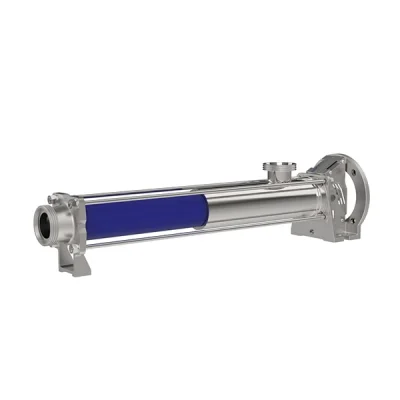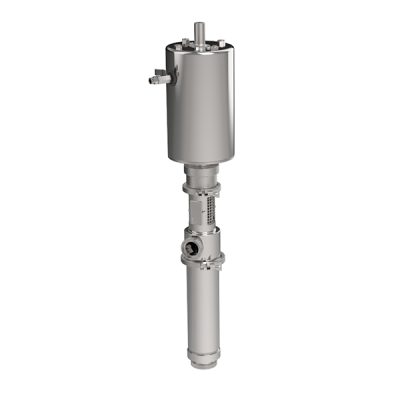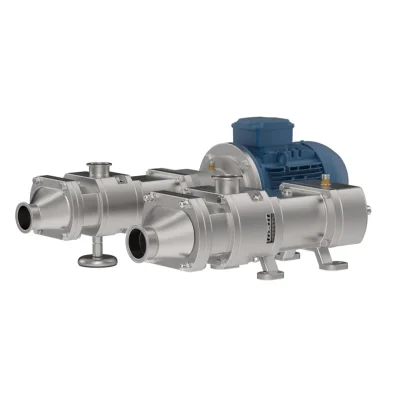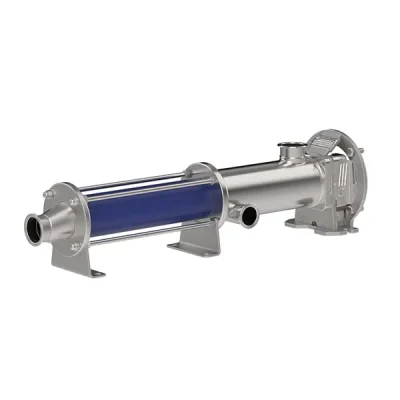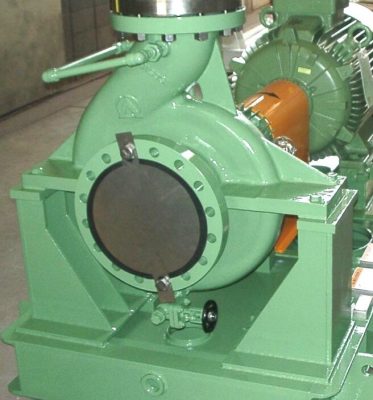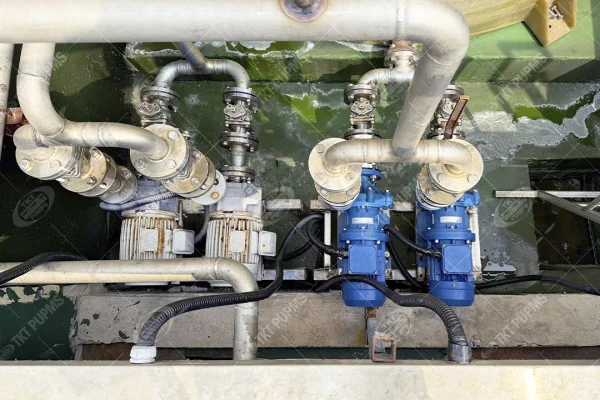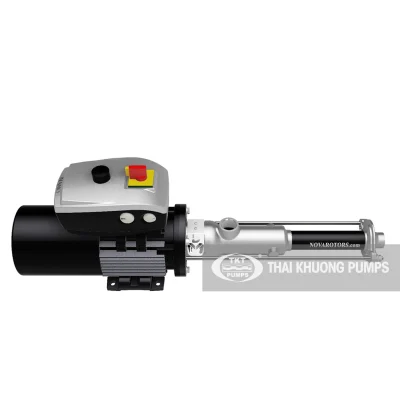
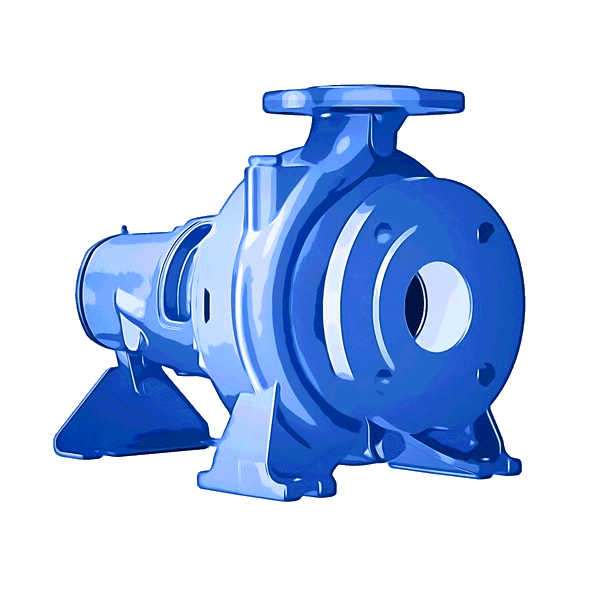
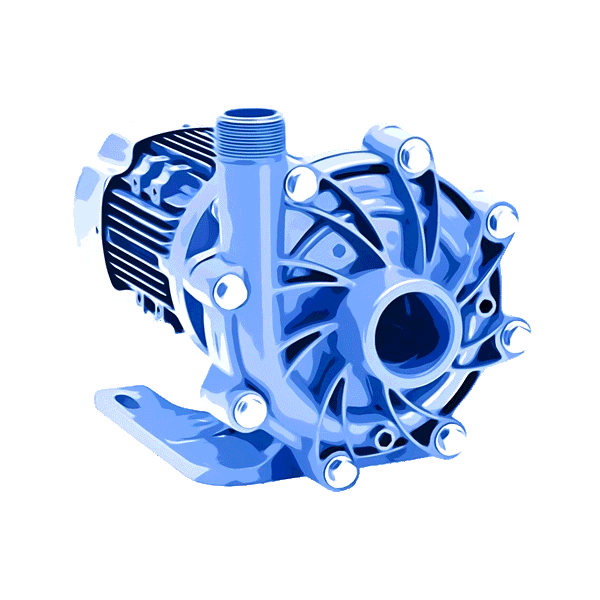
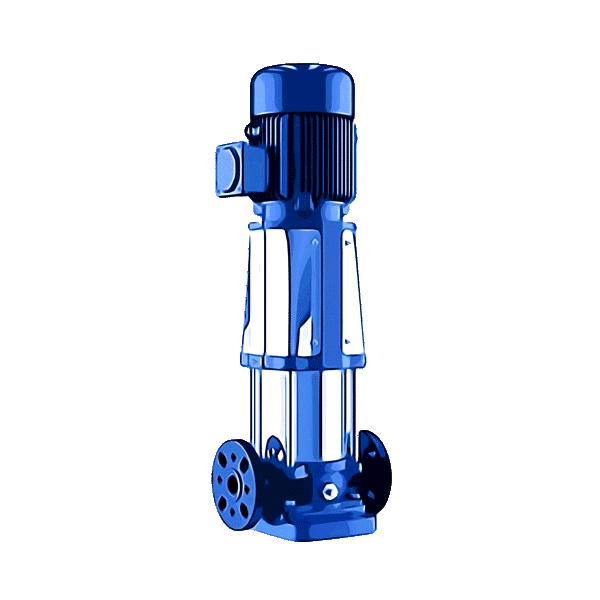




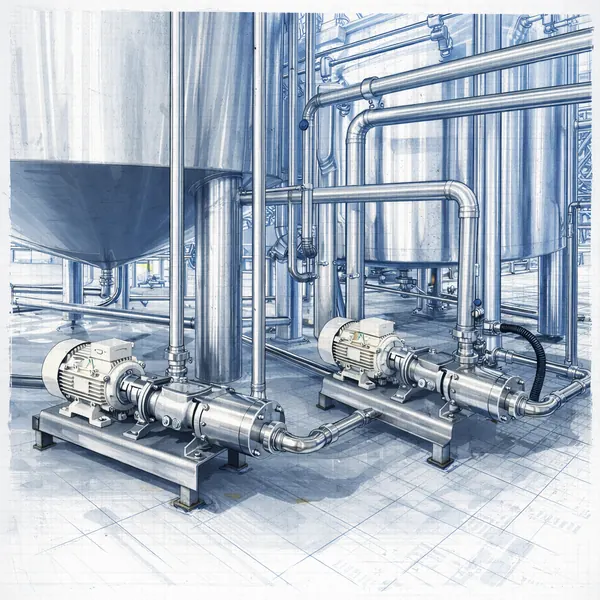

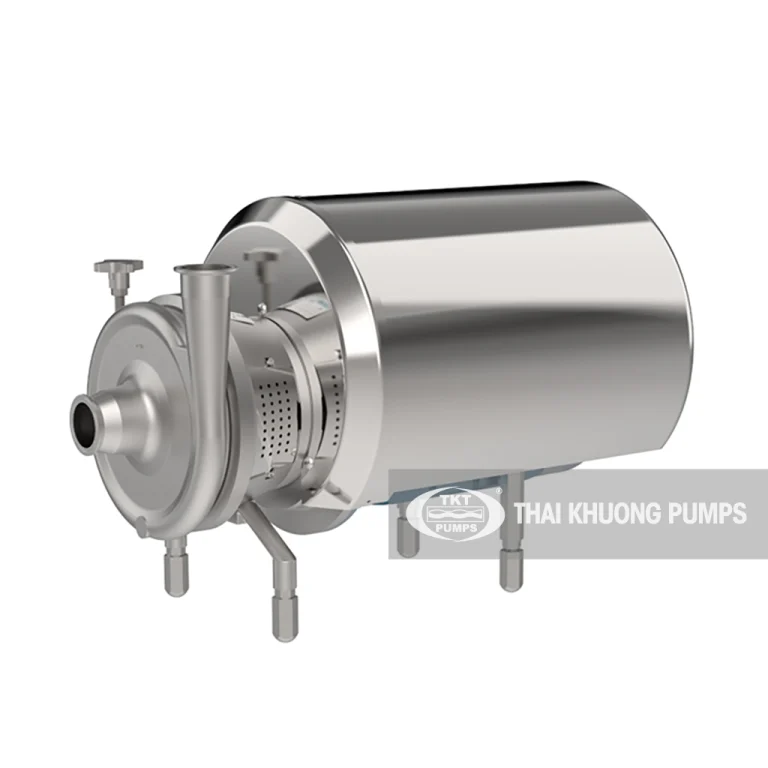
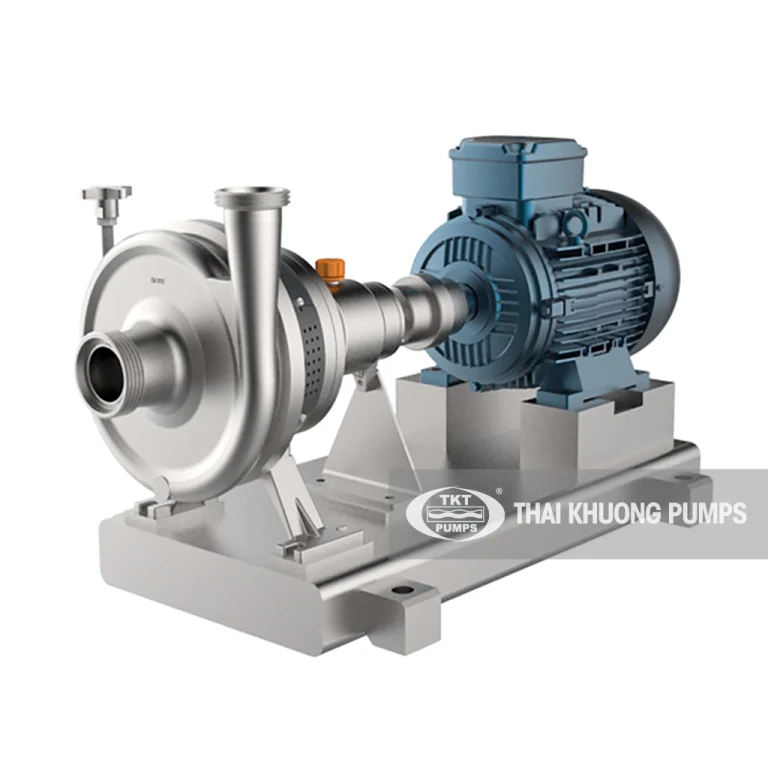
A sanitary centrifugal pump is a centrifugal pump designed for hygienic service to convey liquids in the food & beverage (F&B), pharmaceutical, and cosmetics industries. What sets it apart from a conventional industrial centrifugal pump is the AISI 316L stainless-steel wetted parts, low-roughness polished surfaces that resist bacterial adhesion, a dead-zone-free self-draining design, and quick-release connections that support Cleaning In Place (CIP) and Sterilization In Place (SIP). It is the appropriate choice when high-flow-rate transfer of low-viscosity fluids is required — milk, fruit juice, beer, fermentation broth, or CIP solutions.
- Wetted material AISI 316L, polished surfaces typically Ra ≤0.8 µm
- Dead-zone-free, self-draining construction, cleanable by CIP/SIP
- Quick-release connections: clamp/Tri-Clamp/DIN; food-grade gaskets EPDM/FKM/silicone
- Hygienic standards referenced: EHEDG, 3-A, FDA
- Suited to low-viscosity, high-flow-rate applications in F&B, pharmaceutical, and cosmetics
What Is a Sanitary Centrifugal Pump and How Does It Differ from a Standard Centrifugal Pump
Core Difference: Hygienic Design Over Mechanical Durability Alone
A sanitary centrifugal pump shares the same working principle as every centrifugal pump: a rotating impeller generates centrifugal force that moves fluid from the center to the periphery and into the discharge line. The difference is that every wetted component is designed to eliminate bacterial harbourage points and to allow thorough cleaning without disassembling the pump. Whereas an industrial centrifugal pump prioritizes mechanical durability and cost, a sanitary pump puts hygiene and food safety first: material selection, surface roughness, pump casing geometry, and connection type all serve that goal.
For the same task of transferring low-viscosity fluid at high flow rates, a food processing plant will therefore select a sanitary centrifugal pump over a cast-iron or standard-steel centrifugal pump, in order to meet both operational requirements and quality-control and traceability obligations.
| Criterion | Standard Centrifugal Pump | Sanitary Centrifugal Pump |
|---|---|---|
| Wetted material | Cast iron, steel, sometimes SS304 | AISI 316L stainless steel |
| Pump casing surface | As-cast, no polishing required | Polished, low Ra roughness |
| Cleanability | Typically requires disassembly | CIP/SIP without disassembly |
| Connections | Flange/threaded | Clamp/Tri-Clamp/DIN quick-release |
| Standards reference | Per industrial application | EHEDG, 3-A, FDA |
Construction of a Sanitary Centrifugal Pump
Key Components and Their Hygienic Function
A sanitary centrifugal pump consists of the pump casing (volute), impeller, shaft and mechanical seal, and the inlet–outlet connection assembly. Each component is treated to eliminate dead zones and sharp corners where product could accumulate. The impeller is typically open or semi-open for easy cleaning and to reduce mechanical stress on heat-sensitive fluids; the casing interior corners are radiused, and no exposed threads come into contact with the product.
The mechanical seal is a critical component: for sanitary fluids a single seal in food-compatible material is typically used, and when aseptic conditions are required a flushed seal using sterile liquid may be employed. Gaskets and O-rings are made from food-contact-approved materials such as EPDM, FKM, or silicone, selected according to temperature and CIP chemical requirements.
| Component | Hygienic feature |
|---|---|
| Pump casing (volute) | SS316L, radiused interior corners, self-draining |
| Impeller | Open/semi-open, easy to clean, low mechanical shock to fluid |
| Mechanical seal | Food-grade material; aseptic version with flushed seal |
| Gaskets/O-rings | EPDM, FKM, silicone selected per CIP/temperature |
| Connections | Clamp/Tri-Clamp/DIN quick-release |
Standards and Surface Finish: EHEDG, 3-A, FDA, Ra
Why Surface Roughness and Certification Matter
The lower the surface roughness Ra, the harder it is for bacteria to adhere and the easier they are to wash away; in hygienic processing, product-contact surfaces are typically polished to Ra ≤0.8 µm. This is why sanitary pumps consistently emphasize polished finishes rather than as-cast surfaces. In addition to material and roughness, three hygienic standards are commonly referenced: EHEDG (European Hygienic Engineering & Design Group guidelines), 3-A Sanitary Standards (US dairy-industry standard), and FDA (food-contact material requirements).
CIP (Cleaning In Place) refers to cleaning with recirculated detergent solution without disassembling the equipment; SIP (Sterilization In Place) refers to in-situ sterilization using steam. For pharmaceutical and biotech applications, the higher-tier requirement is aseptic processing, which demands sealed design and appropriate seal flushing. When evaluating a sanitary pump, it is important to clearly define whether the application requires CIP, SIP, or aseptic capability, so that the correct pump configuration can be selected.
| Standard / Concept | Meaning |
|---|---|
| Ra ≤0.8 µm | Low roughness, limits bacterial adhesion, easy to clean |
| EHEDG | European hygienic engineering design guidelines |
| 3-A | US sanitary standards, widely used in the dairy industry |
| FDA | Food-contact material requirements |
| CIP / SIP / Aseptic | Cleaning in place / sterilization in place / aseptic processing |
When to Choose a Sanitary Centrifugal Pump
Suitable Application Characteristics
Sanitary centrifugal pumps perform well with low-viscosity fluids at high flow rates: transferring milk between tanks, supplying process water, pumping beer and beverages, recirculating CIP solution, or feeding pasteurization equipment. For high-viscosity fluids, fluids containing large particles, or applications requiring precise and gentle metering, other pump types — such as positive-displacement or sanitary pneumatic pumps — are more appropriate; in practice these technologies are often used alongside each other in the same processing line.
One important consideration is head: a single-stage sanitary centrifugal pump delivers moderate head; when high head is required for pressure CIP, RO filtration, or boosting, a multi-stage sanitary centrifugal pump is used instead. Accurately determining the required flow rate, head, and fluid properties is the first step before selecting a specific pump model.
| Requirement | Recommended approach |
|---|---|
| Low-viscosity fluid, high flow rate | Single-stage sanitary centrifugal pump |
| High head (pressure CIP, RO) | Multi-stage sanitary centrifugal pump |
| Fluid with particles or fibres | Open-impeller pump with large inlet port |
| Pumping fluid mixed with air (CIP return) | Self-priming liquid-ring pump |
CSF INOX · Italy CS/CSK/CSD Sanitary Centrifugal Pump Range
CSF Inox (Italy) is a brand specializing in sanitary pumps for F&B, pharmaceutical, and cosmetics applications, with all wetted parts in AISI 316L and hygienic connections throughout. Within its centrifugal range, the CS/CSK/CSD series is the principal line: flow rate up to 500 m³/h, head up to 100 m, pressure up to 10 bar, available in 29 sizes with polished surfaces. The CSK is the ASEPTIC version for pharmaceutical and biotech use, while the CSD is a variant within the same family — together covering the range from standard transfer duties to strict aseptic requirements. TKT Pumps is the authorized distributor of CSF Inox in Vietnam, providing selection support based on actual process flow rate, head, and hygienic grade requirements.
Frequently Asked Questions
How does a sanitary centrifugal pump differ from a standard centrifugal pump?
+
The differences lie in the wetted material (AISI 316L), low-roughness polished surfaces, dead-zone-free self-draining construction, quick-release connections for CIP/SIP cleaning, and reference to the hygienic standards EHEDG, 3-A, and FDA. A standard centrifugal pump prioritizes mechanical durability and cost, and does not require these hygienic characteristics.
Why must sanitary pumps use SS316L and polished surfaces?
+
AISI 316L provides good corrosion resistance against CIP chemicals and food fluids. Polishing to a surface roughness of Ra typically ≤0.8 µm makes it difficult for bacteria to adhere and easy to wash away, meeting food safety and quality traceability requirements.
What are CIP and SIP?
+
CIP (Cleaning In Place) is in-situ cleaning with recirculated detergent solution without disassembling the pump. SIP (Sterilization In Place) is in-situ sterilization using steam. Both reduce cleaning downtime and minimize cross-contamination risk.
How do EHEDG, 3-A, and FDA differ?
+
EHEDG is the European hygienic engineering design guideline set; 3-A is the US sanitary standard, widely used in the dairy industry; FDA specifies permitted food-contact materials. A sanitary pump may reference one or more of these standards depending on the target market and application.
When should a sanitary centrifugal pump be chosen over a positive-displacement pump?
+
Sanitary centrifugal pumps are well suited for low-viscosity, high-flow-rate applications such as milk, water, beer, and CIP fluid. For high-viscosity fluids, applications requiring precise metering, or gentle transfer of sensitive products, a positive-displacement or sanitary pneumatic pump should be considered instead.
What performance range does the CSF Inox CS/CSK/CSD series cover?
+
According to CSF Inox technical documentation, the CS/CSK/CSD series is the main sanitary centrifugal range, with flow rate up to 500 m³/h, head up to 100 m, pressure up to 10 bar, available in 29 sizes, AISI 316L material with polished surfaces, and hygienic connections. The CSK is the aseptic version for pharmaceutical/biotech applications.
Need to select the right sanitary centrifugal pump for your process flow rate, head, and hygiene grade? The TKT Pumps engineering team provides selection support for the appropriate CSF Inox model — 19+ years of experience, 28+ brands, 24/7 support.
Submit a Consultation Request or hotline 0941.400.488
Source: CSF Inox (Italy) technical documentation and EHEDG/3-A/FDA hygienic standard references; compiled by TKT Pumps.