












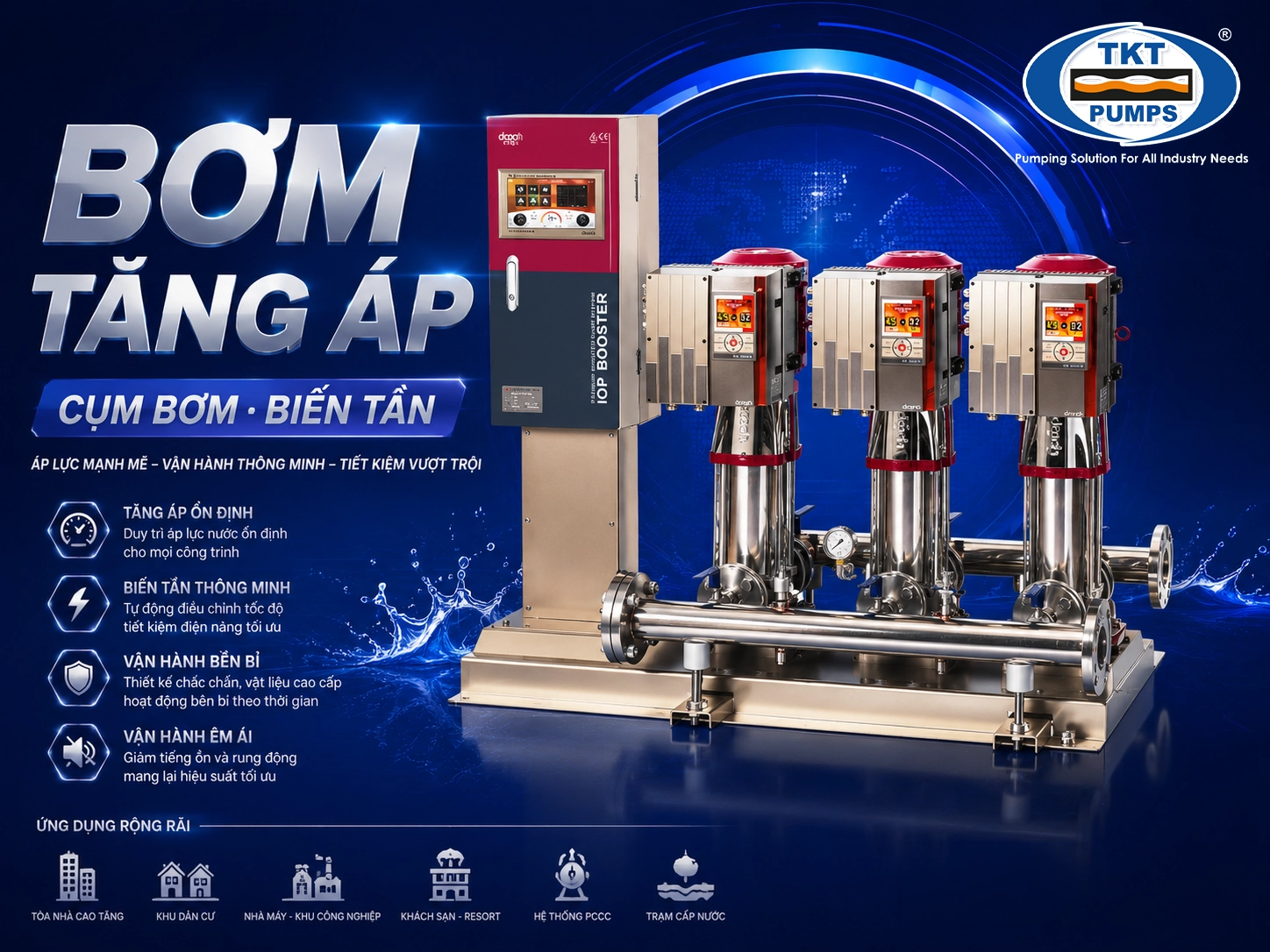
Choose the right booster pump system based on peak flow rate, required pressure, and control method. See the overview on the booster pump page.
Step 1 — Calculate Peak Flow Rate
Peak flow rate is estimated based on the number of simultaneous water use points (taps, fixtures). A multi-pump system with alternating operation helps meet demand peaks and increases reliability.
Step 2 — Determine Required Pressure
Required pressure = height to the most disadvantaged point (typically the top floor) + minimum working pressure at the tap + pipe losses. High-rise buildings may be divided into pressure zones to avoid over-pressurization on lower floors.
Step 3 — Select Control Method
A pressure switch + pressure tank suits small systems (fluctuating pressure, low cost); a variable frequency drive (VFD) maintains constant pressure, saves energy, and reduces start-up cycles for large systems.
Step 4 — Number of Pumps & Materials
A cluster of 1–4 alternating pumps provides the desired reliability; stainless steel casing for clean water applications. Install pressure tanks and pressure sensors as appropriate.
For high-rise building applications, see the article on booster pumps for high-rise buildings. Thái Khương Pumps is an authorized distributor of Caprari (Italy).
Booster Pump System Configuration — Key Parameters

A standard booster pump system covers flow rates up to approximately 50 m³/h and pressure boosts up to ~10 bar, with 1–4 pumps running in alternation — larger-scale systems are custom-designed per project. The key differentiator between systems is the control method: on/off switching via pressure switch, or a variable frequency drive (VFD) that maintains constant pressure.
For buildings with strongly fluctuating demand throughout the day, a VFD-controlled system significantly reduces the number of start-up cycles — the primary cause of bearing wear — while also saving energy during off-peak hours. Traditional on/off-controlled systems remain appropriate for stable loads, provided a sufficiently sized pressure tank is installed.
| Parameter | Standard Value | Selection Notes |
|---|---|---|
| System flow rate | up to ~50 m³/h | calculated based on peak-hour demand |
| Pressure boost | up to ~10 bar | from source pressure to the farthest point + loss allowance |
| Number of pumps | 1–4 (standard N+1) | automatic alternation for even wear |
Frequently Asked Questions
What parameters should I use to select a booster pump?
+
Peak-hour flow rate, the required head to compensate (calculated from source pressure to the required pressure at the farthest point), and the number of pumps in the system (typically 2–3 pumps running in alternation). A VFD-controlled system maintains stable pressure when demand fluctuates.
How many pumps should a booster pump system have?
+
The standard practice is an N+1 redundancy configuration: peak demand shared across 1–2 operating pumps, plus 1 standby pump in alternation. This arrangement allows individual pump maintenance without interrupting the water supply to the entire building.
Is a pressure tank mandatory?
+
For pressure switch on/off-controlled systems, a pressure tank reduces the number of start cycles — the factor that causes the most bearing wear. VFD-controlled systems should still include a small tank to stabilize pressure at very low flow rates.
Spare parts for booster pumps: see the in-stock catalog by model.
Send your specifications — Thái Khương Pumps engineers will advise on configuration + provide a quotation with CO-CQ documentation within 24 hours. Request a quotation →