












Select the right vacuum pump based on the required vacuum level, suction flow rate, and gas characteristics. The gas type (humid, dusty, corrosive, solvent-laden) determines the technology. See the overview on the vacuum pump page.
Step 1 — Required Vacuum Level
Determine the required vacuum level (mbar abs) according to the process: low/medium vacuum (packaging, filtration) or deep vacuum (drying, distillation, electronics). The vacuum level determines the technology.
Step 2 — Suction Flow Rate
Calculate the suction flow rate (m³/h) based on chamber volume and desired evacuation time, plus allowance for system leakage. Large chambers requiring rapid evacuation may benefit from an additional Roots pump (booster).
Step 3 — Technology by Gas Type
Humid/dusty/mildly corrosive gas → liquid ring; deep vacuum required, compact footprint → rotary vane; clean gas output, deep vacuum → dry screw. See the comparison in the article liquid ring vs dry screw.
Step 4 — Cooling & Configuration
Liquid ring requires a water supply; dry-type units use no water or oil in the chamber. Select materials compatible with corrosive gases and appropriate filters/inlet separators. Consider water recovery (liquid ring) for resource savings.
Thái Khương Pumps distributes authorized EU/G7 imported vacuum pumps — send your requirements (vacuum level, flow rate, gas type) for technical consultation.
Operating Range by Vacuum Technology
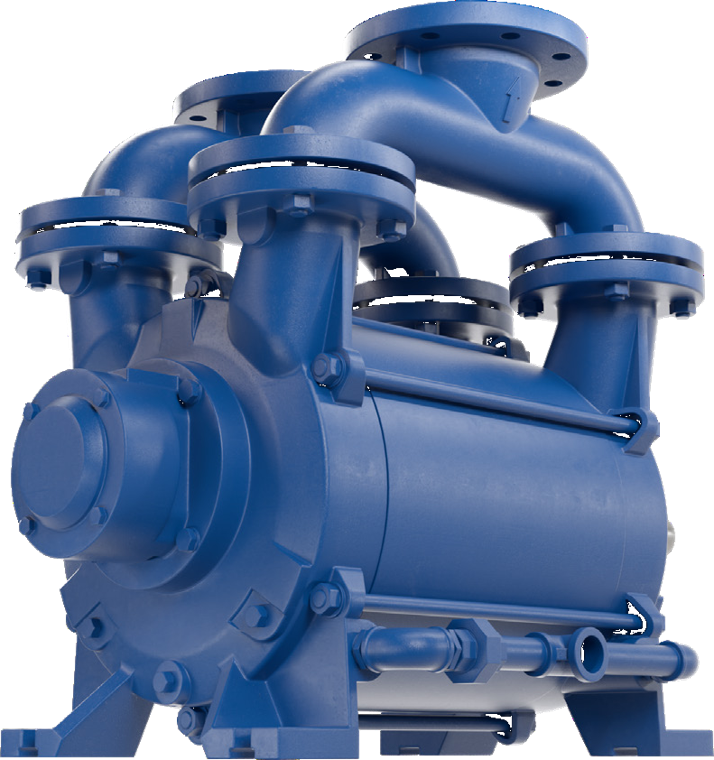
Industrial vacuum pumps cover vacuum levels down to ~33 mbar absolute and suction flow rates up to approximately 1,000 m³/h. The three main technologies are categorized by the nature of the gas handled: liquid ring for humid, vapor-laden gas; rotary vane for clean dry gas; and dry screw for processes requiring deep vacuum without oil or water contamination.
The most frequently misread catalogue specification: nominal flow rate is measured at atmospheric pressure, whereas the actual flow rate at the working vacuum level is significantly lower — you must cross-reference the performance curve at the exact mbar required, adding a leakage allowance for the system.
| Technology | Suitable For | Notes |
|---|---|---|
| Liquid ring (SR VS series) | Humid gas, high vapor content — packaging, filtration, light drying | Requires sealing water; hard water causes scale buildup that reduces vacuum |
| Rotary vane | Clean dry gas, moderate vacuum | Periodic vane maintenance required |
| Dry screw | Deep vacuum process, gas must remain uncontaminated | Higher initial investment; lower long-term operating cost |
Frequently Asked Questions
What parameters determine vacuum pump selection?
+
The required vacuum level (mbar absolute), suction flow rate (m³/h) at that vacuum level, and the nature of the gas being drawn (presence of water vapor, solvents, or dust). These three factors determine whether liquid ring or dry screw technology is appropriate.
When should liquid ring be chosen, and when dry screw?
+
Liquid ring suits humid gas, high vapor content, and moderate budget — accepting water consumption. Dry screw suits processes requiring deep vacuum, where water contamination of the drawn gas is unacceptable, and where lower long-term operating costs are a priority.
What is the most common mistake in vacuum pump selection?
+
Selecting based on the nominal flow rate at atmospheric pressure instead of the flow rate at the actual working vacuum level — the pump will perform significantly below catalogue figures if the performance curve is read incorrectly.
Spare parts for vacuum pumps: view the in-stock catalog by model.
Send your application specifications — Thái Khương Pumps engineers will advise on configuration and provide a quotation with CO-CQ within 24 hours. Request a Quotation →