







In electroplating, anodizing and surface treatment, sediment and suspended particles in the bath cause porous, dull, poorly adhesive coatings. A chemical filter pump — known in English as a filter pump — circulates the solution through a filter housing to keep the bath clean, the plated coating bright and uniform, and extend solution service life. This article provides guidance on selecting the right filter pump for each type of bath.
What is a Chemical Filter Pump (Filter Pump)?
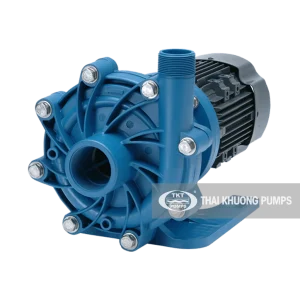
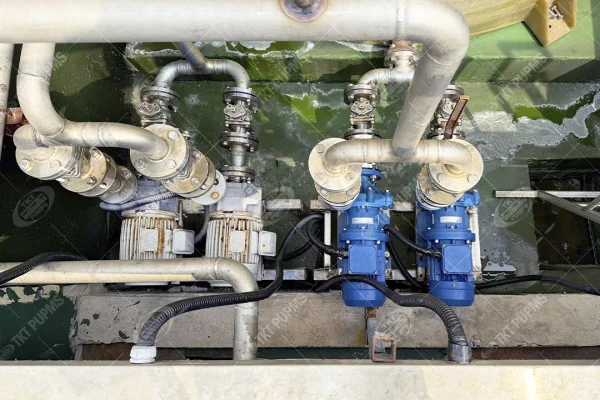
A chemical filter pump is a combination of a chemical-resistant pump (a sealless magnetic drive pump, or a vertical pump) coupled with a filter housing in cartridge, bag, or activated carbon form. The pump draws solution from the bath, forces it through the filter housing to capture sediment and particles, then returns clean solution to the bath — continuous circulation, filtration down to approximately 0.5 µm depending on the element.
Unlike a standard chemical pump (which only transfers solution), a filter pump integrates filtration and is designed for bath circulation duty. The Penguin brand, owned by Finish Thompson (USA), has the legal entity name Filter Pump Industries — “filter pump” is the standard product category name in the plating & surface treatment industry.
Why Do Plating Baths & Surface Treatment Processes Need Filtration?
Sediment, metallic dust and suspended particles cause porous, dull, poorly adhesive coatings and increase rejects. Circulating the solution through a filter pump helps:
- Nickel / Chrome / Zinc coatings remain bright, smooth, uniform
- Remove contaminants, stabilize solution composition
- Extend bath service life, reduce rejects and solution replacement costs
- Combine with activated carbon to remove organic contaminants & excess brightener
- Recover precious metals (gold, silver) from rinse water
Construction of a Filter System: Pump + Filter Housing + Element
A filter pump system consists of three components:
| Component | Role | Common Options (Penguin) |
|---|---|---|
| Pump | Generates circulation flow rate, chemical resistant | Mag-drive MTD · vertical pump P / PS / PHF / PX |
| Filter housing | Contains element/bag/carbon, retains sediment | Cartridge (C / CN) · bag (CB / CBK) · carbon (CT) |
| Element / consumable | Filter media replaced periodically | Wound string (PF) · pleated PP (50µ–0.1µ) · carbon (PC) |
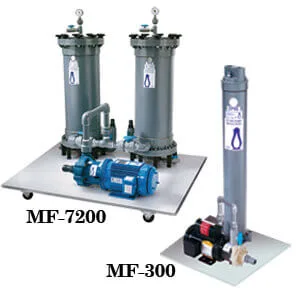
Complete systems (pump + housing pre-assembled) such as the MF mag-drive series (550–3,600 GPH) enable quick installation at the bath.
Choosing the Filter Housing: Cartridge, Bag, or Activated Carbon?
| Housing | When to Use | Characteristics |
|---|---|---|
| Cartridge (C / CN) | Fine filtration, high precision | Element 1×10″ to 12×40″, up to 200 GPM; parallel manifolding increases flow rate |
| Bag (CB / CBK) | High flow rate, heavy sediment load | Low operating cost; CB rated to 100 psi; CBK bag #1/#2 up to 100 GPM |
| Carbon (CT) | Remove organic contaminants, excess brightener | Contains 5–60 lb GAC; used with a downstream filter element |
In practice, units are typically combined: coarse bag filtration → fine cartridge filtration → activated carbon when the bath is contaminated with organics.
Choosing the Pump: Mag-Drive or Vertical Pump?
Mag-drive pumps (sealless, completely leak-free) are suited for corrosive, toxic, volatile chemicals; vertical pumps are installed in the bath, can run dry, and are easy to maintain. Penguin vertical pump range (peak-of-range specifications):
| Pump | Max Flow Rate | Max Head | Characteristics |
|---|---|---|---|
| P | up to 175 gpm (~40 m³/h) | up to 166 ft (~50 m) | Vertical in bath, CPVC/PP/PVDF, up to 280°F |
| PS | up to 290 gpm (~66 m³/h) | up to 150 ft (~46 m) | 316 stainless body, single moving part |
| PHF | up to 400 gpm (~91 m³/h) | up to 145 ft (~44 m) | Self-priming, 2-vane, run-dry capable, pH 0–14 |
| PX | up to 400 gpm (~91 m³/h) | up to 145 ft (~44 m) | High flow rate, bath-submerged, PTFE/PVDF seals |
The above specifications are peak-of-range values per the manufacturer’s brochure; per-model specifications are confirmed by TKT engineers from datasheets at the time of quotation.
Calculating Required Circulation Capacity
Filter pump capacity is calculated from bath volume and turnovers per hour (typically 2–6 per hour depending on the process; bright plating / high cleanliness requirements use more turnovers).
Example: a 1,000-liter bath requiring 4 turnovers/hour → circulation flow rate ≈ 4,000 LPH (~4 m³/h). Provide bath volume, bath type, and chemical details, and TKT engineers will calculate the required capacity and select the pump + housing + element configuration.
Precious Metal Recovery from Rinse Water
For gold and silver plating, the MR-SR metal recovery housing/system uses cation ion-exchange resin to recover approximately 3 troy oz of precious metal per pound of resin from rinse water and drag-out baths — simultaneously recovering value and cleaning wastewater prior to discharge.
Frequently Asked Questions
How does a chemical filter pump differ from a standard chemical pump?
+
A standard chemical pump only transfers solution; a filter pump integrates a filter housing and is designed for bath circulation — drawing in, pushing through the filter element, and continuously returning solution to the bath to keep it clean to approximately 0.5 µm.
Should I use a cartridge, bag, or activated carbon?
+
Cartridge (C) provides fine filtration; bag (CB/CBK) handles high flow rates and heavy sediment loads with low operating cost; carbon (CT) removes organic contaminants. Typically combined as coarse + fine + carbon depending on the bath.
How do I calculate filter pump flow rate?
+
Based on bath volume × turnovers per hour (2–6 per hour). A 1,000-liter bath, 4 turnovers/hour → ~4,000 LPH.
Is TKT an authorized distributor?
+
TKT is the authorized distributor for Finish Thompson / Penguin (Filter Pump Industries) in Vietnam — pumps, filter housings, systems, agitators and filter elements, with configuration consultation and spare parts. Hotline 0941.400.488.
See also: Chemical filter pump solution (filter pump) · MF chemical filter pump · Finish Thompson / Penguin brand · Industrial chemical pump