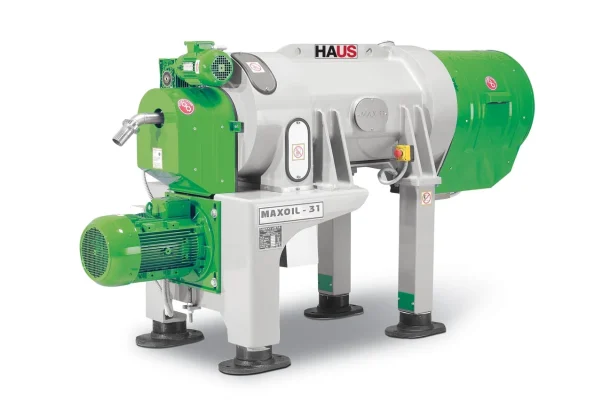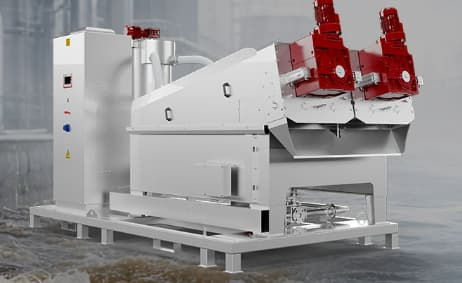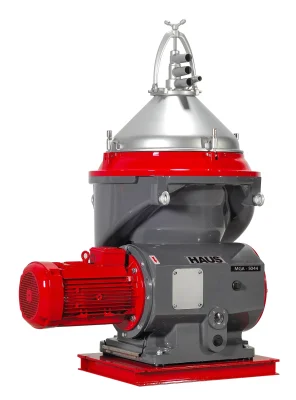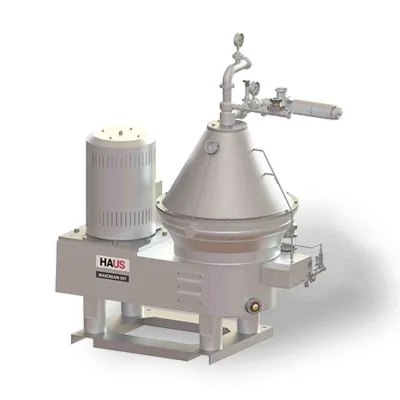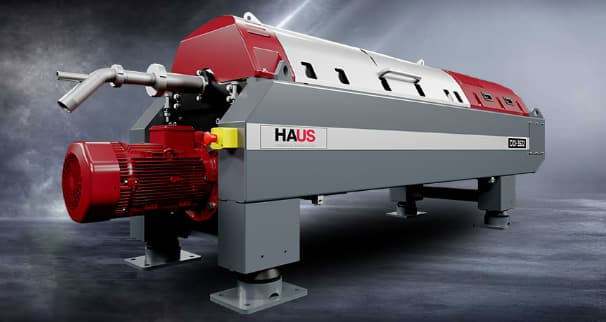




To select the right decanter centrifuge, you need to match four core parameters to the characteristics of the fluid being processed: flow rate (m³/h), bowl diameter, G-force, and scroll differential speed. For the HAUS range, flow rates span 1–180 m³/h and bowl diameters 200–800 mm; choose the DDE, DDF, or DDI series depending on whether the fluid is waste sludge, food product, or industrial liquid.
- Flow rate determines machine size: HAUS covers the range 1–180 m³/h.
- Bowl diameter 200–800 mm; larger bowls deliver higher throughput.
- G-force determines the dryness of the cake after dewatering.
- Scroll differential speed controls cake moisture content and liquid-phase clarity.
- HAUS series: DDE (environmental/wastewater), DDF (food), DDI (industrial).
Four Parameters to Determine Before Selecting a Decanter
Four Parameters to Determine Before Selecting a Decanter
A decanter centrifuge (horizontal scroll centrifuge) performs continuous solid–liquid separation by centrifugal force: the conical–cylindrical bowl rotates at high speed to generate a large G-field, while the scroll (conveyor worm) rotates at a differential speed to push the solid cake toward the conical end; the clarified liquid phase overflows at the other end. The four parameters below collectively determine machine size and separation quality and must therefore be established together, not in isolation.
| Parameter | Effect | Reference Range (HAUS) |
|---|---|---|
| Flow rate | Determines machine size and processing throughput | 1–180 m³/h |
| Bowl diameter | Larger bowl provides higher throughput and longer retention time | 200–800 mm |
| G-force | Determines cake dryness and liquid-phase clarity | Model-dependent |
| Scroll differential speed | Balances cake moisture and solids-recovery efficiency | PLC-controlled |
Flow Rate and Bowl Diameter: How to Size the Machine
Flow Rate and Bowl Diameter: How to Size the Machine
Flow rate is the starting point: you need to know the volume of fluid to be processed per hour (m³/h), along with the inlet solids content (SS or % dry solids). The higher the inlet flow rate or the greater the solids load, the larger the bowl diameter needed to provide adequate settling area and retention time — hence HAUS bowl sizes range from 200 to 800 mm. A larger bowl delivers higher throughput but also increases motor power, frame dimensions, and operating costs, so oversizing should be avoided.
A practical note: size based on peak flow rate rather than average, and allow margin for load fluctuations during peak seasons. For wastewater treatment plants, the sludge flow entering the decanter is typically only a small fraction of the raw water flow rate, so these two figures must be kept separate when sizing.
| Application Scale | Inlet Characteristics | Selection Guidance |
|---|---|---|
| Low flow rate, low solids | Dilute sludge, small batches | Smaller bowl within the 200–800 mm range |
| High flow rate, high solids | Dense sludge, continuous throughput | Larger bowl, higher capacity |
| Highly variable load | Seasonal/shift peaks | Size to peak flow rate + contingency margin |
G-Force and Scroll Differential Speed: Key Factors for Cake Dryness
G-Force and Scroll Differential Speed: Key Factors for Cake Dryness
G-force (relative centrifugal acceleration) is the multiple of gravity generated by the bowl; the higher the G-field, the faster solid particles settle and the drier the cake. Together with the scroll differential speed (the difference in rotational speed between the bowl and the scroll), G-force determines the balance between cake dryness and liquid-phase clarity. A high differential speed discharges the cake quickly, reducing solids retention time and resulting in a wetter cake; a low differential speed retains solids longer for a drier cake but can carry fine solids into the liquid phase if taken too far.
In sludge dewatering, cake dryness also depends on the flocculant polymer dosage: polymer helps fine particles flocculate so that G-force can separate them more effectively. The three variables — G-force, differential speed, and polymer dosage — must therefore be optimized simultaneously during commissioning. On the HAUS range, the high-speed bowl and scroll are PLC-controlled, enabling real-time adjustment of the differential speed to track changing sludge characteristics.
Choosing the HAUS Series by Fluid Type
Choosing the HAUS Series by Fluid Type
Once the flow rate and separation quality requirements are established, the next step is to select the correct series based on the nature of the fluid. HAUS divides its decanter range into three application branches, all sharing the principle of a high-speed bowl combined with a scroll, but differing in hygiene configuration, contact materials, and accessories. Bowl and scroll materials are stainless steel AISI 304 or 316, depending on the corrosion level and hygiene requirements of the industry.
| Series | Main Application | Example Tasks |
|---|---|---|
| DDE | Environmental, wastewater | Biological sludge dewatering, physico-chemical sludge |
| DDF | Food | Oil/protein separation, clarification of food liquids |
| DDI | Industrial | Solid–liquid separation in production lines |
If the objective is fine liquid–liquid phase separation or processing of low-solids fluids (e.g., cream separation from milk, fruit juice clarification, vegetable oil separation), a disk-stack separator from the Separator D/I/F range is more appropriate than a decanter. Decanters handle high-solids fluids effectively thanks to the scroll that continuously conveys the cake out; separators use a disk stack to generate very high G-force for fine-phase separation.
Step-by-Step Selection Process
Step-by-Step Selection Process
A sound decanter selection process moves from inlet data to commissioning trials. The sequence below helps avoid oversizing on capacity or undersizing on G-force — two common errors that misalign capital and operating costs with actual requirements.
| Step | Action | Outcome |
|---|---|---|
| 1 | Measure peak flow rate and inlet solids content | Establish the machine size range |
| 2 | Set target cake dryness / liquid-phase clarity | Guide G-force and differential speed selection |
| 3 | Select series by fluid type (DDE/DDF/DDI) | Match materials and hygiene configuration |
| 4 | Commission with sludge sample + optimize polymer dosage | Confirm actual operating parameters |
HAUS · TURKEY HAUS Decanter Centrifuges distributed by TKT Pumps
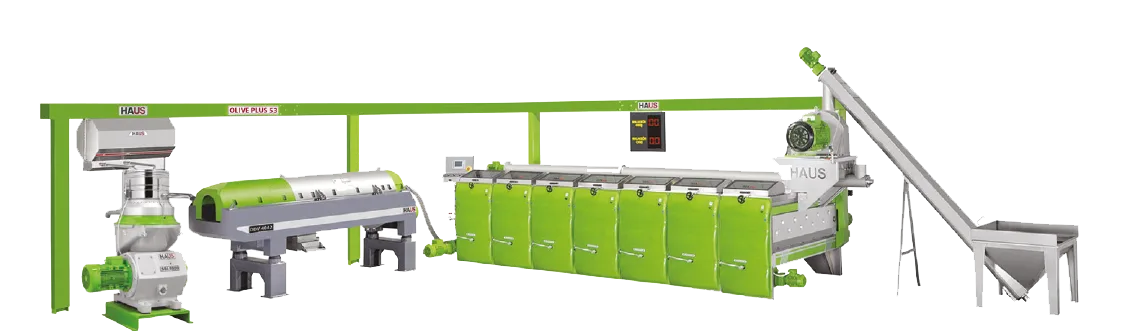
HAUS Centrifuge Technologies was established in 1954 in Aydın, Turkey, specializing in solid–liquid separation centrifuges. The manufacturing facility covers approximately 100,000 m², with products exported to more than 70 countries and certified to ISO 9001, ISO 14001, ISO 22000, and CE. The HAUS decanter range includes the DDE, DDF, and DDI series with flow rates of 1–180 m³/h, bowl diameters of 200–800 mm, bowl and scroll in stainless steel AISI 304/316, and PLC control. TKT Pumps is the authorized distributor of HAUS in Vietnam, with 19+ years of experience, more than 12,000 projects, and 24/7 technical support.
Frequently Asked Questions When Selecting a Decanter Centrifuge
How are flow rate and bowl diameter related?
+
The higher the inlet flow rate or the greater the solids load, the larger the bowl diameter required to provide adequate settling area and retention time. HAUS bowl sizes range from 200 to 800 mm, corresponding to flow rates of 1–180 m³/h; a larger bowl delivers higher throughput but increases motor power and operating costs.
How does G-force affect cake dryness?
+
G-force is the multiple of gravity generated by the bowl; the higher the G-field, the faster solid particles settle and the drier the cake. However, final cake dryness also depends on the scroll differential speed and flocculant polymer dosage, so these three variables must be optimized simultaneously during commissioning.
What is scroll differential speed (differential)?
+
Scroll differential speed is the difference in rotational speed between the bowl and the scroll. A high differential discharges the cake quickly, resulting in a wetter cake; a low differential retains solids longer for a drier cake but can carry fine solids into the liquid phase. On the HAUS range, this parameter is PLC-controlled.
Which series should I choose: DDE, DDF, or DDI?
+
Select based on the type of fluid being processed: DDE for environmental and wastewater applications, DDF for food applications, and DDI for industrial applications. All three share the principle of a high-speed bowl combined with a scroll, but differ in hygiene configuration, contact materials (stainless steel 304/316), and included accessories.
When should a disk-stack separator be used instead of a decanter?
+
When fine liquid–liquid phase separation or processing of low-solids fluids is required (cream separation from milk, fruit juice clarification, vegetable oil separation), the Separator D/I/F disk-stack separator is more appropriate. Decanters handle high-solids fluids effectively, with the scroll continuously conveying the cake out.
Is polymer necessary when dewatering sludge with a decanter?
+
In most sludge dewatering applications, flocculant polymer helps fine particles flocculate so that G-force can separate them more effectively, thereby increasing cake dryness and reducing fine solids in the liquid phase. Polymer dosage should be optimized during commissioning alongside G-force and differential speed settings.
Send your flow rate, solids content, and fluid type so our TKT technical team can recommend the appropriate HAUS series and configuration.
Submit a Consultation Request or hotline 0941.400.488
Source: HAUS Centrifuge Technologies technical documentation (Turkey); compiled by TKT Pumps.