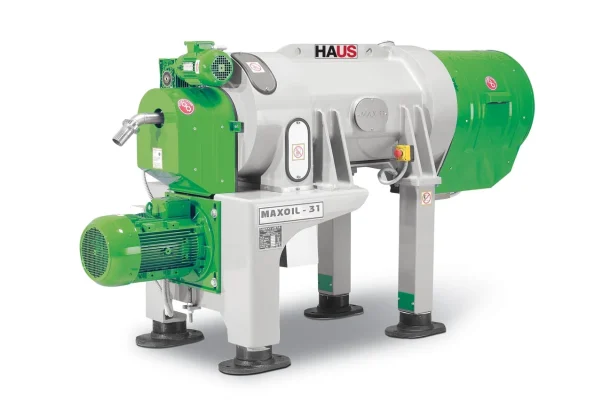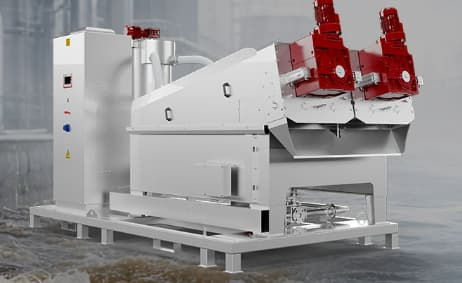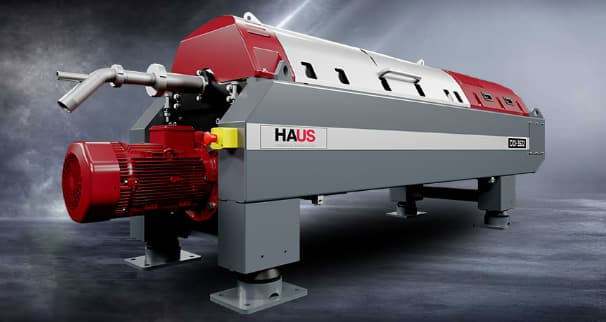




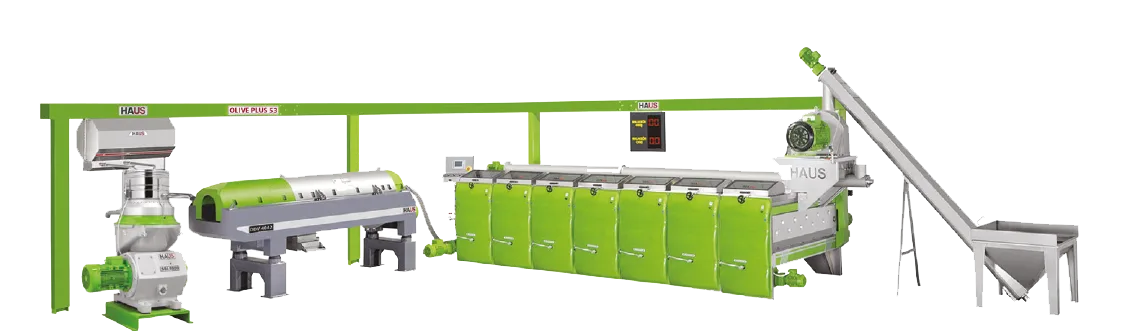
The decanter centrifuge (centrifugal sludge dewatering machine) is a device for continuous wastewater sludge dewatering: it uses centrifugal force to separate solids from water, reducing sludge volume and producing a drier sludge cake that is easier to transport, treat, or landfill. Compared to filter press or belt press, the decanter operates in a closed, automated manner, suited for high and variable sludge flow rates. The DDE series from HAUS (Turkey) is a horizontal sedimentation centrifuge designed specifically for environmental and wastewater applications, with flow rates of 1-180 m³/h, bowl diameters of 200-800 mm, and wetted-parts material in AISI 304/316 stainless steel.
- Decanter separates solids and liquids continuously, without stopping to discharge cake as in a filter press
- Drier sludge cake through the combination of G-force + scroll differential speed + flocculant polymer
- DDE series from HAUS, dedicated to environmental/wastewater applications
- Flow rate 1-180 m³/h, bowl 200-800 mm, stainless steel 304/316
- Closed operation, automated via PLC, reducing odors and labor
How Does the Decanter Centrifuge Dewater Sludge?
Solid-Liquid Separation Principle Using Centrifugal Force
The decanter centrifuge operates on centrifugal force (G-force) to separate phases by density. The conical-cylindrical bowl rotates at high speed, generating a force field many times that of gravity. This forces the heavier solid phase outward against the bowl wall, while the lighter liquid phase remains on the inside.
Inside the bowl, a scroll (conveyor screw) rotates in the same direction but at a differential speed relative to the bowl. This speed differential enables the scroll to continuously scrape the solid sludge layer along the bowl wall toward the conical end and discharge it, while the clarified liquid (effluent) overflows at the cylindrical end on the other side. This allows solid-liquid separation to occur continuously, without stopping the machine to discharge solids.
In wastewater treatment, sludge typically has low solids content and fine particles, so flocculant polymer must be dosed before the sludge enters the decanter to aggregate fine particles into larger flocs, improving separation efficiency and producing a drier sludge cake.
| Component | Role |
|---|---|
| Bowl | Rotates at high speed, generating G-force to separate phases by density |
| Scroll | Rotates at differential speed, continuously conveys solids to the conical end |
| Differential gearbox | Adjusts the speed differential between bowl and scroll |
| Flocculant polymer | Aggregates fine particles into flocs, increasing sludge cake dryness |
| PLC control panel | Automates operation, monitors speed and torque |
Why Choose a Decanter for Sludge Dewatering?
Compared to Filter Press and Belt Press
Each sludge dewatering technology has its own strengths. The decanter centrifuge is typically selected when the plant needs to handle high sludge flow rates, continuous operation, and a closed system with minimal odor emission. The table below provides a qualitative comparison to help select the right technology for each requirement.
| Criterion | Decanter Centrifuge | Filter Press | Belt Press |
|---|---|---|---|
| Operation mode | Continuous | Batch | Continuous |
| Enclosure / odor | Closed, low odor | Open during cake discharge | Open |
| Automation | High (PLC) | Medium | Medium |
| Footprint | Compact | Large | Large |
| Power consumption | Higher | Low | Low |
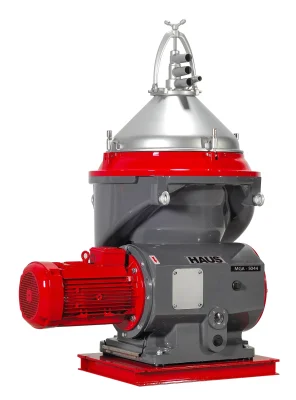
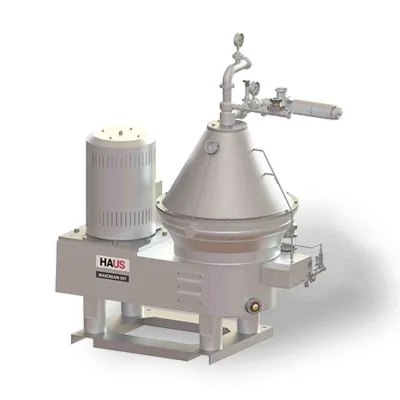
The decanter is suitable for municipal wastewater treatment plants, food and beverage factories, textile dyeing, paper, chemical, and many other industries with stable or highly variable sludge flow rates. When fine-phase separation (liquid-liquid) is required rather than solid-liquid separation, a disk-stack separator is used — this is a different equipment category within the HAUS product range.
Key Factors Determining Sludge Cake Dryness
G-Force, Differential Speed, and Polymer Dosage
Sludge cake dryness is not determined by a single parameter but results from the interplay of multiple factors. Understanding these variables helps optimize operation and avoid polymer waste.
| Factor | Effect |
|---|---|
| G-force (bowl speed) | Higher G-force increases the dewatering pressure, producing a drier sludge cake |
| Scroll differential speed | Lower differential speed keeps solids in the bowl longer, increasing dryness; too low risks blockage |
| Polymer dosage | Adequate polymer forms firm flocs; too little or too much both reduce efficiency |
| Bowl diameter | Larger bowls (up to 800 mm) provide higher throughput capacity |
| Feed sludge characteristics | Solids content, particle size, and viscosity directly affect results |
With the bowl range of 200-800 mm and flow rates of 1-180 m³/h, the DDE series covers a wide range of treatment plant scales, from small stations to high-capacity plants. Selecting the correct machine size should be based on actual sludge characteristics and design flow rate.
Materials and Practical Operation
Stainless Steel 304/316 and PLC Automation
Wetted-parts components on the DDE series are manufactured from AISI 304 or 316 stainless steel. AISI 304 meets the requirements of most standard wastewater applications, while AISI 316 offers better corrosion resistance in environments with chlorides or high corrosivity. Material selection should be based on the sludge composition of each specific plant.
Operation is controlled via PLC: the system monitors bowl speed, scroll differential speed, and torque for stable running, and automatically adjusts when the sludge load changes. With closed and automated operation, the decanter significantly reduces manual labor and limits odor emission compared to open sludge pressing methods.
To maintain consistent performance, periodic maintenance schedules are required for the scroll, bearings, and polymer dosing system. Scroll wear caused by abrasive sludge is a factor to monitor, especially with industrial sludge containing sand or hard particles.
HAUS · TURKEY HAUS Sludge Separation Centrifuge
HAUS Centrifuge Technologies was established in 1954 in Aydın (Turkey), specializing in solid-liquid separation centrifuges. The manufacturing facility covers approximately 100,000 m², with products exported to more than 70 countries, certified to ISO 9001, ISO 14001, ISO 22000, and CE. The HAUS decanter range includes DDE (environmental/wastewater), DDF (food), and DDI (industrial), with flow rates of 1-180 m³/h and bowl diameters of 200-800 mm. The DDE series is specifically configured for continuous wastewater sludge dewatering, reducing sludge volume and producing a drier sludge cake. TKT Pumps is the HAUS distributor in Vietnam, providing consultation for model selection, installation, and spare parts.
Frequently Asked Questions
How does a decanter centrifuge differ from a filter press?
+
The decanter separates solids and liquids continuously using centrifugal force and a scroll that conveys solids out, operating in a closed and automated manner; whereas the filter press works in batches and must stop to discharge the sludge cake. The decanter suits high flow rates and continuous operation, while the filter press produces a drier cake and consumes less power per batch.
Is polymer required for sludge dewatering with a decanter?
+
Yes. Wastewater sludge typically contains fine particles, so flocculant polymer must be dosed to aggregate them into larger flocs, improving separation efficiency and producing a drier sludge cake. Polymer dosage must be adjusted according to sludge characteristics to optimize cost and cake dryness.
What are the flow rate and bowl size options for the HAUS DDE series?
+
The HAUS decanter range has flow rates of 1-180 m³/h and bowl diameters of 200-800 mm, with wetted parts in AISI 304/316 stainless steel. The specific machine size is selected based on the design flow rate and sludge characteristics of each treatment plant.
What factors affect sludge cake dryness?
+
Sludge cake dryness depends on G-force (bowl speed), scroll differential speed, and polymer dosage, combined with the feed sludge characteristics. Increasing G-force and optimizing differential speed together with appropriate polymer will produce a drier sludge cake.
Should I choose stainless steel 304 or 316 for a sludge separation machine?
+
Stainless steel 304 is suitable for most standard wastewater applications. When the sludge contains chlorides or is highly corrosive, stainless steel 316 should be selected for better corrosion resistance. The choice should be based on an actual sludge composition analysis.
What industries can use a decanter centrifuge?
+
Decanters are used in municipal wastewater treatment plants, food and beverage factories, textile dyeing, paper, chemical, and many other industries requiring sludge dewatering. For food-grade or specific industrial sludge, HAUS offers the DDF and DDI series respectively.
Need consultation on selecting the right DDE sludge separation centrifuge for your plant’s flow rate and sludge characteristics? The TKT Pumps technical team with 19+ years of experience and over 12,000 projects is ready to assist.
Send a consultation request or hotline 0941.400.488
Source: technical documentation from HAUS Centrifuge Technologies (Turkey); compiled by TKT Pumps.