



For sludge dewatering at wastewater treatment stations, three technologies are commonly considered: the decanter centrifuge, the filter press, and the belt press. When a station requires continuous, automated, odor-contained, and compact operation, the decanter centrifuge is typically well-suited; when very dry sludge cake is the priority and batch operation with manual handling is acceptable, the filter press has the advantage; while the belt press suits applications where low power consumption is desired and an open system is acceptable. This article analyzes all three options across key criteria to help you select the right technology for your actual conditions.
- Decanter: continuous, automated, enclosed with minimal odor, compact footprint
- Filter press: batch operation, very dry sludge cake, high manual labor requirement
- Belt press: continuous, low power consumption, open system prone to odor dispersal
- All three require flocculant polymer for sludge flocculation before separation
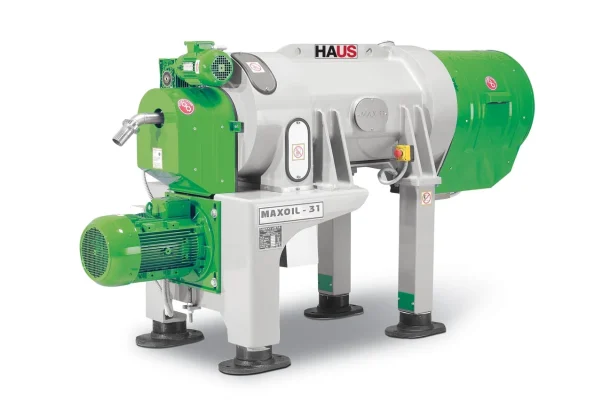
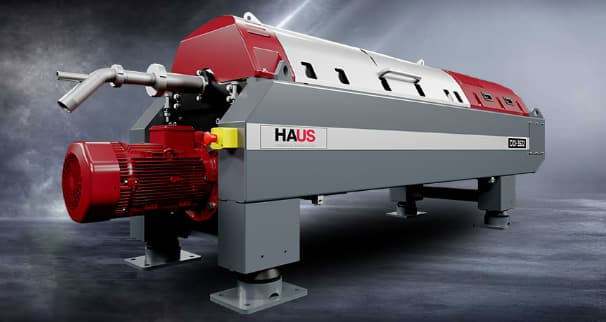
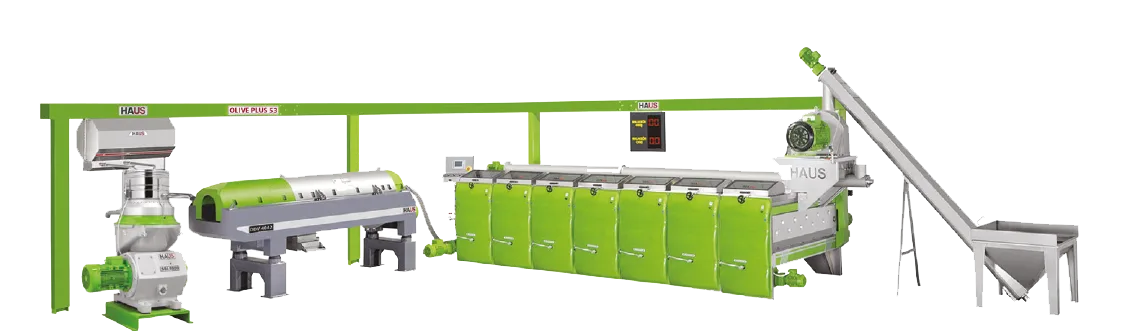
- HAUS DDE series decanter for automated wastewater treatment station operation
Three Common Sludge Dewatering Technologies
How Decanter, Filter Press, and Belt Press Differ
Sludge dewatering is the step of removing water from sludge after biological or physico-chemical treatment, to reduce volume and lower transportation and disposal costs. Three different working principles:
The decanter centrifuge uses centrifugal force (G-force): a conical-cylindrical bowl rotates at high speed while the scroll (conveyor screw) rotates at a differential speed to push solids toward the conical end, with the liquid phase overflowing from the other end. The process runs continuously, enclosed within the machine body.
The filter press pumps sludge into chambers between filter cloth-covered plates, where pressure forces water through the cloth, retaining solids to form a sludge cake. This is a batch process: feed – press – open plates – discharge cake – clean.
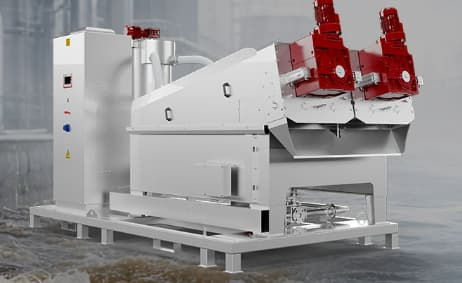
The belt press spreads sludge onto a continuously moving filter belt and squeezes it between two belts through a roller system to extract water. The system is typically open, easy to observe but also prone to odor dispersal.
| Criterion | Decanter (centrifuge) | Filter Press | Belt Press |
|---|---|---|---|
| Operating mode | Continuous | Batch | Continuous |
| Automation level | High | Low (highly manual) | Moderate |
| Odor containment | Enclosed system | Relatively enclosed | Open system |
| Installation footprint | Compact | Large | Large |
Sludge Cake Dryness and Determining Factors
What Determines Sludge Cake Dryness
Sludge cake dryness (solids content) is a key criterion as it determines the volume of sludge requiring further handling. For the decanter centrifuge, dryness depends on G-force, the differential speed between the bowl and scroll, and flocculant polymer dosage. Increasing G-force and optimizing polymer dosage yields drier cake from the same machine.
The filter press typically produces very dry sludge cake due to high pressing pressure and extended batch hold time, making it suitable when the goal is maximum volume reduction and batch handling is not a concern. The belt press delivers moderate dryness in exchange for low power consumption and straightforward operation.
One important shared requirement: all three technologies require flocculant polymer to flocculate sludge particles before separation. The wrong polymer type or incorrect dosage results in wet cake, turbid filtrate, and excessive chemical use — applicable to decanter, filter press, and belt press alike.
Operation, Labor, and Odor
Hidden Costs Lie in the Operation Phase
Equipment purchase price is only one component. Annual operating costs truly reflect the total cost of ownership:
- Decanter: runs continuously and automatically via PLC, requires minimal operator attendance, and the enclosed system limits odor within the facility. The trade-off is high-speed rotating components that require periodic maintenance.
- Filter press: each batch requires an operator to open the plates, remove the sludge cake, and clean the filter cloth — labor-intensive with downtime between batches.
- Belt press: low power consumption but the open system readily disperses odors; the filter belt requires continuous washing and periodic replacement.
For wastewater treatment stations located near residential areas or within food processing plants, odor containment is typically prioritized, tipping the balance toward enclosed systems such as the decanter.
Selecting Technology Based on Station Conditions
When to Choose a Decanter, Filter Press, or Belt Press
No single technology suits every situation — the right choice must be based on sludge flow rate, sludge characteristics, available space, and odor requirements. General guidance:
| Station Conditions | Recommended Direction |
|---|---|
| Requires continuous operation, minimal staffing, limited space | Decanter (centrifuge) |
| Near residential areas / food processing plants, odor containment priority | Decanter |
| Priority on very dry sludge cake, accepts manual batch operation | Filter Press |
| Priority on low power consumption, ample space, less odor-sensitive | Belt Press |
| High sludge flow rate, requires automation | Decanter |
For stations requiring continuous and automated sludge dewatering, the decanter centrifuge is a commonly selected option thanks to its combination of enclosed system, compact footprint, and high automation level. Refer to the wastewater treatment solutions page to place the dewatering equipment in its correct position within the process line.
HAUS · TURKEY HAUS Decanter Centrifuge for Sludge Dewatering
HAUS Centrifuge Technologies (Turkey, established 1954 in Aydın) specializes in solid-liquid separation centrifuges. The manufacturing facility covers approximately 100,000 m², with products exported to over 70 countries and certified to ISO 9001, ISO 14001, ISO 22000, and CE.
The DDE decanter series is designed for environmental and wastewater applications, providing continuous, automated sludge dewatering. The machines use a high-speed bowl combined with a PLC-controlled scroll, constructed from AISI 304/316 stainless steel. Within the HAUS decanter product range, flow rates span 1–180 m³/h and bowl diameters range from 200–800 mm depending on model — suitable from small stations to large-scale installations. In addition to the DDE for environmental use, HAUS also offers the DDF for food applications and the DDI for industrial use.
Frequently Asked Questions
What is the fundamental difference between a decanter centrifuge and a filter press?
+
The decanter centrifuge separates solids and liquid continuously using centrifugal force and a scroll conveyor, operating automatically in an enclosed system with a compact footprint. The filter press operates in batches, using pressure to force water through filter cloth, producing very dry sludge cake but requiring extensive manual handling per batch.
Which technology produces drier sludge cake?
+
The filter press typically produces very dry sludge cake due to its high pressing pressure and long batch hold time. The decanter achieves high and consistent dryness when G-force, differential speed, and polymer are optimized; the belt press delivers moderate dryness. Actual dryness depends on sludge type and polymer dosage.
Does a decanter centrifuge require polymer?
+
Yes. All three technologies — decanter, filter press, and belt press — require flocculant polymer to flocculate sludge particles before separation. Selecting the correct polymer type and dosage results in drier cake, clearer filtrate, and reduced chemical consumption.
Why do stations near residential areas tend to choose the decanter?
+
The decanter is an enclosed system that limits odor dispersal to the surrounding environment, whereas the belt press is an open system that readily releases odors. For stations located near residential areas or within food processing plants, the odor containment factor therefore favors the decanter.
Does a decanter centrifuge require a large footprint?
+
The decanter has a compact design compared with filter press and belt press at equivalent capacity, making it suitable for stations with limited space. This is one reason the decanter is often selected for installation in facilities with a small floor area.
Which HAUS decanter series is designed for wastewater treatment?
+
HAUS offers the DDE decanter series for environmental and wastewater applications, providing continuous, automated sludge dewatering in AISI 304/316 stainless steel. Flow rates span 1–180 m³/h and bowl diameters range from 200–800 mm depending on model. HAUS also offers the DDF for food applications and the DDI for industrial use.
Need guidance on selecting the right sludge dewatering technology for your sludge type and station scale? The TKT Pumps technical team with 19+ years of experience and 12k+ projects is ready to assist.
Submit a Consultation Request or hotline 0941.400.488
Source: HAUS Centrifuge Technologies technical documentation, compiled by TKT.