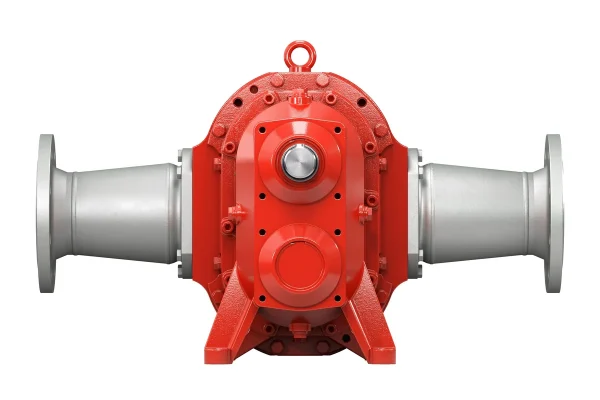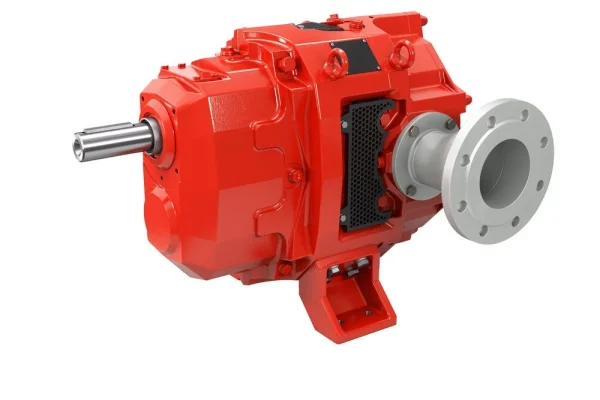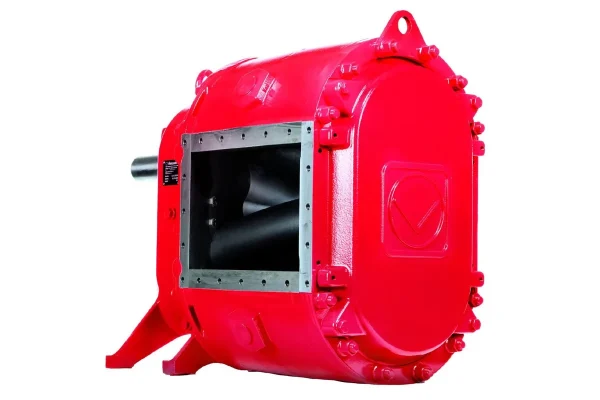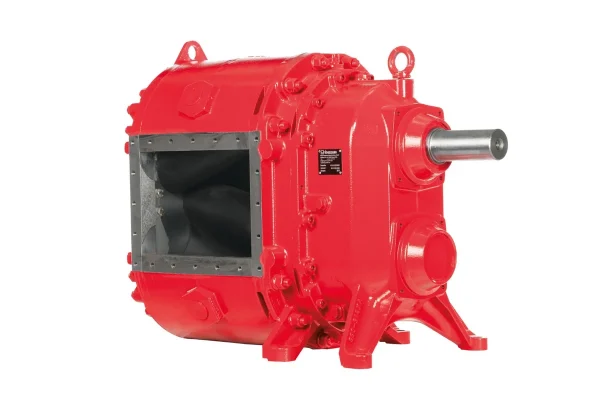




Advanced rotary lobe pumps that simultaneously meet EHEDG, 3-A, and ATEX are a suitable choice for food, pharmaceutical, and cosmetic production lines with stringent hygiene requirements and potentially explosive environments. Within this category, the OMAC C/CF series (Italy) stands out for its front-loading mechanical seal — technicians can replace the seal on-site without removing the pump body from the pipeline, reducing downtime. This article explains the construction, hygiene standards, and how to select the right pump series.
- Rotary lobe pump = rotary positive displacement pump, 2 non-contacting rotors, smooth pumping with low shear.
- OMAC C/CF meets EHEDG + 3-A + ATEX simultaneously for high-hygiene and potentially explosive areas.
- Front-loading mechanical seal: quick replacement without removing the pump from the pipeline.
- OMAC BF full stainless steel Tri-Clamp, surface roughness 0.8–2 µm, pressure up to 20 bar.
- Product-contact material AISI 316L, CIP/SIP compatible.
Working Principle of Rotary Lobe Pumps and Why They Suit Shear-Sensitive Fluids
Two Rotors Rotating in Synchrony, Without Contact
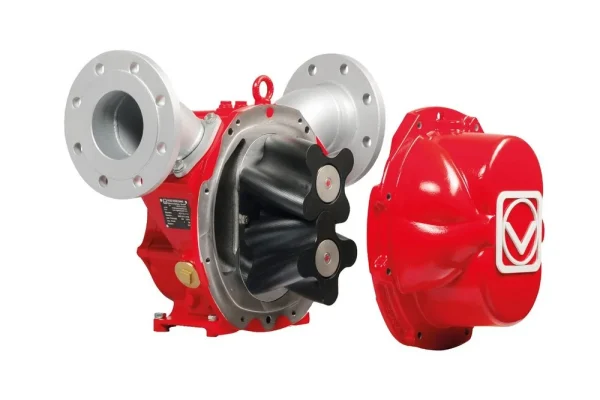
A rotary lobe pump is a type of rotary positive displacement pump. Two lobe-shaped rotors rotate in opposite directions, synchronized by a timing gearbox at the rear, maintaining a very small clearance and never making direct contact with each other. As a result, the pump chamber requires no lubrication, generates no metal particles, and does not contaminate the product.
With each revolution, the cavities between the rotors and the pump casing draw fluid in at the inlet and push it to the outlet at a fixed volume. This mechanism produces smooth, low-pulsation flow with low shear on the fluid structure — an important characteristic when pumping cream, sauce, yogurt, fruit-particle liquids, or meat pieces. This also represents a clear difference from centrifugal pumps (which are better suited for thin fluids and generate higher shear).
The main wear components in a rotary lobe pump are the mechanical seal and the rotor clearance. Therefore, the seal design — in particular how it is removed and installed — directly affects maintenance cost and downtime.
How EHEDG, 3-A, and ATEX Differ
Three Standard Sets for Three Different Objectives
These three groups of standards are often mentioned together but address different concerns. Understanding each correctly helps you determine which certifications a pump series needs to meet for each production area.
| Standard | Objective | Typical Application |
|---|---|---|
| EHEDG | Hygienic design, effective clean-in-place (CIP), no fluid pooling | Food, beverages, pharmaceuticals |
| 3-A | Dairy and food industry hygiene standard (North America) | Milk, cream, products susceptible to contamination |
| ATEX | Equipment safety in potentially explosive environments | Alcohol, solvents, flavorings, areas with flammable gas/dust |
The OMAC C/CF series is designed to meet all three simultaneously: EHEDG and 3-A for hygiene requirements, and ATEX for areas with explosion risk. This makes it suitable for production lines that process shear-sensitive fluids while also working with volatile solvents or flavorings.
Front-Loading Mechanical Seal: Faster Maintenance
Replace the Seal Without Removing the Pump from the Pipeline
On many rotary lobe pumps, replacing the mechanical seal requires removing the entire pump body from the pipeline, which leads to production line interruption and contamination risk when the pipeline is opened. The OMAC C/CF series uses a front-loading seal: simply open the pump chamber cover to access and replace the seal immediately, while the pump body remains on the pipeline.
For food or pharmaceutical production lines running in batches and performing regular CIP/SIP, the seal is a wear part that requires periodic replacement. The ability to replace it quickly on-site helps reduce downtime and simplifies the cleaning procedure after maintenance. This is a point worth considering when total operating cost depends more on maintenance downtime hours than on the initial purchase price.
Choosing Between the C/CF or BF Series for Your Application
Quick Comparison of Two Advanced Options
When both hygiene and pressure requirements are high, two options worth considering in the OMAC catalog are the C/CF series (focused on certifications and maintenance) and the BF series (focused on surface roughness and full stainless steel construction).
| Criterion | OMAC C/CF | OMAC BF |
|---|---|---|
| Orientation | Advanced, full certifications | Full stainless steel, smooth surface |
| Certifications | EHEDG + 3-A + ATEX | Hygienic design, full stainless steel |
| Mechanical seal | Front-loading, quick replacement | Per configuration |
| Connections | Hygienic per standard | Tri-Clamp |
| Surface roughness | Per configuration | 0.8–2 µm |
| Pressure | Industrial-grade | Up to 20 bar |
General guidance: choose C/CF when a complete EHEDG/3-A/ATEX certification package is needed and on-site seal maintenance speed is a priority; choose BF when preference is for a smooth product-contact surface (0.8–2 µm), convenient Tri-Clamp connections, and operation at pressures up to 20 bar. Product-contact materials in both series are AISI 316L and both support CIP/SIP.
Practical Application in Production Facilities
When to Use Advanced Rotary Lobe Pumps
Advanced rotary lobe pumps deliver value at positions where the fluid is both shear-sensitive and high-viscosity, sometimes containing solid particles, and where the area requires strict hygiene:
- Food & beverage: transferring cream, sauces, jam, pastry filling, fruit-particle liquids; structure preservation and regular CIP/SIP are required.
- Pharmaceuticals: syrup, gel, suspensions in areas requiring hygienic design and material traceability.
- Cosmetics: moisturizing creams, lotions, high-viscosity fluids requiring smooth, low-shear pumping; areas that may contain solvents require ATEX.
For thin fluids at high flow rates, sanitary centrifugal pumps are generally more economical; for very high-viscosity fluids, eccentric screw pumps are an alternative. Rotary lobe pumps occupy the middle range: medium-to-high viscosity, shear-sensitive fluids, potentially containing particles — exactly where the C/CF and BF series perform well.
OMAC · Italy Sanitary Rotary Lobe Pumps Distributed by TKT Pumps
OMAC (Italy) specializes in sanitary rotary lobe pumps for food, chemical, and cosmetic industries, with body and rotor materials in AISI 316L. The C/CF series is the advanced tier meeting EHEDG + 3-A + ATEX with a front-loading mechanical seal; the BF series is full stainless steel Tri-Clamp with surface roughness 0.8–2 µm and pressure up to 20 bar. The catalog also includes the B series (17 sizes, flow rate up to 315 m³/h, pressure up to 20 bar), BA/BB (high hygiene per 3-A, self-draining, CIP/SIP), and BE (IEC flange monobloc, handles solid particles). TKT Pumps provides consulting on sizing and seal configuration for each application — with 19+ years of experience, 12k+ projects, and 28+ distributed brands.
Frequently Asked Questions
How does an EHEDG lobe pump differ from a standard lobe pump?
+
An EHEDG-certified lobe pump is designed for effective clean-in-place (CIP), with no dead zones where fluid can pool and easy material traceability for product-contact surfaces. A standard lobe pump may meet technical requirements for flow rate and pressure but does not guarantee these hygiene criteria, making it less suitable for food and pharmaceutical applications.
When is an ATEX-rated lobe pump required?
+
When the pump operates in an area with explosion risk — for example, production lines using alcohol, solvents, volatile flavorings, or areas with combustible dust. ATEX ensures the equipment does not become an ignition source. The OMAC C/CF series meets ATEX along with EHEDG and 3-A, making it suitable for areas that require both hygiene and explosion protection.
What are the benefits of a front-loading seal?
+
A front-loading mechanical seal allows seal replacement without removing the pump body from the pipeline. This results in shorter downtime and a simpler cleaning procedure after maintenance — particularly valuable for batch production lines that perform frequent CIP/SIP.
Should I choose OMAC C/CF or BF?
+
Choose C/CF when a complete EHEDG/3-A/ATEX certification package is needed and on-site seal maintenance speed is a priority. Choose BF when preference is for a smooth product-contact surface (roughness 0.8–2 µm), Tri-Clamp connections, and operation at pressures up to 20 bar. TKT can provide advice based on the specific fluid type, viscosity, and installation environment.
Can a rotary lobe pump handle fluids containing solid particles?
+
Yes. Because the two rotors do not contact each other and the flow is low-shear, a rotary lobe pump can transfer high-viscosity fluids containing solid particles such as fruit pieces or meat with minimal structural damage. Particle handling capability depends on pump size and rotor type — consultation based on actual particle size is recommended.
Compared to a sanitary centrifugal pump, when should a rotary lobe pump be used?
+
A sanitary centrifugal pump is suited to thin fluids at high flow rates. A rotary lobe pump is appropriate when the fluid is medium-to-high viscosity, shear-sensitive, or contains solid particles, and a smooth, low-shear flow is needed. Many production facilities use both for different stages on the same production line.
Need to select a rotary lobe pump meeting EHEDG/3-A/ATEX for your production line? The TKT Pumps technical team provides advice on pump sizing, rotor type, and seal configuration to match your specific fluid and installation environment.
Submit a Consultation Request or hotline 0941.400.488
Source: OMAC (Italy) technical documentation for sanitary rotary lobe pump series C/CF, BF, B, BA/BB, BE. Compiled by TKT Pumps.