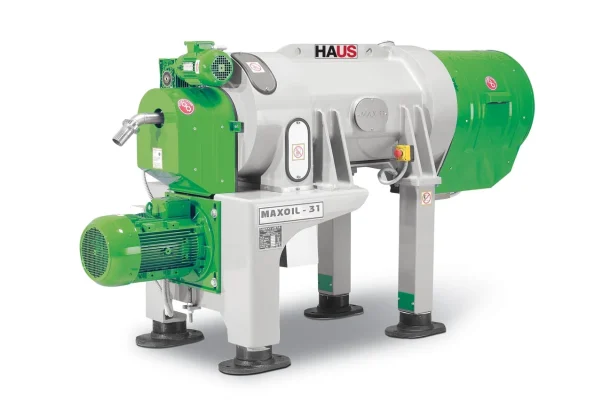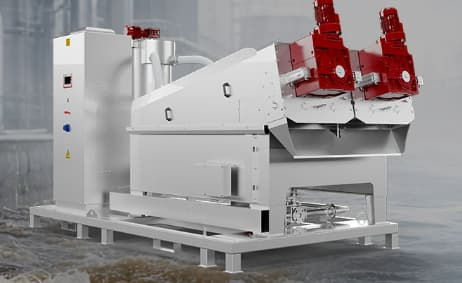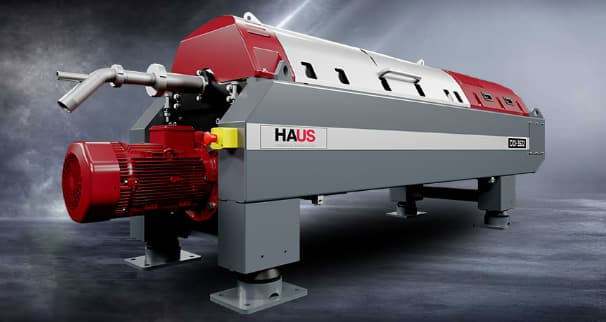




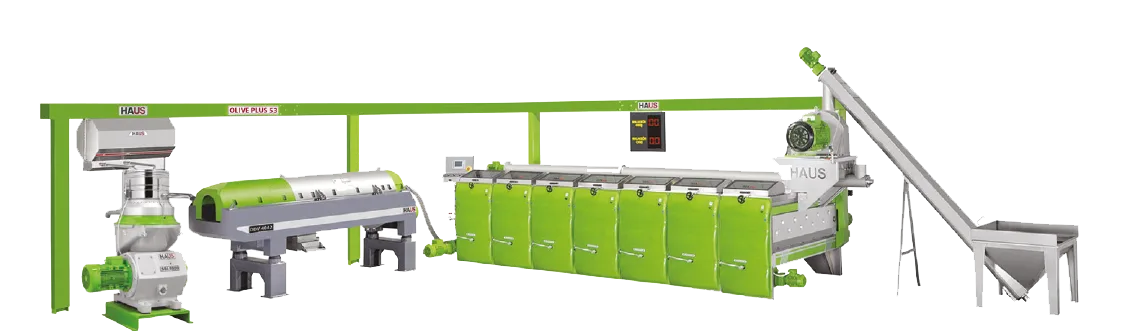
A decanter centrifuge (also called a sedimentation centrifuge or scroll centrifuge) is a continuous solid-liquid separation device that uses centrifugal force, employing a high-speed rotating conical-cylindrical bowl combined with a differential-speed scroll conveyor to discharge the solid cake. Unlike batch centrifuges, a decanter feeds material and discharges solids continuously, making it suitable for sludge dewatering, oil separation, protein separation, and food raw-material clarification at industrial scale.
- Decanter = horizontal sedimentation centrifuge, continuous solid-liquid separation by G-force
- Main mechanism: high-speed rotating bowl + differential-speed scroll conveyor to discharge solids
- Applications: sludge dewatering (requires flocculant polymer), oil/protein separation, food clarification
- HAUS offers 3 series by sector: DDE (environmental), DDF (food), DDI (industrial)
- Flow rate 1–180 m³/h, bowl diameter 200–800 mm, AISI 304/316 stainless steel
What Is a Decanter Centrifuge?
Definition and Terminology
A decanter centrifuge is a horizontal sedimentation centrifuge — a machine that separates solid-liquid mixtures continuously. The name “decanter” derives from the verb “to decant” — the process of separating the clarified liquid from the settled solids. The defining difference from other separation devices is that a decanter operates continuously: the feed slurry is pumped in without interruption, the solid phase is conveyed out at one end by the scroll, and the liquid phase overflows at the other end — no machine shutdown is needed to discharge solids.
The machine is well suited when the feed stream contains a high solids content and large-throughput solid-liquid separation is required. This is why the decanter centrifuge has become the central piece of equipment in wastewater treatment plants, food processing facilities, and many industrial phase-separation processes.
Working Principle of the Sedimentation Centrifuge
Centrifugal Force Separates Phases by Density
The decanter operates on a fundamental principle: when rotating at high speed, the centrifugal force (G-force) acting on the mixture is many times greater than gravity, causing phases of different densities to separate rapidly. Inside the conical-cylindrical rotating bowl, the denser solid phase is forced outward against the bowl wall, while the lighter liquid phase migrates toward the axis. A co-axial scroll conveyor, rotating at a differential speed relative to the bowl, continuously scrapes the solid cake along the bowl wall toward the conical discharge end, while the clarified liquid flows back toward the cylindrical end and overflows through adjustable weir plates.
| Component | Role in the separation process |
|---|---|
| Conical-cylindrical bowl | Rotates at high speed to generate G-force; solid phase sediments against the bowl wall |
| Scroll conveyor | Rotates at differential speed; continuously conveys solid cake to the conical discharge end |
| Overflow weir | Adjusts liquid pool depth, affecting the clarity of the liquid phase |
| PLC control system | Monitors bowl speed, differential speed, and torque for optimum operation |
The three key operating parameters are G-force (governs separation efficiency), differential speed between bowl and scroll (determines solids retention time and cake dryness), and flocculant polymer dosage for sludge applications. A larger bowl diameter provides higher processing capacity; on HAUS machines, bowl diameters range from 200 to 800 mm depending on model, with flow rates from 1 to 180 m³/h.
How Does a Decanter Differ from a Disk-Stack Separator?
Two Families of Centrifugal Separators
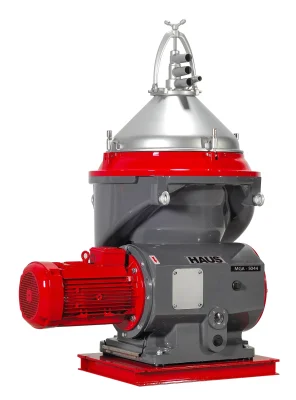
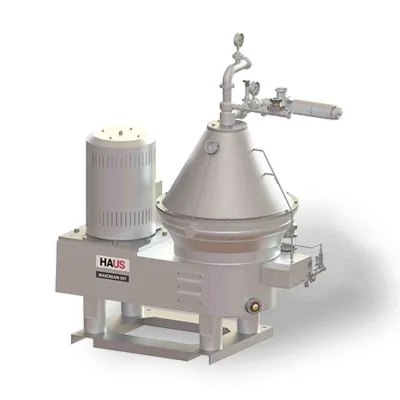
Many users confuse the decanter with the disk-stack separator because both are centrifuges. However, they address different problems. The decanter excels with streams that have a high solids content and require continuous solids discharge via the scroll. A disk-stack separator uses a stack of conical discs to divide the flow into thin layers, achieving very high G-force to separate fine phases — such as cream from milk or water from oil — when the solids content is very low.
| Criterion | Decanter (sedimentation centrifuge) | Disk-stack separator |
|---|---|---|
| Separation mechanism | Horizontal bowl + scroll conveyor | Conical disc stack, very high G-force |
| Suitable for | Solid-liquid separation, high solids content | Fine-phase separation (liquid-liquid / low solids) |
| Application examples | Sludge dewatering, oil solids separation | Cream/milk separation, fruit juice clarification |
| HAUS series | DDE / DDF / DDI | Separator D / I / F |
When advising on equipment selection, correctly identifying the right family of machines from the outset prevents misguided investment: thick sludge streams call for a decanter, while streams requiring two clear liquid phases to be separated call for a separator.
Common Applications of the Decanter Centrifuge
From Wastewater Treatment to Food Processing
The most frequently cited application is sludge dewatering in wastewater treatment: the decanter reduces sludge moisture content to lower transport volume and processing costs, typically combined with flocculant polymer dosing to improve sludge cake dryness. In the food industry, decanters separate vegetable oils, isolate proteins, and clarify or classify raw materials. In other industrial processes, the machine handles solid removal, liquid clarification, and recovery of valuable solid fractions.
- Environmental (HAUS DDE): sludge dewatering at municipal and industrial wastewater treatment plants.
- Food (HAUS DDF): oil separation, protein isolation, and raw-material clarification using sanitary-grade stainless steel construction.
- Industrial (HAUS DDI): solid-liquid separation across diverse production lines.
Because the machine operates with corrosive media or under hygienic requirements, wetted parts are typically manufactured from AISI 304 or 316 stainless steel depending on the severity of the application.
HAUS · TURKEY Decanter Centrifuge Solutions
HAUS Centrifuge Technologies (established in 1954 in Aydın, Turkey) specialises in solid-liquid centrifugal separation equipment, with a manufacturing facility of approximately 100,000 m² and products exported to more than 70 countries. The management system is certified to ISO 9001, ISO 14001, ISO 22000, and CE standards. The HAUS decanter range includes DDE for environmental/wastewater, DDF for food, and DDI for industrial applications; flow rates 1–180 m³/h, bowl diameter 200–800 mm, high-speed bowl and scroll controlled by PLC, wetted parts in AISI 304/316 stainless steel. TKT Pumps distributes and provides configuration consulting matched to each sludge type and separation stream.
Frequently Asked Questions
Are a decanter centrifuge and a sedimentation centrifuge the same thing?
+
Yes. “Decanter centrifuge”, “sedimentation centrifuge”, and “scroll centrifuge” are different names for the same type of equipment: a horizontal sedimentation centrifuge that continuously separates solids from liquid using a rotating bowl and scroll conveyor.
What phases can a decanter separate?
+
A decanter primarily separates solids from liquid and is well suited to high-solids feeds. Some applications also achieve simultaneous three-phase separation (solids – heavy liquid – light liquid), for example in oil separation, depending on machine configuration.
Why does sludge dewatering require polymer?
+
Flocculant polymer causes fine solid particles to agglomerate into larger flocs, making them easier to sediment and separate under centrifugal force. The correct polymer dosage improves sludge cake dryness and the clarity of the liquid phase.
How does bowl diameter affect processing capacity?
+
A larger bowl diameter provides higher processing capacity. On the HAUS range, bowl diameters span 200–800 mm and flow rates from 1 to 180 m³/h, selected according to actual application requirements.
When should you choose a separator instead of a decanter?
+
If the stream to be separated consists of two liquid phases or contains very little solid and requires high clarity (such as cream separation from milk or fruit juice clarification), a disk-stack separator is more appropriate than a decanter.
What materials does the HAUS decanter use for food-grade applications?
+
Wetted parts typically use AISI 304 or 316 stainless steel. The DDF food series emphasises materials and design that meet hygienic requirements, suitable for oil separation, protein isolation, and raw-material clarification.
Need to identify the right decanter for your sludge type or separation stream? The TKT Pumps technical team, with 19+ years of experience and 12,000+ projects, is ready to advise on configuration, flow rate, and materials.
Submit a Consultation Request or hotline 0941.400.488
Source: technical documentation by HAUS Centrifuge Technologies (Turkey); compiled by TKT.