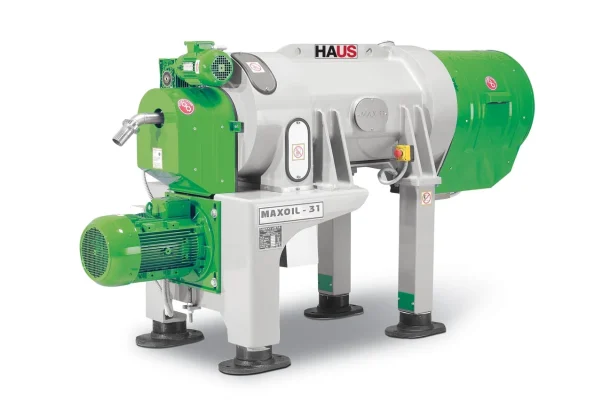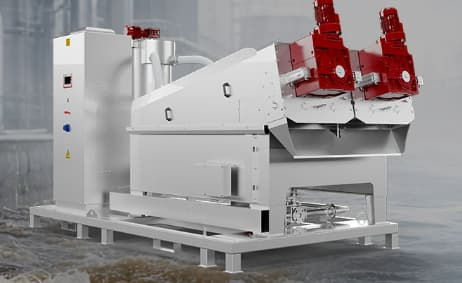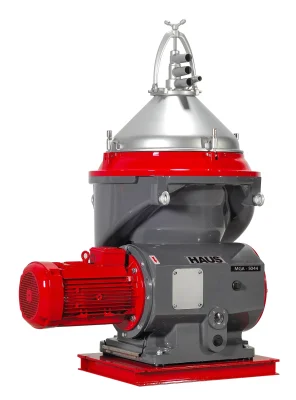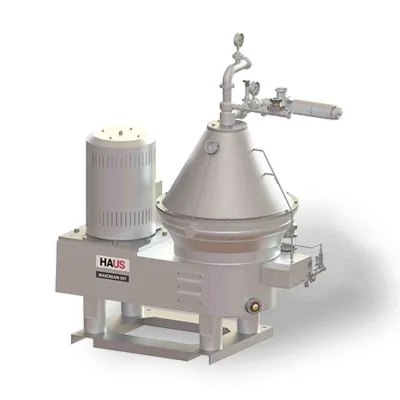




The disk-stack separator is a centrifuge that uses very high G-force to separate phases of differing densities at a fine level: separating cream from milk, clarifying fruit juice, or removing water and sediment from vegetable oil and fish oil. Unlike the horizontal decanter centrifuge — which handles high-solids mixtures — the disk-stack separator divides the flow into thin layers between multiple stacked conical discs to achieve high-precision liquid-liquid or low-solids liquid separation.
- Fine-phase separation via stacked conical discs + high G-force
- Applications: cream/milk separation, fruit juice clarification, vegetable oil & fish oil separation
- Suited for liquid-liquid or low-solids liquid mixtures
- AISI 304/316 stainless steel for food hygiene requirements
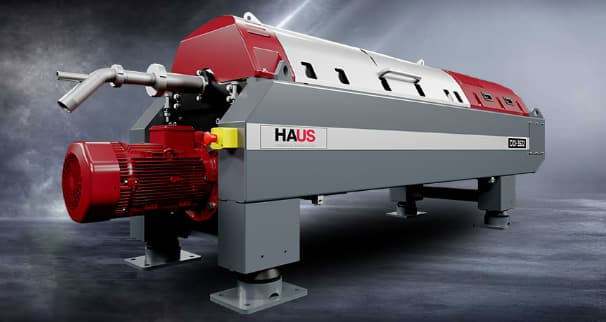
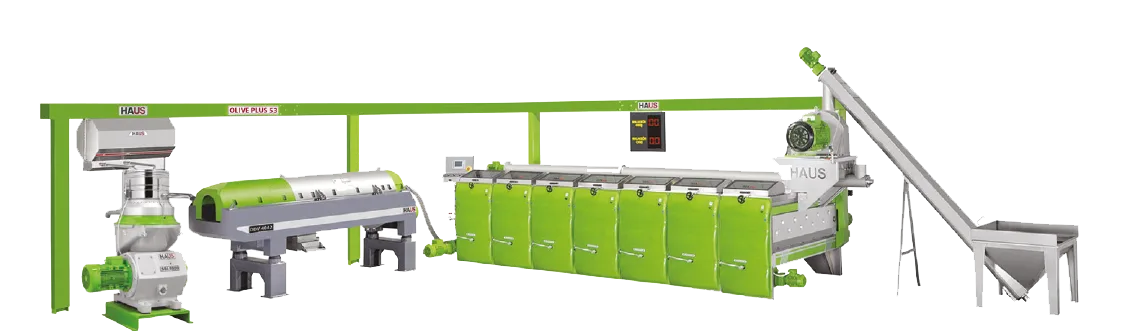
- HAUS (Turkey) offers Separator D/I/F series + olive oil processing lines
Working Principle of the Disk-Stack Separator
Stacked Conical Discs Split the Flow into Thin Layers
In a disk-stack separator, the liquid mixture is fed into a bowl (drum) rotating at very high speed. Inside the bowl is a stack of closely spaced conical discs that divide the liquid flow into many thin layers between the discs. As the bowl spins, centrifugal force generates G-force many times greater than gravity, driving the heavy phase (water, sediment) toward the bowl wall and moving the light phase (oil, cream) toward the axis. Splitting the flow into thin layers shortens the distance each particle must travel to separate, enabling the machine to process mixtures that are difficult to separate and that gravity settling alone cannot handle within a practical timeframe.
The two separated liquid phases are discharged through two separate outlets. Solids (if present) accumulate in the peripheral zone of the bowl and are discharged periodically depending on the configuration. Through this mechanism, the disk-stack separator achieves fine-phase separation that high-solids solid-liquid separation equipment cannot easily match in terms of liquid-phase clarity.
| Factor | Role in Phase Separation |
|---|---|
| Bowl speed | Determines G-force; higher speed means stronger separation force |
| Number & angle of conical discs | Splits flow into thin layers, increases effective settling area |
| Phase densities | Greater density difference between phases means easier separation |
| Feed flow rate | Lower flow rate means longer residence time and more thorough separation |
Differences from the Decanter Centrifuge
Fine-Phase Separation vs. High-Solids Solid-Liquid Separation
The two types of centrifuge are often confused. The horizontal decanter centrifuge uses a conical-cylindrical bowl with a differential-speed scroll conveyor to push solids toward the conical end, suited for sludge dewatering and processing high-solids mixtures. The disk-stack separator, by contrast, targets fine-phase separation: liquid-liquid separation or clarification of low-solids liquids, where product clarity and purity matter more than cake compression capability.
| Criterion | Disk-stack separator | Decanter |
|---|---|---|
| Mechanism | Stacked conical discs, high G-force | Bowl + scroll conveyor, continuous discharge |
| Primary application | Fine-phase separation (liquid-liquid/low solids) | Solid-liquid separation, sludge dewatering |
| Solids content | Low to medium | Medium to high |
| Typical output | Cream, clarified fruit juice, clean oil | Dried sludge, cake, crude separated oil |
In many plants, the two equipment types complement each other: the decanter handles the primary separation of high-solids content, followed by the disk-stack separator performing the finishing step to achieve the desired clarity.
Applications in Food and Beverage
Milk, Fruit Juice, and Oil Separation
Disk-stack separators are widely used in the dairy industry to separate cream from milk and standardize fat content, while simultaneously clarifying milk by removing fine impurities. In fruit juice processing, the equipment clarifies the pressed juice by removing fine suspended solids, enabling the product to meet clarity specifications. For oil applications, the separator removes water and sediment from vegetable oil and fish oil, serving as an important refining step in the processing line.
| Industry | Separation task | Outcome |
|---|---|---|
| Dairy & dairy products | Cream separation, fat standardization, milk clarification | Cream & skim milk, clarified milk |
| Fruit juice | Removal of fine suspended solids | Clarified juice meeting specification |
| Vegetable oil | Removal of water & sediment from oil | Cleaner oil for downstream processing |
| Fish oil | Separation of water/solids phase from oil | Refined fish oil |
Due to direct contact with food products, feed-contact parts are typically made from AISI 304/316 stainless steel to meet hygiene and corrosion-resistance requirements, facilitating CIP cleaning.
Selecting the Right Separator for Your Needs
Key Selection Factors
Selecting a disk-stack separator should begin with the characteristics of the feed stream: the number of phases to be separated (two-phase liquid-liquid or three-phase with solids), the density of each phase, the solids content and particle size, and the required output clarity. The required processing flow rate and food hygiene requirements will determine the bowl configuration, construction materials, and solids discharge method.
- Fine liquid-liquid separation, low solids: prioritize a disk-stack separator
- High-solids mixture requiring dewatering: consider a decanter for the primary stage, then a separator for the finishing step
- Food-contact requirements: specify stainless 304/316 and a CIP-friendly design
- Target flow rate and clarification level: determine bowl size and operating speed
Since detailed parameters depend on the specific model and application, consulting with an application engineer is recommended to select the correct configuration rather than relying solely on catalogue data.
HAUS · TURKEY HAUS Disk-Stack Separator Solutions
HAUS Centrifuge Technologies (founded 1954 in Aydın, Turkey) is a manufacturer of centrifugal separation equipment with a plant of approximately 100,000 m², exporting to more than 70 countries and certified to ISO 9001/14001/22000 and CE. In the fine-phase separation category, HAUS offers the Separator D/I/F series using the disk-stack mechanism, covering cream/milk separation, fruit juice clarification, vegetable oil and fish oil separation, as well as olive oil processing lines. Feed-contact parts are manufactured from AISI 304/316 stainless steel, meeting food hygiene requirements.
As the HAUS distributor in Vietnam, TKT Pumps — with 19+ years of experience, 12,000+ projects, and 28+ brands — provides configuration consultation, installation, and spare parts with 24/7 service support.
Frequently Asked Questions
How does a disk-stack separator differ from a decanter centrifuge?
+
The disk-stack separator uses stacked conical discs and high G-force for fine-phase separation (liquid-liquid or low-solids liquid), delivering high clarification. The decanter uses a bowl with a scroll conveyor to discharge solids, suited for high-solids solid-liquid separation and sludge dewatering. The two types commonly complement each other in the same processing line.
What is the working principle of a cream separator?
+
Milk is fed into a high-speed rotating bowl containing stacked conical discs. Centrifugal force drives the heavy phase (skim milk) toward the bowl wall and moves the light phase (cream, fat) toward the axis, thereby separating cream and standardizing fat content while removing fine impurities to clarify the milk.
What types of mixtures can this equipment separate?
+
It is suited to liquid-liquid or low-solids liquid mixtures requiring fine separation: separating cream from milk, clarifying fruit juice, and removing water and sediment from vegetable oil and fish oil. For high-solids mixtures, a decanter should be used for the primary separation stage first.
Do the construction materials meet food-industry requirements?
+
Feed-contact parts are typically manufactured from AISI 304/316 stainless steel, meeting hygiene and corrosion-resistance requirements for the food industry, while being compatible with CIP cleaning procedures.
What disk-stack separator series does HAUS offer?
+
HAUS offers the Separator D/I/F series based on the disk-stack mechanism, together with olive oil processing lines, covering cream/milk separation, fruit juice clarification, and vegetable oil and fish oil separation. Specific parameters depend on the model and application.
How do I select the right separator for my plant?
+
You need to identify the number of phases to be separated, the density of each phase, solids content, required flow rate and clarification level, and applicable hygiene standards. Since these factors vary by model and application, consulting with TKT’s application engineers is recommended to determine the correct configuration.
Submit a Consultation Request or hotline 0941.400.488
Source: HAUS Centrifuge Technologies documentation (Turkey); compiled by TKT.