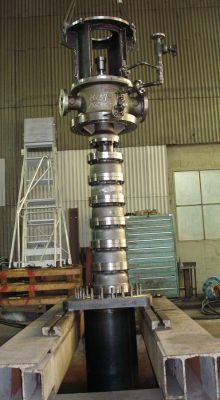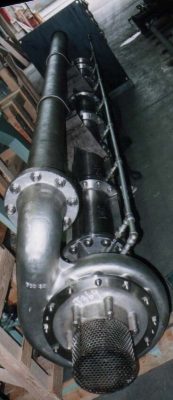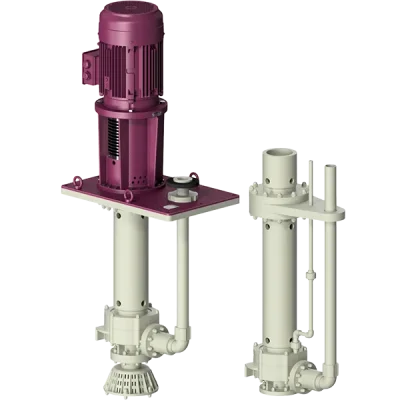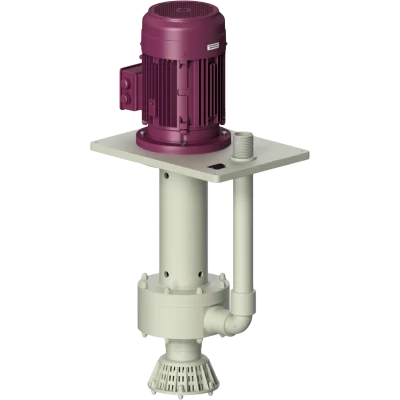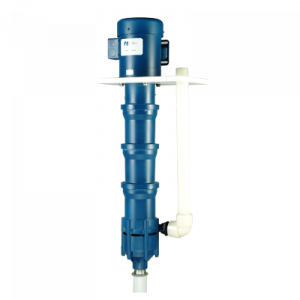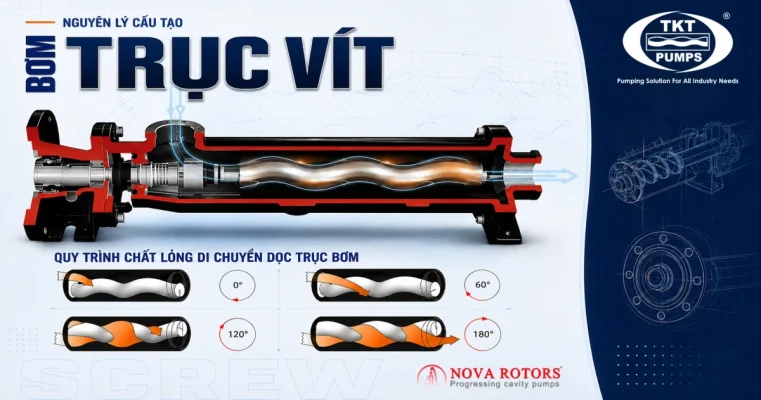
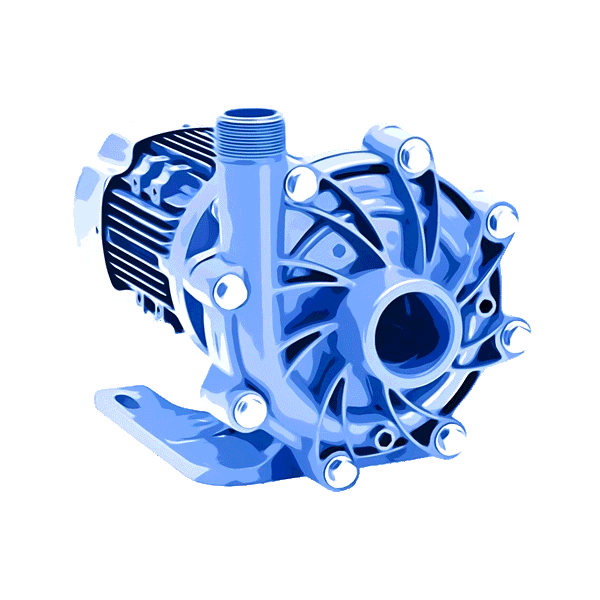
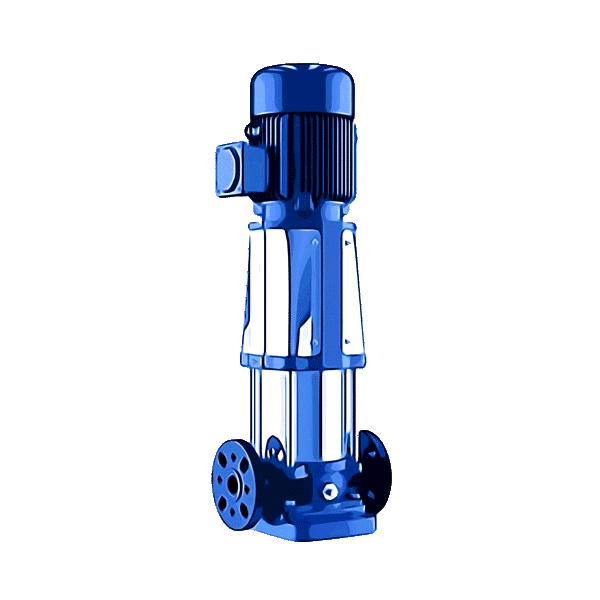


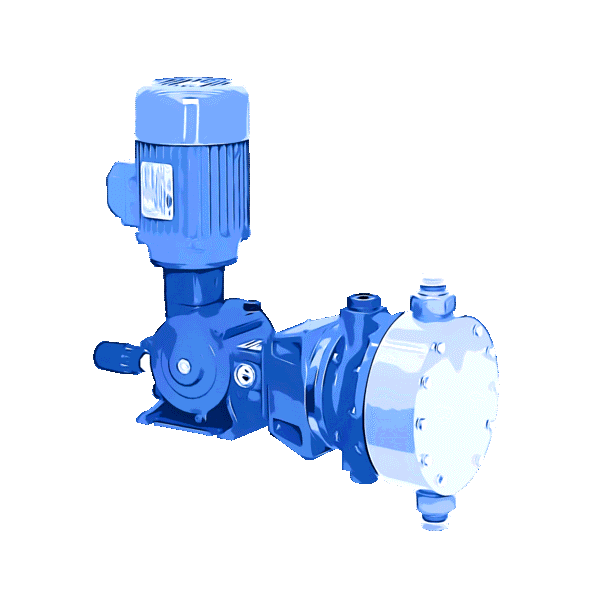


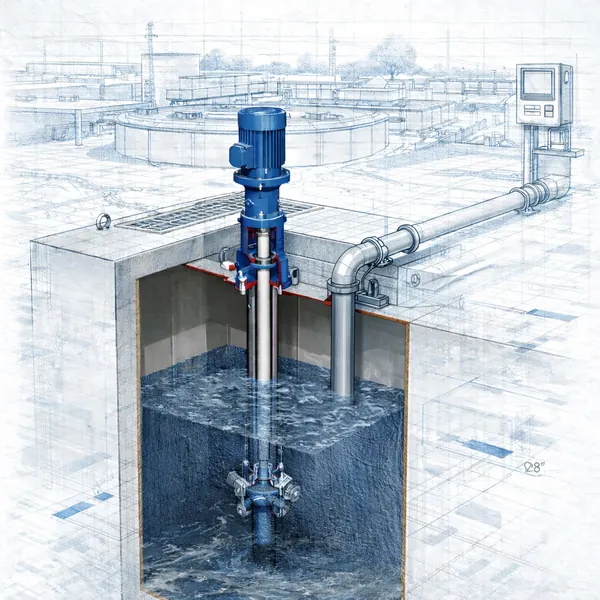
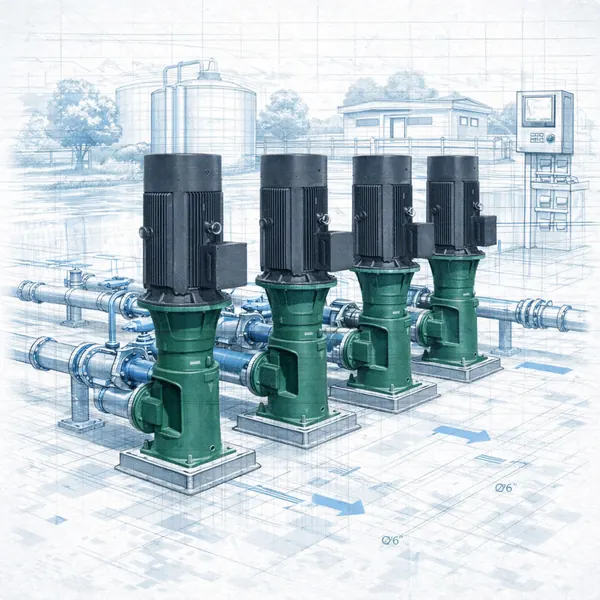
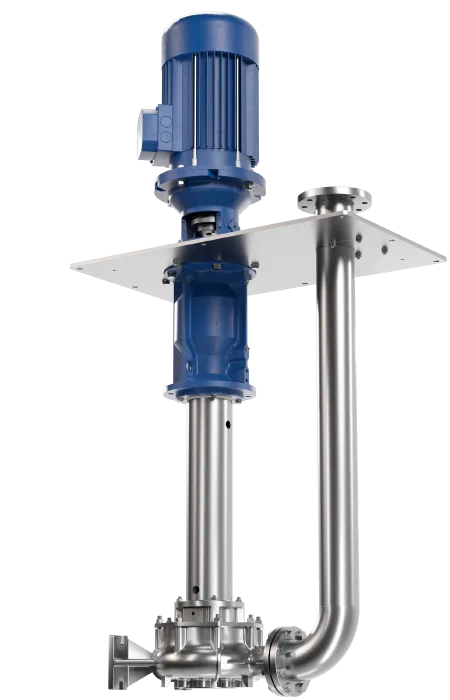
A cantilever pump is a vertical centrifugal pump with its pump end submerged in a tank or sump, but with all bearings and seals located above the liquid level — no support bearings or bushings are submerged in the fluid. This allows the pump to handle wastewater, chemicals, and heavily laden fluids without concern for bearing wear from dry running or abrasion by solid particles. It is a suitable choice for sumps, chemical storage tanks, and dewatering points where standard submersible pumps are prone to bearing failure.
- Vertical shaft placed in the tank, with bearings and seals above the liquid level — no submerged components below.
- Free passage up to 150mm; vortex/channel impellers preferred for passing solids and fibrous material.
- Self-priming when the liquid level covers the impeller; can be mounted on a tank cover or alongside the tank, with submersion depth up to approximately 5m depending on configuration.
- Construction materials include cast iron, AISI 316, Superduplex, or 904L; ATEX option available for hazardous environments.
- Simplified maintenance as there are no submerged bearings to remove; reduced risk of seal leakage into the fluid.
What Is a Cantilever Pump and How Does It Differ from a Submersible Pump
Vertical Shaft Construction Without Submerged Bearings
The term “cantilever” accurately describes the operating principle: a long vertical shaft has one end carrying the impeller submerged in the tank, while the other end is supported by a bearing assembly and mechanical seal mounted on the top baseplate — similar to a cantilevered beam. The portion of the shaft submerged in the fluid has no intermediate support bearings below the liquid surface. This is the fundamental difference from submersible pumps or older long-shaft vertical turbine pumps, which require sleeve bearings along the shaft that are lubricated by the pumped fluid itself.
Submerged bearings are a classic weak point when pumping dirty fluids: if the liquid level drops below the bearing, it runs dry and wears out rapidly; if the fluid contains solid particles, they enter the bearing clearance and score the shaft. The cantilever design eliminates this risk simply by having no bearings there. The trade-off is that the cantilevered shaft length is limited to control deflection and vibration, so the impeller submersion depth is typically up to approximately 5m depending on the configuration.
| Criterion | Cantilever | Submersible pump / long-shaft pump with submerged bearings |
|---|---|---|
| Support bearings in fluid | None | Yes (sleeve bearings lubricated by the fluid) |
| Dry running / low liquid level | Tolerates exposed impeller zone | Bearing failure risk when fluid level drops |
| Fluid with solids / fibrous content | Suitable when using vortex/channel impellers | Particles enter bearing clearance causing wear |
| Seal location | Above liquid level, easy to inspect | Seal/motor submerged (submersible pump) |
Applications in Sumps and Chemical Tanks
Why It Suits Sumps and Storage Tanks
Industrial sumps and chemical storage tanks often collect fluid unevenly: sometimes full, sometimes nearly empty, with sediment, and occasionally fibrous or solid debris. Cantilever pumps handle this effectively because they mount directly on the tank cover or alongside the tank, lowering the impeller into the area to be pumped, and self-prime when the liquid level covers the impeller — no foot valve or separate priming system is required. When the liquid level fluctuates, the bearing and seal assembly remains safely above.
For chemical applications, a key advantage is that the mechanical seal and bearings are located outside the fluid, making them easy to monitor and service at the first sign of leakage, reducing the risk of corrosive media entering the bearing assembly. Combined with a wide free passage (up to 150mm) and vortex/channel impellers, the pump handles fluids containing suspended solids or fibrous material with minimal clogging — exactly what is required for industrial wastewater, process residues, and production effluents. Common industries include wastewater treatment, chemical processing, food production, biofuels, and textile dyeing.
| Application context | Fluid requirements | Suitable cantilever configuration |
|---|---|---|
| Wastewater sump | Sediment, fibrous material, fluctuating level | Vortex/channel impeller, cast iron or 316 material |
| Corrosive chemical tank | Corrosion resistance, leak containment | AISI 316 / Superduplex / 904L, seal above fluid |
| Tank in hazardous / explosive atmosphere | Safe for hazardous area classification | ATEX-certified configuration option |
| Pumping fluid with large solids | Passage of large solid particles | Free passage up to 150mm |
Impeller Type and Material Selection
Vortex Impellers, Channel Impellers, and Material Options
The impeller type determines solids-handling capability and clog resistance. A vortex (recessed) impeller is set back inside the pump casing, generating a swirling flow that propels solids and fibrous material through with minimal impeller contact — suitable for heavily contaminated fluids with good anti-clogging performance. A channel impeller (multi-passage) delivers higher flow rates when solids concentration is moderate. For cleaner fluids where efficiency is a priority, a closed impeller may be selected. In cantilever pumps for sumps and dirty tanks, vortex and channel impellers are generally the reliable choice, prioritizing unobstructed passage over peak hydraulic efficiency.
In terms of materials, the standard range includes cast iron for neutral fluids, AISI 316 for general chemical service, and Superduplex or 904L for more aggressive corrosive environments. Pumps can be configured to ISO 2858 / EN 733 / ISO 5199 standards depending on the series, with multiple mechanical seal arrangements available to match the specific fluid characteristics.
Installation and Operation Considerations
Submersion Depth, Self-Priming, and Maintenance
When selecting a cantilever pump, the impeller submersion depth is the primary parameter: the cantilevered shaft has a length limit to keep vibration within acceptable bounds, so for tanks deeper than the standard range, an extended-shaft configuration or an alternative pump solution should be considered. The pump self-primes when the impeller is submerged, so the installation should ensure the impeller remains below the minimum operating liquid level, or accommodate controlled flood-and-drain cycles. Since the seals and bearings are located on the top baseplate, inspection, greasing, and seal replacement are carried out at the working platform level — without having to remove a submerged bearing assembly as with older long-shaft vertical pumps.
For corrosive or hazardous fluids, positioning the seal above the liquid aids early leak detection and limits exposure of corrosive media to the bearing assembly. Correct material pairing of impeller, casing, and shaft to the specific chemical, temperature, and solids content is essential to prevent premature wear. This is a step that should be discussed with an application engineer before finalizing the configuration.
SALVATORE ROBUSCHI · ITALY Cantilever Pump Range for Tanks and Sumps
Salvatore Robuschi (Italy, part of Gruppo Aturia) offers the CANTILEVER range of vertical in-tank pumps with no submerged bearings or seals, and a free passage of up to 150mm for fluids containing solid particles. The pump self-primes when the liquid level covers the impeller and can be mounted on a tank cover or alongside the tank, with submersion depth up to approximately 5m depending on configuration. Available construction materials include cast iron, AISI 316, Superduplex, and 904L, with an ATEX option, conforming to ISO 2858 / EN 733 / ISO 5199 standards. The process range also includes vortex (RC) and channel (RB) impeller types to match the specific requirements of solids-laden fluids. TKT is the authorized distributor of Salvatore Robuschi in Vietnam, providing technical consultation on model and configuration selection based on actual operating conditions.
Frequently Asked Questions
How does a cantilever pump differ from a submersible pump?
+
A cantilever pump positions its impeller in the tank but keeps all bearings and seals above the liquid level, with no components submerged in the fluid. A submersible pump has both the motor and seals fully immersed. With no submerged bearings, the cantilever design is less prone to failure when the liquid level drops or when the fluid contains abrasive solid particles.
How deep can a cantilever pump be submerged?
+
Because it is a single-end cantilevered shaft, the shaft length is limited to control vibration. Cantilever pumps typically allow impeller submersion to approximately 5m depending on the configuration; deeper tanks require consideration of an extended-shaft option or an alternative pump solution.
Is a cantilever pump self-priming?
+
Yes. The pump self-primes when the liquid level covers the impeller, with no foot valve or separate priming system required. Since the impeller is already positioned in the tank, the pump operates as soon as the fluid level is sufficient to cover the impeller.
What size solid particles can a cantilever pump pass?
+
The free passage of cantilever pump models reaches up to 150mm depending on the model. When large solids or fibrous fluids must be handled, a vortex or channel impeller should be selected for clog resistance.
Can cantilever pumps be used for corrosive chemicals?
+
Yes. The cantilever range is available in cast iron, AISI 316, Superduplex, and 904L construction, with an ATEX option for flammable or explosive atmospheres. Positioning the seal above the liquid level aids early leak detection and limits corrosive media from reaching the bearings.
Is cantilever pump maintenance complex?
+
Maintenance is simpler than for long-shaft pumps with submerged bearings, because the seals and bearings are on the top baseplate at the working platform level. Inspection, greasing, and seal replacement are performed from above, without the need to pull a submerged bearing assembly out of the tank.
Source: Salvatore Robuschi (Gruppo Aturia, Italy) technical documentation on the cantilever pump range; compiled by TKT.