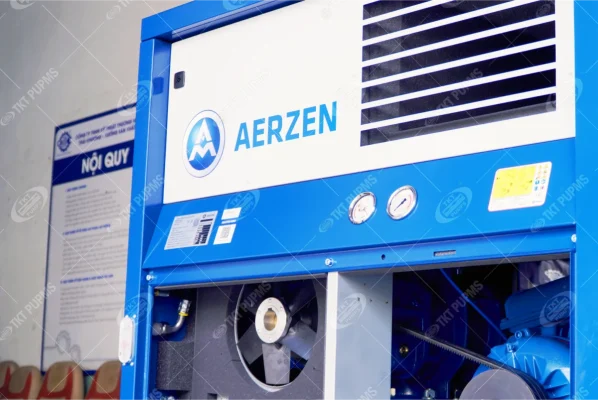




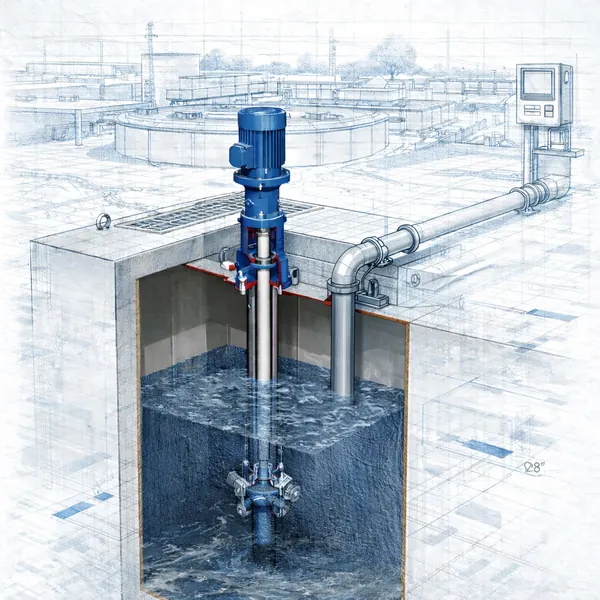
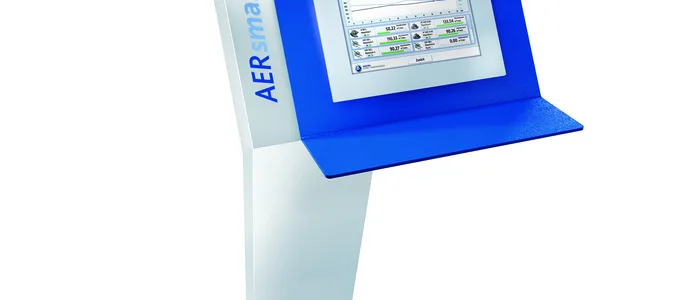
AERsmart is Aerzen’s master control unit, responsible for coordinating multiple air blowers operating within the same aeration station. Rather than letting each machine run independently, AERsmart reads the actual oxygen demand of the biological tank and selects an efficient combination of machines to deliver precisely the required flow rate. Since the aeration stage is a major electricity consumer in a wastewater treatment plant, optimizing how air blowers are coordinated is a significant lever for energy savings.
- AERsmart coordinates up to 12 air blowers, including units from other manufacturers (per Aerzen documentation).
- The system selects the appropriate machine combination based on real-time oxygen demand and flow rate requirements.
- The control system alone can add up to 15% additional energy savings (configuration-dependent, per Aerzen).
- Aeration is the largest electricity consumer in a wastewater treatment plant — optimizing control equals primary savings.
- AERtronic controls individual machines; AERsmart coordinates the entire group — two complementary control levels.
What is AERsmart and what problem does it solve?
The continuously varying load challenge of aeration tanks
In biological wastewater treatment, the oxygen demand of the aeration tank fluctuates continuously with incoming flow rate and organic load — low at night, high during peak hours. If each air blower runs independently at a fixed operating point, the blower station typically over-supplies air at low load and operates inefficiently at high load.
AERsmart is described by Aerzen as an “intelligent master control” that addresses precisely this problem. The system receives demand signals (required oxygen quantity or flow rate) via analog reference signals or bus connections, then optimally distributes flow among the machines based on the characteristic performance data for each unit stored in the algorithm. The goal is for the installed blower station to operate near the efficiency point permitted by the configuration, across low, medium, and high load levels.
How does AERsmart coordinate multiple air blowers?
Demand-based coordination rather than fixed operation
The core mechanism of multi-blower control is “demand-based control” — supplying air according to actual demand. AERsmart reads the tank’s oxygen demand signal (typically linked to a DO — dissolved oxygen sensor), calculates the total required flow rate, then decides: how many machines to activate, which ones run at base load, and which ones modulate speed. Aerzen documentation states the system can coordinate up to 12 machines, including units from other manufacturers, and displays all process data, individual machine performance, and operating history on a 12-inch touchscreen.
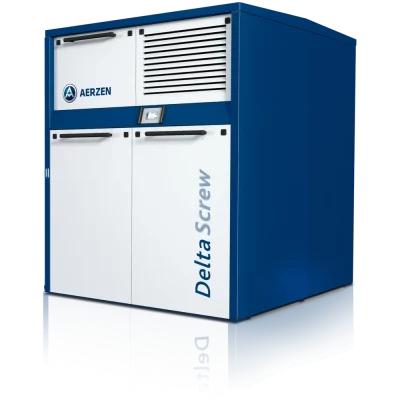
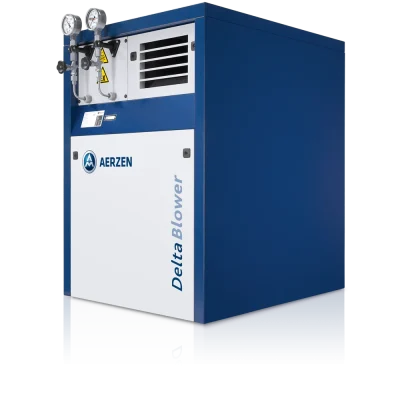
A key capability is that AERsmart can coordinate different air blower technologies within the same group — Roots (Delta Blower), screw (Delta Hybrid), and turbo (Aerzen Turbo) — each with its own flow rate range and efficiency profile. This allows the system, at each load level, to prioritize the machine suited to that operating range rather than forcing a single machine to run away from its efficiency point.
| Control Level | Role | Machines Managed | Display |
|---|---|---|---|
| AERtronic | Per-unit control | Up to 5 Aerzen machines (MODBUS RTU) | 4.3-inch touchscreen |
| AERsmart | Full-group coordination (master) | Up to 12 machines, including other brands | 12-inch touchscreen |
| VFD (Variable Frequency Drive) | Speed modulation per machine load | On each machine | — |
Figures in table per Aerzen documentation; actual configuration depends on the project.
Why does intelligent control reduce energy consumption in aeration?
Aeration is the major electricity consumer in the plant
In a wastewater treatment plant, the aeration stage for biological tanks typically accounts for a large share of operational electricity consumption. This is why every percentage of savings on the blower station has a direct impact on monthly electricity costs. There are three cumulative layers of optimization: (1) selecting the right machine technology for the load range, (2) speed modulation via variable frequency drives (VFDs) to closely track demand, and (3) coordinating the entire group via a master controller so no machine runs excessively or away from its efficiency point.
According to Aerzen, the AERsmart control system alone can add up to 15% additional savings, and when combined with the synchronized trio of air blower technologies (Performance3 — Delta Blower, Delta Hybrid, Aerzen Turbo), total savings can reach up to 30% compared to a less optimized configuration. These figures are illustrative and depend on the blower group configuration, load profile, and operating conditions of each individual plant.
| Optimization Layer | How it works | Electricity Impact |
|---|---|---|
| Machine technology selection | Roots / screw / turbo per flow rate range | Tracks high efficiency across each load range |
| Variable Frequency Drive (VFD) | Adjusts machine speed to instantaneous load | Prevents over-supply at low load |
| AERsmart (master) | Coordinates machine count and optimal combination | Up to 15% additional (configuration-dependent) |
AERtronic, AERsmart, or VFD — which control level to choose?
Three control levels that complement, not replace, each other
The three control layers are not mutually exclusive but are stacked in tiers. The VFD sits on each individual machine, adjusting speed with load to track instantaneous demand. AERtronic is the local controller on each machine, managing the working pressure at its optimum and able to synchronize up to 5 Aerzen machines via MODBUS RTU through base/rotation switching. AERsmart is the higher layer — coordinating the entire group according to the oxygen demand of the process, including machines from other manufacturers.
The selection principle is straightforward: a plant with 1–2 machines is generally adequate with AERtronic and a VFD; plants with multiple machines, multiple technologies, and strongly fluctuating loads are where AERsmart delivers its coordination value. TKT Pumps can survey the load profile and existing configuration to recommend the appropriate control level.
AERZEN · GERMANY Aerzen Aeration Control Solutions at TKT Pumps
Aerzen (Germany) provides an ecosystem of air blowers along with AERtronic and AERsmart control levels for wastewater treatment plants. TKT Pumps is Aerzen’s authorized distributor in Vietnam, with 19+ years of experience in pump and blower equipment, supporting survey, blower group configuration selection, and energy-efficient control solutions tailored to each plant, along with spare parts and 24/7 technical service.
Frequently Asked Questions about AERsmart Air Blower Control
How many air blowers can AERsmart coordinate at most?
+
According to Aerzen documentation, AERsmart can coordinate up to 12 air blowers in the same group, including units from other manufacturers. The system selects the appropriate machine combination based on real-time oxygen demand and flow rate, and displays data on a 12-inch touchscreen.
How much electricity can AERsmart save?
+
Aerzen states that the AERsmart control system alone can add up to 15% additional savings, and when the three air blower technologies (Performance3) are combined synchronously, total savings can reach up to 30% compared to a less optimized configuration. Actual figures depend on the blower group configuration, load profile, and operating conditions of each plant.
What is the difference between AERtronic and AERsmart?
+
AERtronic is the local controller on each machine, managing working pressure and synchronizing up to 5 Aerzen machines via MODBUS RTU. AERsmart is the master controller at a higher level, coordinating the entire group of up to 12 machines according to the process oxygen demand. The two levels complement each other rather than acting as substitutes.
Is a VFD still needed when using AERsmart?
+
Yes. The VFD operates at the individual machine level, adjusting speed to instantaneous load, while AERsmart coordinates the number and combination of machines at the group level. The two mechanisms are tiered: the VFD tracks demand for a single machine, while AERsmart optimizes the entire group so no machine runs excessively.
What applications is AERsmart used for?
+
The typical application is aeration for biological tanks in wastewater treatment plants — where oxygen load fluctuates significantly and the aeration stage consumes the majority of electricity. This is the environment where demand-based multi-machine coordination delivers clear savings value.
Can AERsmart control air blowers from other manufacturers?
+
According to Aerzen, AERsmart supports integration of machines from other manufacturers into the coordination group, based on their performance characteristic data loaded into the algorithm. The specific capability and level of integration depend on the equipment and need to be assessed on a per-project basis.
Source: Aerzen technical documentation (AERsmart, AERtronic – control technology) and wastewater treatment industry knowledge. Compiled by TKT.