



In a wastewater treatment (WWT) plant, the aeration process in the aerobic tank consumes approximately 60–80% of the plant’s total electricity. Therefore, to save energy on air blowers, the effective approach is to select the right blower technology for the load range, operate according to actual oxygen demand, and combine multiple machines. With this approach, Aerzen’s (Germany) Performance³ solution achieves energy savings of up to approximately 30% compared to conventional configurations.
- Aeration accounts for 60–80% of a WWT plant’s energy — this is the key area to optimize.
- 3 blower technologies: Roots (positive displacement), screw (Delta Hybrid), centrifugal turbo.
- Selecting the right machine for the load range + operating by oxygen demand significantly reduces energy consumption.
- Aerzen Performance³ combines 3 technologies: savings of up to approximately 30%.
- The AERsmart control system distributes flow rate to up to 12 machines for further optimization.
Why Do Air Blowers Consume So Much Energy in WWT Plants?
Aeration Is the Major Energy-Consuming Stage in Wastewater Treatment
The aerobic tank requires a continuous oxygen supply for microorganisms to decompose organic matter. This task is carried out by the air blower, which pushes air through the diffuser system at the bottom of the tank. According to Aerzen documentation, the aeration stage consumes 60–80% of the total electricity in a WWT plant. In other words, every percentage point of efficiency saved at the blower translates directly into monthly electricity cost reductions.
A common challenge is that the tank load is not constant: flow rates and pollution levels vary by hour of the day, by season, and by rainfall. An air blower running at fixed power will supply excess air at low load and insufficient air at high load — both scenarios waste electricity or reduce output quality. This is precisely why air blower energy savings must be tied to the ability to adjust flow rate according to actual oxygen demand.
Three Types of Air Blowers and Their Respective Efficiencies
Roots, Screw, and Turbo — Select by Load Range
An air blower is a low-pressure air supply device (typically ≤1 bar) with high flow rates, distinct from a high-pressure air compressor. There are three main technology types, each with its own strengths in terms of efficiency and operating range:
| Technology | Working Principle | Efficiency Advantage | Suitable For |
|---|---|---|---|
| Roots (positive displacement) | 2-lobe rotor, forced air delivery | Simple construction, durable, low investment | Stable base load, medium capacity |
| Screw | Helical rotor compresses air along the shaft axis | Higher efficiency than Roots, energy saving | Variable load, wide adjustment range |
| Centrifugal turbo | High-speed impeller | High efficiency at very high flow rates | Large base load, high-capacity plants |
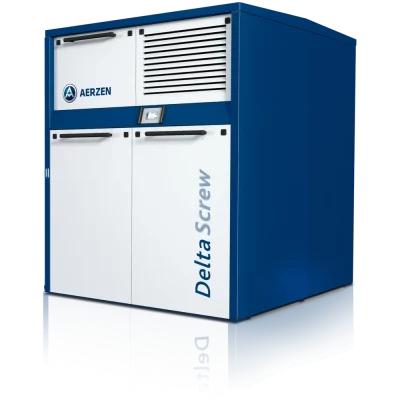
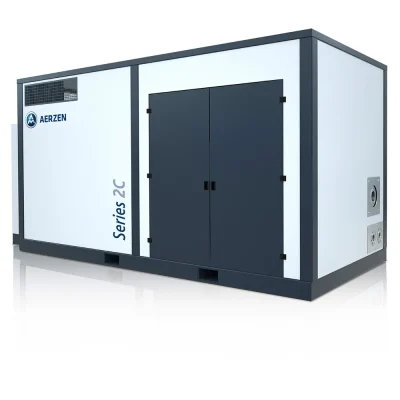
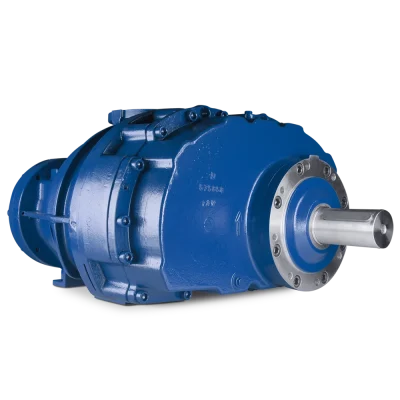
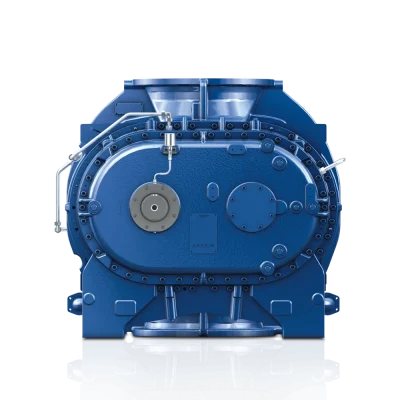
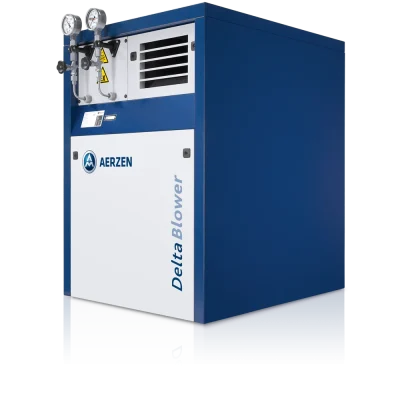
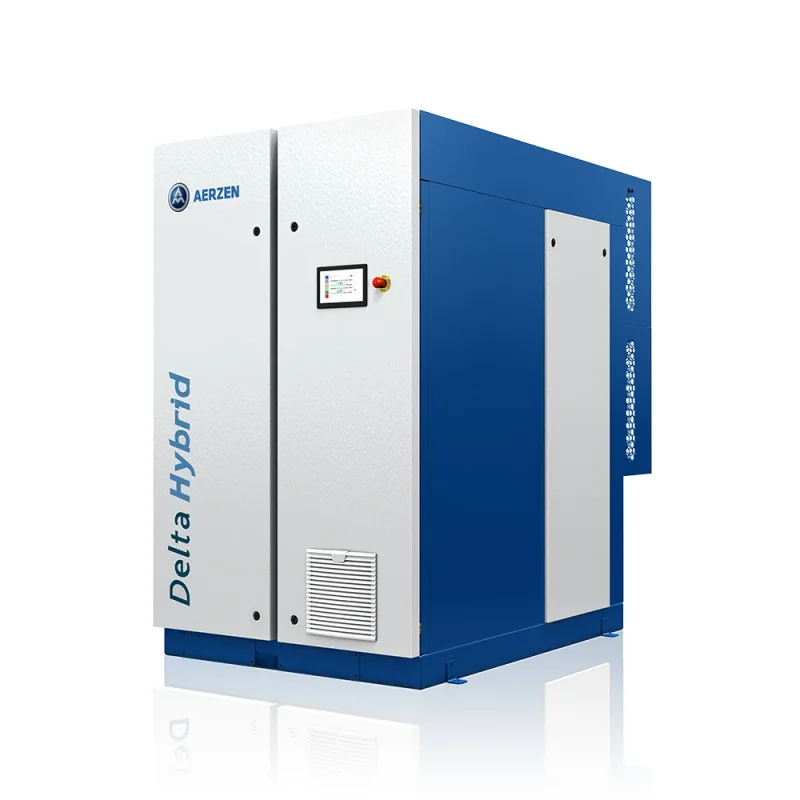
In Aerzen’s product range, these three technologies correspond to the Delta Blower (Roots), Delta Hybrid (screw), and Aerzen Turbo (turbo). According to manufacturer documentation, the direct-drive Delta Hybrid series alone can achieve energy savings of up to 37% compared to conventional blowers depending on operating conditions.
Why Does Combining Multiple Machines Save More Energy?
Turbo Handles Base Load, Screw Handles Peak Load and Low Load
No single air blower type is optimal for every operating point. The effective approach is to use a turbo blower for base load — where the machine runs continuously near its high-efficiency point — and supplement it with the Delta Hybrid screw machine for peak load or low flow conditions, where a wide adjustment range is needed. When the load fluctuates, the system starts/stops and speed-controls each machine to track oxygen demand closely, rather than running one large machine at partial load.
This is the principle behind the Performance³ solution — Aerzen combines three technologies (Delta Blower, Delta Hybrid, and Aerzen Turbo) in an oil-free air supply system for aeration tanks. According to manufacturer documentation, this combined configuration achieves savings of up to approximately 30% compared to the conventional approach. One example cited by Aerzen: switching from the positive-displacement Delta Blower GM 35S (55 kW motor) to the screw Delta Hybrid D 30S (37 kW motor) saves approximately 25% in electricity.
Demand-Based Control — The Second Layer of Savings
AERsmart: Distributing Flow Rate to Up to 12 Machines
Selecting the right machines is only half the story. The other half is control: ensuring that the total air flow rate is distributed to each machine at its efficient operating point at all times. Aerzen’s AERsmart control system handles this, coordinating flow rates for up to 12 machines (including equipment from other manufacturers) within the same station. According to manufacturer documentation, AERsmart can reduce energy consumption by an additional approximately 8% compared to hardware-only combinations.
The benefit of this control layer is most evident in plants with highly variable loads: the system automatically redistributes load among machines according to the actual profile, avoiding excess air supply at night or during low-flow periods. For a stage that accounts for 60–80% of plant electricity, a few additional percentage points saved here accumulate into a significant figure over each year.
Oil-Free and Applications Beyond Wastewater Treatment
Clean Air for Sensitive Processes, Efficiency for Every Industry
In WWT aeration and many process applications, the supplied air must be oil-free to avoid contaminating microorganisms and products. The air blower series described above are all oil-free in the compression chamber — suitable for industries requiring clean air per ISO 8573-1 standards, such as food, pharmaceutical, and cleanroom processes.
Beyond aerobic tank aeration, air blowers are also used for pneumatic conveying of powders and granules, biogas processing, vacuum generation (Roots vacuum), process gas applications, and aquaculture aeration. The energy-saving principle remains the same: select the right technology for the load range, operate on demand, and coordinate multiple machines with a control system when the scale is large enough.
AERZEN · GERMANY German Air Blower Technology for Energy Savings
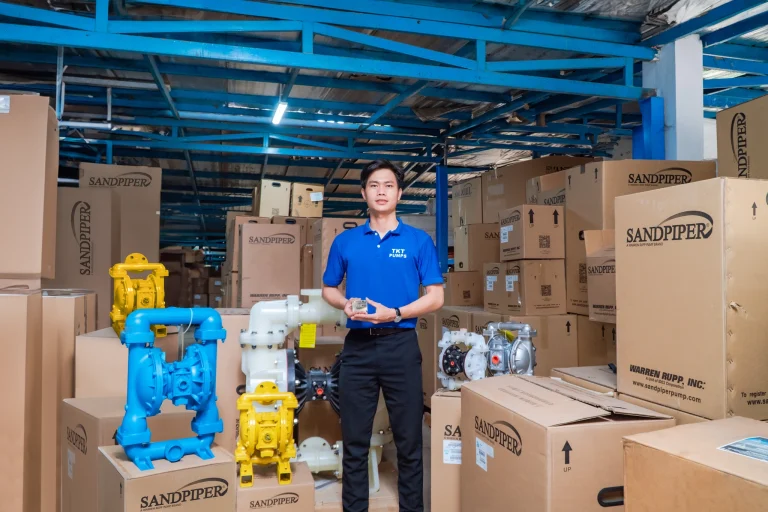
Aerzen is a German air blower and air compressor brand with extensive experience in industrial air supply. The trio of Delta Blower (Roots), Delta Hybrid (screw), and Aerzen Turbo (turbo) covers all three technologies to configure according to each load range, combined with the AERsmart control system to optimize electricity consumption for the aeration stage. TKT Pumps is the authorized consultant, supplier, and technical support for Aerzen in Vietnam — with 19+ years of experience, 12,000+ projects, and a warehouse of 5,000+ spare parts, with 24/7 support.
Frequently Asked Questions on Air Blower Energy Savings
What percentage of a wastewater treatment plant’s energy do air blowers consume?
+
According to Aerzen documentation, the aeration stage in the aerobic tank consumes approximately 60–80% of a WWT plant’s total electricity. This is the stage that should be prioritized for optimization to reduce operating costs.
Which type of air blower saves energy for WWT aeration?
+
No single type is optimal for every load point. Centrifugal turbo is efficient for large base loads; the screw machine (Delta Hybrid) has a wide adjustment range, suitable for variable loads; Roots is durable and low-investment for stable loads. Combining types according to load range achieves overall efficient performance.
How much does Aerzen’s Performance³ solution save?
+
According to Aerzen documentation, the Performance³ three-technology combined configuration achieves savings of up to approximately 30% compared to the conventional approach; adding the AERsmart control system can reduce consumption by a further approximately 8%.
How does a screw air blower differ from a Roots machine?
+
The Roots machine delivers positive-displacement airflow with 2-lobe rotors, featuring simple construction and durability. The screw machine compresses air along the shaft axis with helical rotors, generally offering higher efficiency and a wider adjustment range, saving energy under variable load conditions.
Is an oil-free air blower necessary for aeration?
+
Oil-free air avoids contaminating microorganisms and products, and is recommended for WWT aeration and mandatory for food, pharmaceutical, and cleanroom processes per ISO 8573-1 standards.
Can an operating blower station be upgraded for energy savings?
+
Yes. Depending on the current condition, options include replacing machines with higher-efficiency units for the load range, adding machines for peak/low load, or adding a control layer to coordinate multiple machines. TKT supports load profile assessment to recommend the appropriate solution.
Need a load profile assessment and configuration recommendation for energy-saving air blowers at your plant? TKT Pumps’ technical team is ready to advise on the appropriate Aerzen solution.
Submit a Consultation Request or hotline 0941.400.488
Source: Aerzen wastewater treatment application documentation and Performance³ materials (aerzen.com); compiled and localized by TKT.