



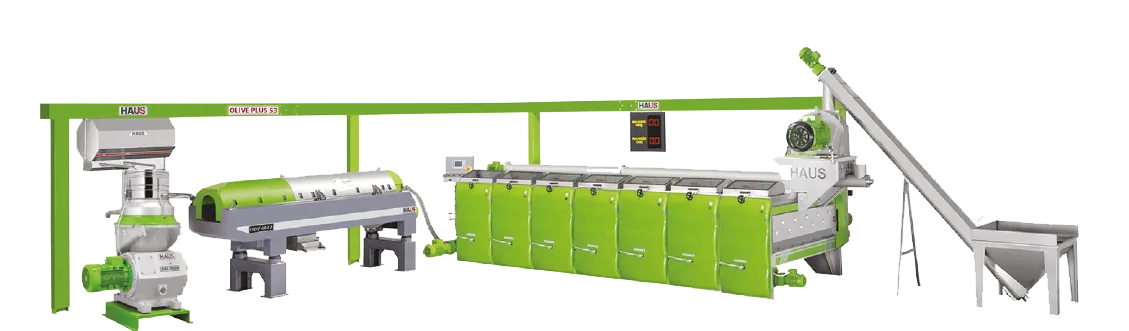
A centrifugal olive oil extraction line is a continuous oil separation process that replaces traditional pressing: crushed and malaxed olives are fed through a horizontal scroll centrifuge (decanter) to separate into 2–3 phases — oil, water, and pomace — and then through a disk-stack separator to polish the oil, removing residual solids and water. The entire sequence operates as a closed, clean, and steady-flow system, suited for processing olive oil to food-hygiene standards.
- Decanter separates 2–3 phases of oil/water/pomace by centrifugal force, operating continuously
- Disk-stack separator polishes the oil, removing residual water and fine solids
- Centrifugal process replaces traditional pressing — steady flow, enclosed system
- HAUS offers dedicated olive oil lines in AISI 304/316 stainless steel
- Decanter bowl diameter 200–800 mm, flow rate 1–180 m³/h depending on model
Working principle of centrifugal olive oil separation
Why centrifugal force replaces traditional pressing
Centrifugal separators operate on the basis of centrifugal force (G-force): when crushed olive paste spins at high speed, phases of different densities stratify — lighter oil migrates inward while heavier water and pomace are forced outward. Compared with traditional batch pressing, which is intermittent and difficult to keep hygienic, the centrifugal method delivers continuous flow, stable throughput, and an enclosed system that minimises air contact — a key factor in maintaining oil quality.
A typical centrifugal olive oil line comprises two main pieces of equipment working in series. The decanter handles rough primary separation of the multi-phase olive paste, while the disk-stack separator carries out the polishing step. This combination achieves efficient oil separation while maintaining a one-directional, CIP-cleanable process.
| Method | Mode of operation | Characteristics |
|---|---|---|
| Traditional pressing | Batch mode, mechanical compression | Intermittent, difficult hygiene control |
| Continuous centrifugation | Decanter + separator | Continuous, enclosed, steady flow |
Role of the decanter in olive oil separation
Separating 2–3 phases of oil, water, and pomace
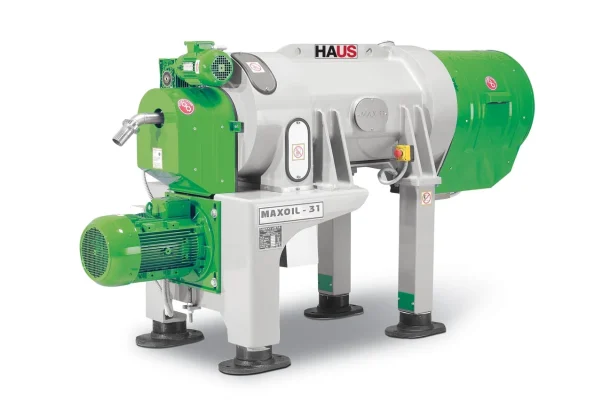
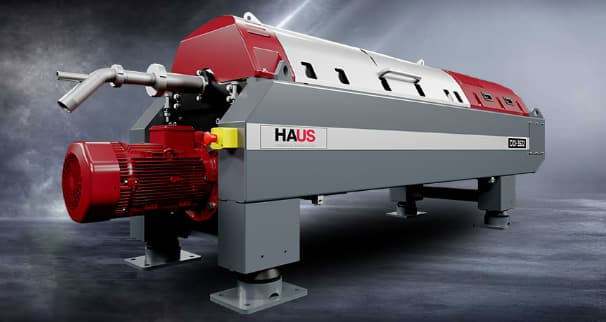
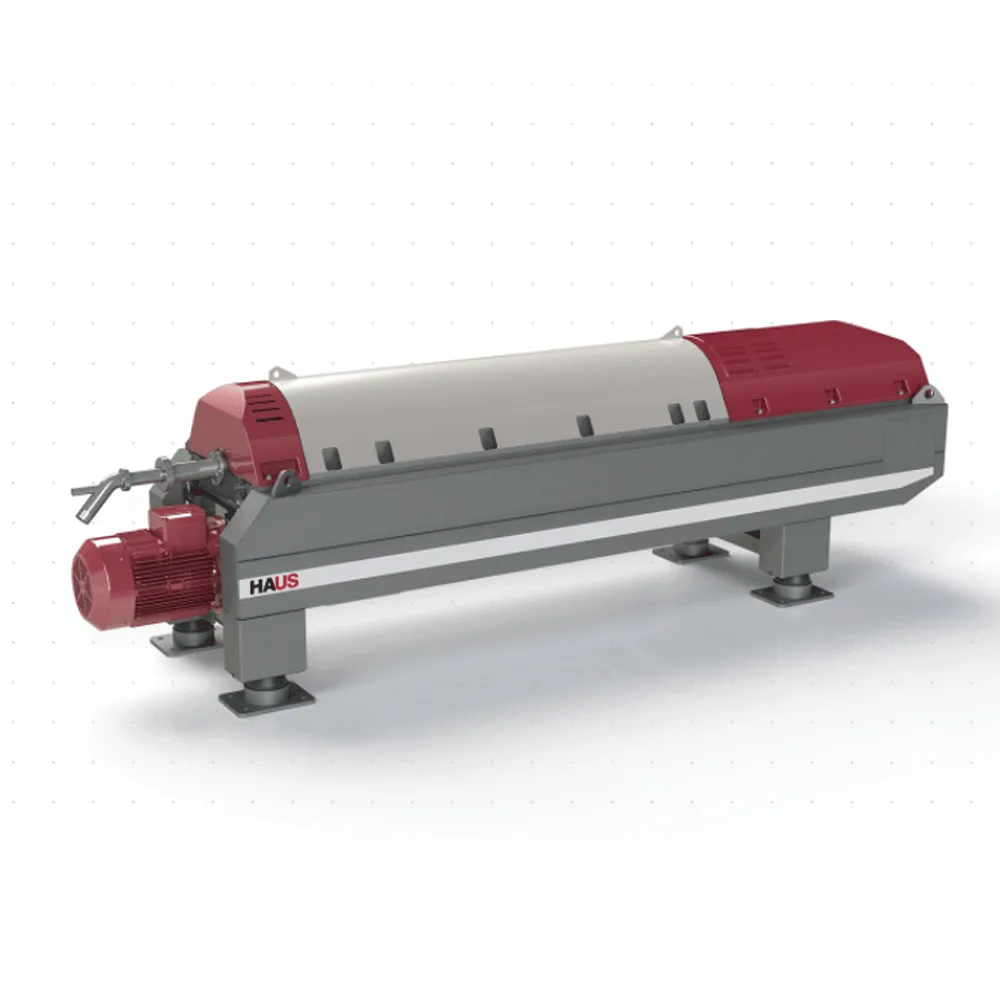
The decanter (horizontal scroll centrifuge) is the heart of the primary separation stage. The conical-cylindrical bowl spins at high speed, generating substantial G-force; inside, a scroll conveyor rotates at a differential speed relative to the bowl. Solid pomace (olive pulp and pits) is continuously conveyed toward the conical end and discharged, while the liquid phase — comprising oil and water — overflows at the opposite end. Depending on configuration, the decanter can separate 2 phases (liquid + pomace) or 3 phases (oil + water + pomace) in a single step.
HAUS designs decanters for food processing lines in AISI 304/316 stainless steel, with bowl diameters of 200–800 mm and flow rates of 1–180 m³/h depending on model. PLC-controlled differential speed between the bowl and scroll conveyor allows operators to fine-tune pomace moisture content and liquid phase clarity to suit each feedstock.
| HAUS decanter specification | Value (per catalogue) |
|---|---|
| Bowl diameter | 200–800 mm |
| Flow rate | 1–180 m³/h (depending on model) |
| Material | AISI 304/316 stainless steel |
| Number of separation phases | 2-phase or 3-phase |
Separator for oil polishing after the decanter
Disk stack removes residual water and fine solids
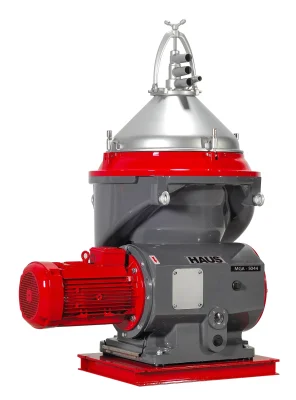
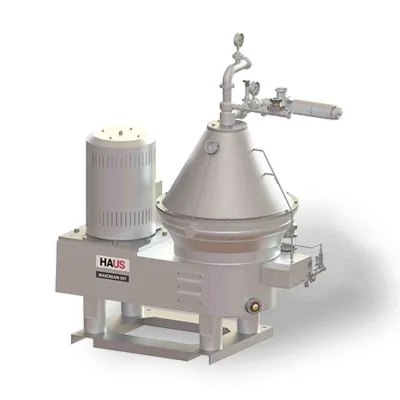
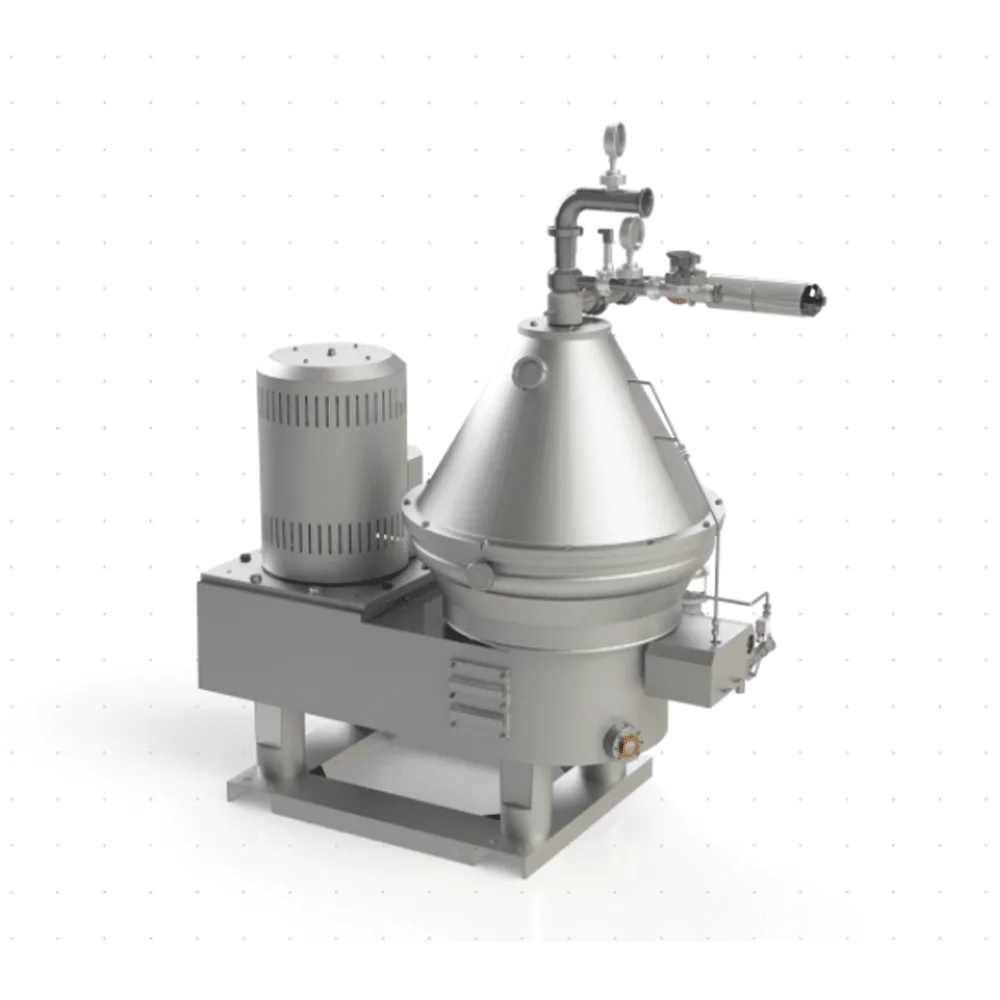
After the decanter, the oil phase still contains a quantity of water and fine solids. This is where the disk-stack separator comes in. The equipment uses a stack of conical discs to split the flow into very thin layers; combined with very high G-force, this separates the fine phase — residual water and solids separate cleanly from the oil — yielding a clearer and more stable finished product.
The core distinction: the decanter excels at solid-liquid separation when solids content is high (the scroll conveyor continuously discharges pomace), while the disk-stack separator specialises in fine-phase separation when solids content is low. In an olive oil line, the two pieces of equipment complement each other: the decanter for primary separation, the separator for polishing.
| Criterion | Decanter | Disk-stack separator |
|---|---|---|
| Separation mechanism | Bowl + scroll conveyor | Conical disc stack |
| Suited for | Solid-liquid, high solids content | Fine-phase separation, low solids content |
| Role in the line | Primary separation of oil/water/pomace | Oil polishing |
Process flow of a centrifugal olive oil line
From raw olives to finished oil
A centrifugal olive oil extraction line typically follows a series of sequential steps, ensuring one-directional material flow that is easy to control:
| Step | Stage | Objective |
|---|---|---|
| 1 | Olive crushing | Break down fruit tissue, release oil droplets |
| 2 | Malaxing | Aggregate oil droplets into a continuous phase |
| 3 | Decanter | Separate 2–3 phases of oil/water/pomace |
| 4 | Separator | Polish the oil, remove residual water and fine solids |
| 5 | Storage and filtration | Stabilise the finished oil |
Thanks to AISI 304/316 stainless steel construction and hygienic design, the line meets food processing requirements, is easy to clean, and minimises cross-contamination. Using the same working principle, decanters and separators are also used to separate other vegetable oils and fish oil, not just olive oil.
HAUS · TURKEY HAUS olive oil extraction line
HAUS Centrifuge Technologies (established 1954 in Aydın, Turkey) specialises in solid-liquid separation centrifuges, with a manufacturing facility of approximately 100,000 m² and products exported to more than 70 countries. HAUS holds ISO 9001, ISO 14001, ISO 22000, and CE certifications. For the olive oil industry, HAUS supplies a dedicated olive oil line comprising a decanter (DDF food series) for 2–3 phase separation and a disk-stack separator (D/I/F series) for oil polishing — continuous centrifugal operation, AISI 304/316 stainless steel construction. TKT Pumps is the authorised distributor of HAUS in Vietnam, with 19+ years of experience and 12,000+ projects completed.
Frequently asked questions
How does centrifugal olive oil separation differ from traditional pressing?
+
Traditional pressing operates in batch mode using mechanical compression, making it prone to interruption and difficult to keep hygienic. Centrifugal separation uses G-force to stratify phases by density, operating continuously, in an enclosed system with steady flow. The centrifugal process limits air contact, helping to maintain more consistent oil quality.
Why are both a decanter and a separator needed in the line?
+
The decanter handles primary separation, processing high solids content with the scroll conveyor to discharge pomace and yield an oil phase that still contains water and solids. The disk-stack separator handles the polishing stage, using very high G-force to remove the remaining water and fine solids. The two pieces of equipment complement each other to deliver clear and stable oil.
How many phases can a decanter separate at once?
+
Depending on configuration, a decanter can separate 2 phases (liquid and pomace) or 3 phases (oil, water, and pomace) in a single step. For olive oil, the 3-phase configuration separates the oil from both water and pomace at the decanter stage before the stream is sent to the separator for polishing.
What materials are used in the HAUS olive oil line?
+
HAUS decanters and separators for food processing are manufactured from AISI 304/316 stainless steel, meeting hygiene and corrosion-resistance requirements. Decanter bowl diameter ranges from 200–800 mm, with flow rates of 1–180 m³/h depending on model.
Can this line be used for other vegetable oils?
+
Yes. Using the same decanter and disk-stack separator working principle, HAUS centrifugal oil separation technology also applies to other vegetable oils and fish oil, not limited to olive oil. Equipment configuration is selected according to the feedstock characteristics and target product specifications.
How do I select the right decanter and separator configuration?
+
Model selection depends on the olive throughput to be processed, the number of separation phases required, and the target finished oil quality. You should consult the TKT technical team to determine the appropriate flow rate, bowl size, and separator configuration for your plant’s actual requirements.
Need consultation on a centrifugal olive oil extraction line for your plant? The TKT Pumps technical team is ready to help you select the right HAUS decanter and separator configuration.
Send a consultation request or call hotline 0941.400.488
Source: technical documentation from HAUS Centrifuge Technologies (Turkey) — compiled by TKT.