








Human beings cannot live without domestic water. We need water for drinking, washing, and bathing.
In modern life, housing needs — apartments and condominiums — have become increasingly diverse. Building a water supply system is no longer a simple task.
For apartment buildings, or a multi-room, multi-storey house, water supply must be planned as a system. It demands a high level of technical expertise, especially to ensure that all occupants have adequate domestic water at all times.
Why Is a Water Supply System Necessary?
You or someone in your family has almost certainly experienced a water outage at some point. It could be an interruption from the utility provider, or issues with pipes, pumps, storage tanks, and so on — all of which can disrupt the domestic water supply.
The goal is to ensure that, when your household faces such a situation, there is still water available for everyone to use — at least for one full day and night.
This provides time for the utility provider or for us to address the malfunction. We should use reserve water tanks in the basement or on the rooftop to allow additional time for repairs.
Does building a water supply system for your home need to comply with any standards?
The answer is yes!
Compliance helps you minimize risks from unforeseen incidents, and if something does go wrong, it makes troubleshooting much easier.
Common Water Supply System Standards
Several water supply system standards are commonly applied, including:
Standard TCVN 4513 – 1988
- Internal water supply
- Design standard.
Standard TCXD 3989-1985
- Construction design document system for water supply and drainage
- External pipeline network
- Construction drawings
Standard TCXDVN 33-2006
- Water supply
- Pipeline network and works
- Design standard
Below are examples of designed water supply standards:
- For one security guard: 20 l/person-day
- For one service staff member: 50 l/person-day
- For one office employee: 30 l/person-day
- For one café/supermarket visitor: 7 l/person
- For one food & beverage guest: 25 l/person
- For one supermarket visitor: 5 l/person
- Water for pavements, roads, and greenery: 1.5 l/m²
Household-Scale Water Supply Systems
1. Case where water flows by gravity to the rooftop tank:

Characteristics:
- For individual dwellings where the municipal water supply pressure is strong enough to reach a tank placed on the rooftop
- Water from the rooftop tank flows by gravity to each tap in the house; water pressure and velocity are not very high — especially on upper floors close to the rooftop tank
- The only water reserve is the rooftop tank, so it must have a large capacity. Water is supplied into the rooftop tank through a float valve by gravity flow.
Calculating the rooftop tank reserve capacity:
Example: a household of 6 people, using a standard of 300 litres/person/day: Q => 6 x 300 = 1,800 litres/person/day. Water for irrigation is taken as 10% of domestic water consumption, or 1.5 litres/m².
=> Total water volume = 1,800 + 1,800 x 0.1 = 1,980 litres/person/day => Rooftop tank capacity = 2 cubic metres.
2. System with a pump and rooftop tank:
Characteristics:
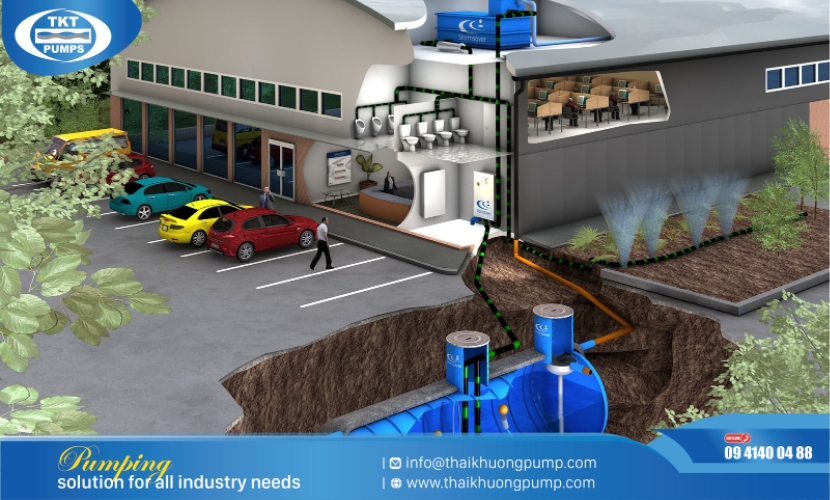
- To overcome situations where municipal water pressure cannot reach the rooftop tank, an additional lower tank is installed and water is pumped up to the rooftop tank
- Water from the rooftop tank flows by gravity to each tap in the house; pressure and flow velocity are not very high — especially on upper floors near the rooftop tank
- Additional space is required for the underground tank below, and there are monthly electricity costs for the submersible pump. Water reserves are mainly held in the underground tank and the rooftop tank.
3. Calculating rooftop tank reserve capacity and pump sizing:
Example: As above, the daily water demand is 1,980 litres.
- Rooftop tank capacity: 1,980 x 0.3 = 594 litres ≈ 600 litres. => Select a 1 cubic metre tank for water storage; start pumping when 300 litres remain
- Additionally, an underground tank for the pump is required (0.5 to 2 times the daily water supply) = 1 x 1,980 = 1,980 litres ≈ 2 cubic metres. => Select a 2 cubic metre underground tank
- System includes a pump and rooftop tank.
Water Supply Systems for Buildings — Apartment Complexes and Offices
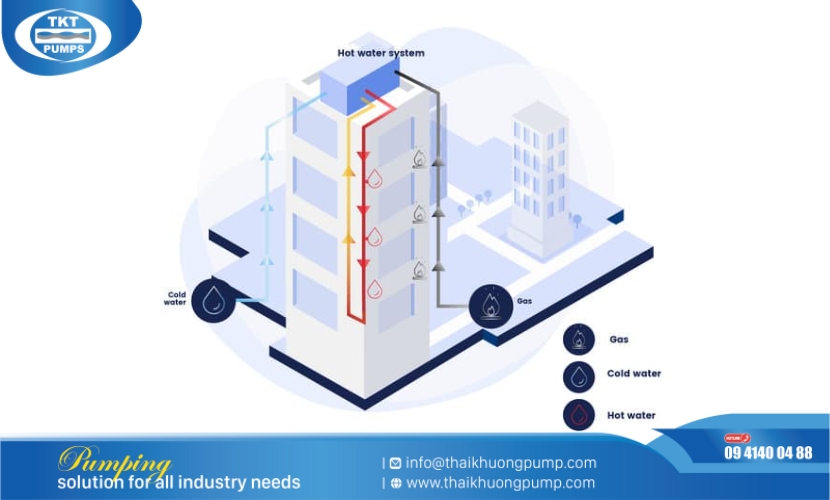
Characteristics:
- Insufficient water supply pressure to pump up to the rooftop tank
- All occupants share a common rooftop supply tank and an underground intake tank, along with a shared pump system
- On lower floors, where pressure is high, pressure reducing valves are added to reduce pressure — typically to 2 bar. On floors near the rooftop, where pressure is low due to proximity to the rooftop tank, booster pumps may be installed to ensure adequate supply pressure
- The average water velocity is selected at 2 m/s. Once the flow rate for each zone is known, the pipe cross-section can be calculated.
Water supply system calculation:
Example for a building comprising:
- Residential occupants: 1,240 people (average 6 people per apartment)
- Water use standard: 300 l/person/day
- Office occupants: 1,280 people
- Water use standard: 25 litres/person.
Calculating the underground water storage tank:
=> Residential water demand Q = 300 x 1,240/1,000 = 372 m³/day
=> Office block water demand: Qh = 1,280 x 25/1,000 = 32 m³/day
Total water supply flow rate for domestic needs:
=> Qt = Q + Qh = 372 + 32 = 404 m³/day
Calculating Water Supply for Public Services
Plant watering, floor washing, etc. Calculated per standard TCXDVN-33-2006: the public service water demand is taken as 10% of the calculated building flow rate.
=> Public service water demand: Qcc = 404 x 0.1 = 40.4 m³/day = 0.47 l/s
Total water supply flow rate for the building:
=> Qtc = Qt + Qcc = 372 + 32 + 40.4 = 444.4 m³/day. We select 444 m³/day
The underground cistern capacity is calculated using the formula:
=> Qcistern = (0.5 to 2) x Qdaily = 1.6 x 444 = 710 m³/day
=> Selected underground cistern capacity: 710 m³
The fire-fighting water reserve volume may be added to arrive at the total building tank capacity, or a separate fire water tank may be installed.
This cistern can therefore meet the entire building’s water needs for more than one full day in the event of an interruption to the external municipal water supply.
Water meter selection (1):
- Based on Table 6 — TCVN 4513:1988 — selecting Q daily = 404 m³/day = 17 m³/hour.
- Select a horizontal-axis turbine water meter, size 80 (range: 45–500 m³/day).
Rooftop tank calculation (4):
Hourly water demand: Qh = 404/24 = 17 m³/h
=> Rooftop tank balancing capacity: Wbc = 0.3 x Qdaily = 0.3 x 404 = 121.2 m³
=> Select a rooftop tank for domestic use of: 120 m³ (divided into 2 tanks, each 60 m³). Additionally, a separate fire-fighting water tank is installed on the rooftop, independent of the domestic rooftop tank — this will be discussed in a separate article on fire protection water tanks.
Pump sizing (3):
Flow Rate Qb, Head, and Pipe Diameter
Calculating the main pump — pumping water from the underground cistern to the rooftop tank:
- Based on the calculated parameters above, we select: Qb = 60 m³/h
- Suction pipe diameter: flow rate 60 m³/h, velocity 2 m/s. Select 2 suction pipes of diameter DN100
- Discharge pipe diameter: flow rate 60 m³/h, velocity 3 m/s. Select discharge pipe diameter DN100.
Typically, 3 pumps are selected (2 duty pumps and 1 standby), receiving a low-water signal from the rooftop level and triggering the basement pump signal, which closes the contactor circuit to supply power to the pump.
When the water reaches the preset level, the electrical signal to the contactor coil is cut and the pump stops.
Calculating the Booster Pump, Pressure Tank, and User Connections
For end users
Because of their proximity to the rooftop tank, upper floors do not achieve the required design pressure — a minimum pressure of 1.5 bar, equivalent to 15 metres of head, is required.
This means that for floors within 15 metres below the rooftop (approximately 3 floors), a booster pump and pressure tank must be added to the design.
Booster pump
- Maintain an average pressure of 2 bar at the rooftop floor nearest to the end users. => Select a pump with a head of 35 metres.
- Flow rate is selected according to the number of water users within 15 metres measured from the rooftop tank level downward. Select 2 pumps (1 duty, 1 standby).
- The booster pump uses a variable-frequency drive (VFD) controlled by the set water pressure via an analogue pressure sensor, continuously maintaining an outlet pressure of 1.5 to 2 bar.
Pressure tank
- Select a pressure range of 2 to 3.5 bar; for example, the supply flow rate to the users is 235 litres/minute.
- Pump operating time: 15 minutes. => Pe = 2 bar, Pd = 3.5 bar, n = 15 minutes.
- RU = 16.5 x Q/n = 16.5 x 235/15 = 258 litres.
- Based on the pressure tank capacity look-up table: => Pressure tank volume = 750 litres.

Calculation for end users
For gravity-flow pressure requirements of 1.5 bar to 3.5 bar — equivalent to 15 metres to 35 metres of head below the rooftop tank — water can simply flow by gravity, as the pressure meets the required level.
Calculation for pressure reducing valves
Naturally, at heights exceeding 35 metres, the pressure on lower floors will be excessive; therefore, pressure reducing valves are used to maintain pressure between 1.5 bar and 3 bar.
Accordingly, for every 15 metres of height from the end-user point (8), one additional pressure reducing valve must be installed to maintain pressure between 1.5 bar and 3 bar.
Example: Water pressure table — calculated for a typical 23-storey building + 1 rooftop floor + 2 basement levels:

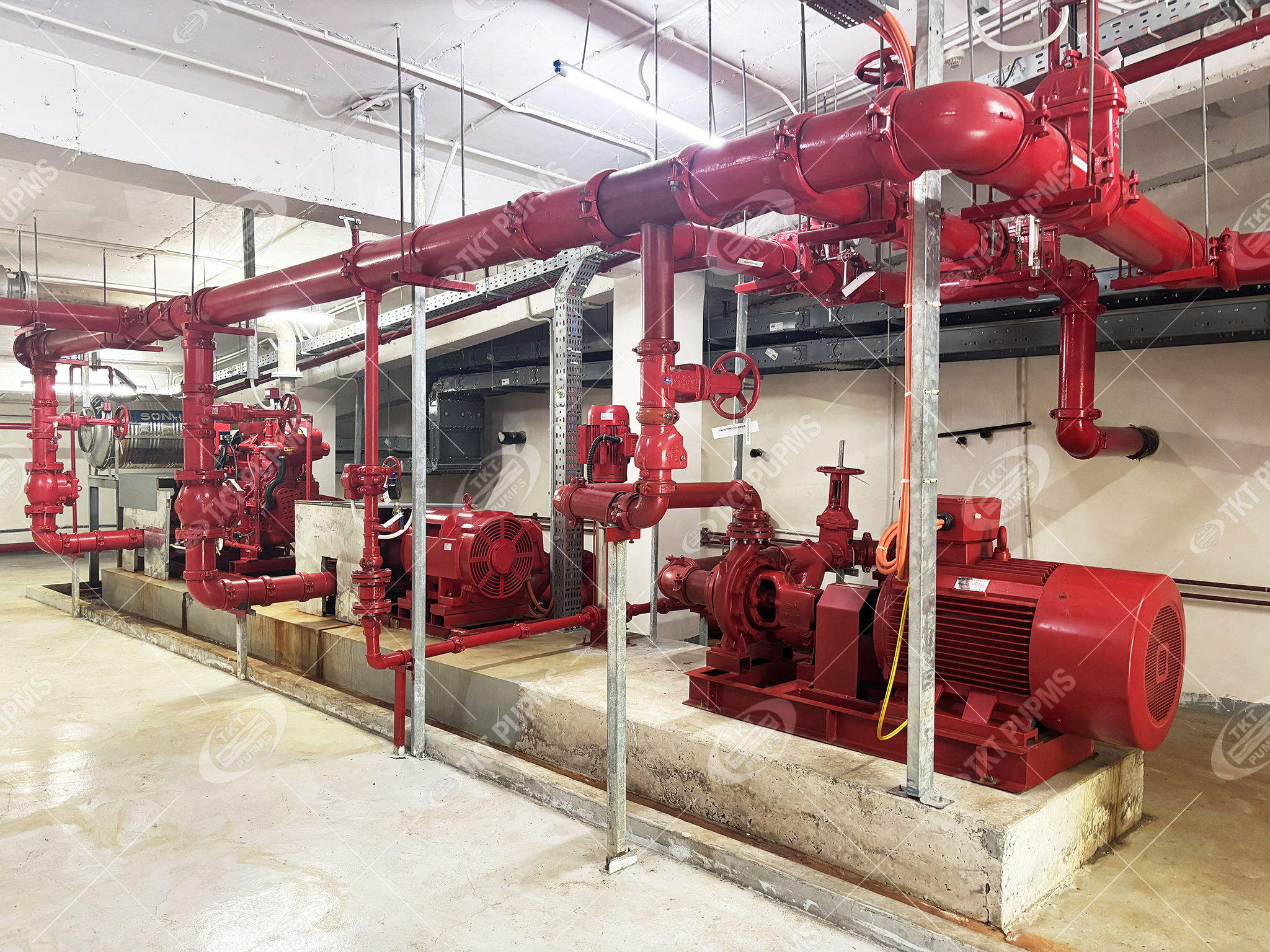
Water supply system model from the Thiên Nam office building — Ho Chi Minh City

Through this article, we have gained a foundational understanding of water supply systems, as well as the necessary and sufficient conditions for building a complete water supply system. If you have any questions or need more specific advice for your requirements, please contact Thái Khương immediately for prompt support! Thái Khương always has stock ready to serve your urgent needs!